


1876: Llanchala Railway Ltd
The railway that brought the islands together. The most commercially successful and influential railway of its time.
History

Railways

About Llanchala Rly
Llanchala Rly Maps
Llanchala Railway Ltd (LR)
At a glance:
Established: 1876
Ceased independent operation: 1885
Principal island: Glynoch
Headquarters: Llanchala
Constituent railways: Llanchala & South Western Railway (L&SWR); Aberfael China Clay Railway (ACCR); southern and coastal interests of the Glynoch Mineral Railway Company (GMRC) |
Principal activities: Passenger services, port traffic, china clay, minerals, industrial freight and general merchandise
Principal operating area: Southern Glynoch, with through services extending across Little Rathmor and, from September 1885, towards Rathmor
Locomotive livery: Caerwyn Blue, with fine gold lining and polished brass fittings
Passenger carriage livery: Caerwyn Blue, natural varnished wooden window frames, cream or gold lettering and dark underframes
Locomotive facilities: Access to the Bryn Lar railway works on Little Rathmor
Key figure: Edward H. Ashcombe, founding chairman
Successor: Glynoch & Rathmor Railway (G&R), founding partner with the Rathmor Railway in 1885
The Railway That Brought the Islands Together
Formed in 1876 from three very different railway interests, Llanchala Railway Ltd became one of the most commercially successful and influential railway companies in the Caerwyn Isles. Unlike many of its contemporaries, its strength lay not in the number of miles of railway it owned, but in its ability to establish cooperative agreements, negotiate running rights and operate services across the networks of neighbouring companies. Under the leadership of Edward H. Ashcombe, whose family had longstanding interests in the international shipping trade, the company developed into a financially secure passenger and freight undertaking. Its greatest achievement came in 1885, when the opening of Llyngor Bridge created the opportunity to unite the railway systems of Glynoch and Rathmor. Within three months, Llanchala Railway Ltd and the Rathmor Railway had agreed to combine their interests, creating the Glynoch & Rathmor Railway.
But first, we need to understand what the Llanchala Railway was, how it came into being, and how it fits into the wonderful railway history of our islands.
Llanchala Railway Timeline
Glynoch Mineral Railway Company
Southern and Coastal Sectors
Aberfael China Clay Railway
Llanchala & South West Railway
Llanchala Railway Ltd
Glynoch & Rathmor Rly

Llanchala Railway Motif
Origins: Pre 1876: Three Railways, One Ambition
The origins of Llanchala Railway Ltd lay in three railway undertakings whose histories had developed along very different paths. The Llanchala & South Western Railway, established in 1859, had become one of the most commercially enterprising passenger railways on Glynoch. Although it constructed railway along the southern coast between Aberfael and Rowenport, much of its wider influence came through the negotiation of running rights over lines belonging to other companies. By operating trains over existing railway infrastructure, the L&SWR had extended its passenger services well beyond the limits of its own track. Its substantial carriage fleet, experience in passenger operations and network of commercial agreements would prove invaluable to the company that eventually succeeded it.
The Aberfael China Clay Railway, dating from 1855, had a very different purpose. Established to transport china clay from inland workings to Aberfael harbour, the ACCR represented the industrial foundations upon which much of Glynoch's early railway development had been built. Its contribution was primarily in freight traffic, industrial infrastructure and the reliable movement of minerals between the island's productive hinterland and its ports.
The third constituent was the southern and coastal portion of the Glynoch Mineral Railway Company. The GMRC had developed into a substantial railway undertaking, carrying mineral traffic and, increasingly, passengers. However, its directors had become divided over the company's future direction. Some wished to preserve the railway's independence and concentrate upon its central and highland routes. Others saw greater opportunities in developing connections with neighbouring railways and the growing passenger network.
By the middle of the 1870s, the commercial interests of the L&SWR, ACCR and southern GMRC directors had become closely aligned. All three recognised that a coordinated railway organisation could offer considerable advantages over the continued operation of separate and sometimes competing undertakings. The foundations of Llanchala Railway Ltd were already in place.
1870-1876: Two Men, Two Visions
The opening of Llanchala Bridge in 1870 changed the commercial possibilities of railway operation on Glynoch. For the first time, the developing railway system offered the prospect of convenient connections beyond the island itself, through Little Rathmor and towards the neighbouring islands. Among those who immediately recognised the opportunity was Edward H. Ashcombe, a director of the Llanchala & South Western Railway. Ashcombe came from a family whose business interests were firmly rooted in the shipping trade of Llanchala. The Ashcombe Shipping Company had grown from a family-owned maritime business into an established merchant shipping concern, operating vessels between ports throughout Britain, Ireland and continental Europe, with commercial interests extending considerably further afield. Although the family remained firmly associated with Llanchala, its vessels followed the demands of international trade rather than confining themselves to the waters of the Caerwyn Isles. Edward had grown up understanding that the success of a shipping business depended not merely upon the vessels themselves, but upon the reliable movement of passengers and merchandise to and from the ports they served. To him, railways were a natural extension of the family's maritime interests. A railway could bring passengers to a departing ship, distribute imported merchandise inland, and carry agricultural or industrial products from distant districts to the harbour. The more closely these services were coordinated, the greater the commercial opportunities for everyone involved. Ashcombe became a determined advocate of cooperative railway operation, particularly the negotiation of passenger-running rights across company boundaries.
His outlook brought him into conflict with Richard T. Cledwyn, a prominent GMRC director whose family wealth was rooted in the iron-ore mines of the Glynoch Highlands. Cledwyn believed that the GMRC had surrendered valuable commercial opportunities by granting the L&SWR passenger-running rights over its southern route on terms that were too generous. He maintained that the original agreements applied specifically to the Rowenport–Llanchala corridor and should not be interpreted as an unrestricted right to exploit future connections beyond Llanchala. Ashcombe and his supporters argued that reliable, cooperative agreements were essential to the growth of the railway network. The dispute was not merely about the interpretation of an existing contract. It represented two fundamentally different philosophies of railway management. Cledwyn regarded independent control of railway infrastructure as the foundation of commercial security. Ashcombe believed that a railway's greatest value lay in the destinations it could serve and the connections it could provide. Neither man was without justification, and both understood the increasingly important commercial value of the southern railway corridor. Nevertheless, their differences contributed to a growing division within the GMRC board. By 1876, a reorganisation of the company's interests had become increasingly difficult to avoid.
.
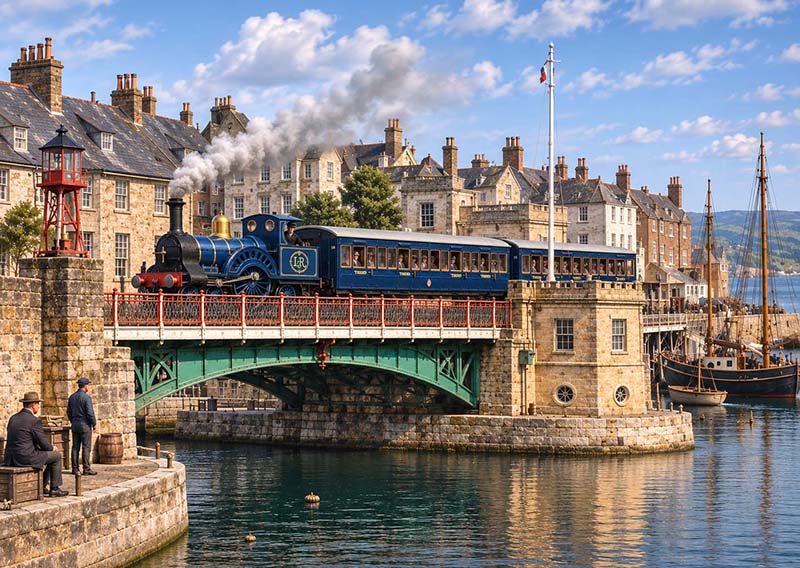
Llanchala Railway No1 crossing the Llanchala Bridge
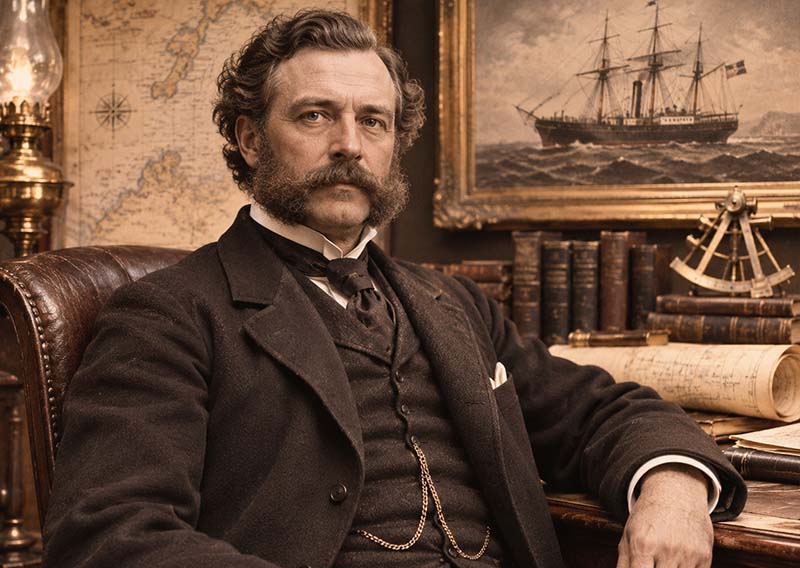
Edward H. Ashcombe - Chairman of Llanchala Railway
1876: The Great Reorganisation
The railway reorganisation of 1876 brought the competing interests of southern and central Glynoch into separate organisations. The central and highland portion of the GMRC passed into the newly formed Glynoch Central Railway, under the influence of Richard T. Cledwyn and the directors who shared his determination to preserve the independence of the highland railway system. The southern and coastal GMRC interests followed a different course. They joined the Llanchala & South Western Railway and the Aberfael China Clay Railway in the formation of Llanchala Railway Ltd. Edward H. Ashcombe, whose experience in railway cooperation had made him a leading figure in the negotiations, became the new company's first chairman. The undertaking inherited a diverse collection of railway interests. Its passenger business drew heavily upon the experience and rolling stock of the former L&SWR, while the ACCR and GMRC interests provided established industrial traffic, freight facilities and important connections with the ports and productive districts of southern Glynoch. The immediate challenge was to bring these operations under a coordinated management structure. Timetables had to be reconciled, freight arrangements standardised and the separate companies' operating practices brought into closer alignment. The new company was not created simply to acquire more railway mileage. Its purpose was to make the existing network work more efficiently.
A New Identity: Caerwyn Blue
One of the most visible changes was the introduction of a distinctive new livery. The company adopted Caerwyn Blue, a rich, deep blue associated with the wider identity of the Caerwyn Isles, as the principal colour for both its locomotives and passenger carriages. Locomotives were finished in deep blue with fine gold lining and polished brass fittings, while passenger carriages carried the same colour with natural varnished wooden window frames and cream or gold lettering. The former L&SWR's olive-green carriages were gradually repainted as they passed through the works, creating a transitional period during which trains could contain vehicles in both old and new liveries. The change symbolised more than a new company name. It represented the emergence of a railway that regarded itself as part of a wider inter-island transport network.
1876-1885: A Railway Built on Connections
During the years following its formation, Llanchala Railway Ltd developed a reputation for sound commercial management and practical cooperation with neighbouring companies. Under Ashcombe's chairmanship, the railway continued to expand its influence through negotiated running rights and coordinated passenger services. Rather than attempting to construct an entirely independent railway network, it made effective use of existing lines and established relationships with other railway undertakings. The approach was particularly valuable on Little Rathmor. The island's railway system offered important connections beyond Glynoch, while the locomotive facilities at Bryn Lar, developed by the Little Rathmor Railway, provided advantages that were not available to every company. The Llanchala Railway developed access to these facilities through its cooperative agreements, enabling its growing locomotive and carriage fleet to benefit from better maintenance arrangements. This contrasted with the position of the Glynoch Central Railway, which continued to rely upon the cramped locomotive works inherited from the GMRC on the western side of Llanchala. The difference reflected the wider philosophies of the two companies. Where the Glynoch Central Railway remained cautious about dependence upon neighbouring railway undertakings, the Llanchala Railway regarded cooperation as an essential part of its business.
Passengers, Ports and Merchandise
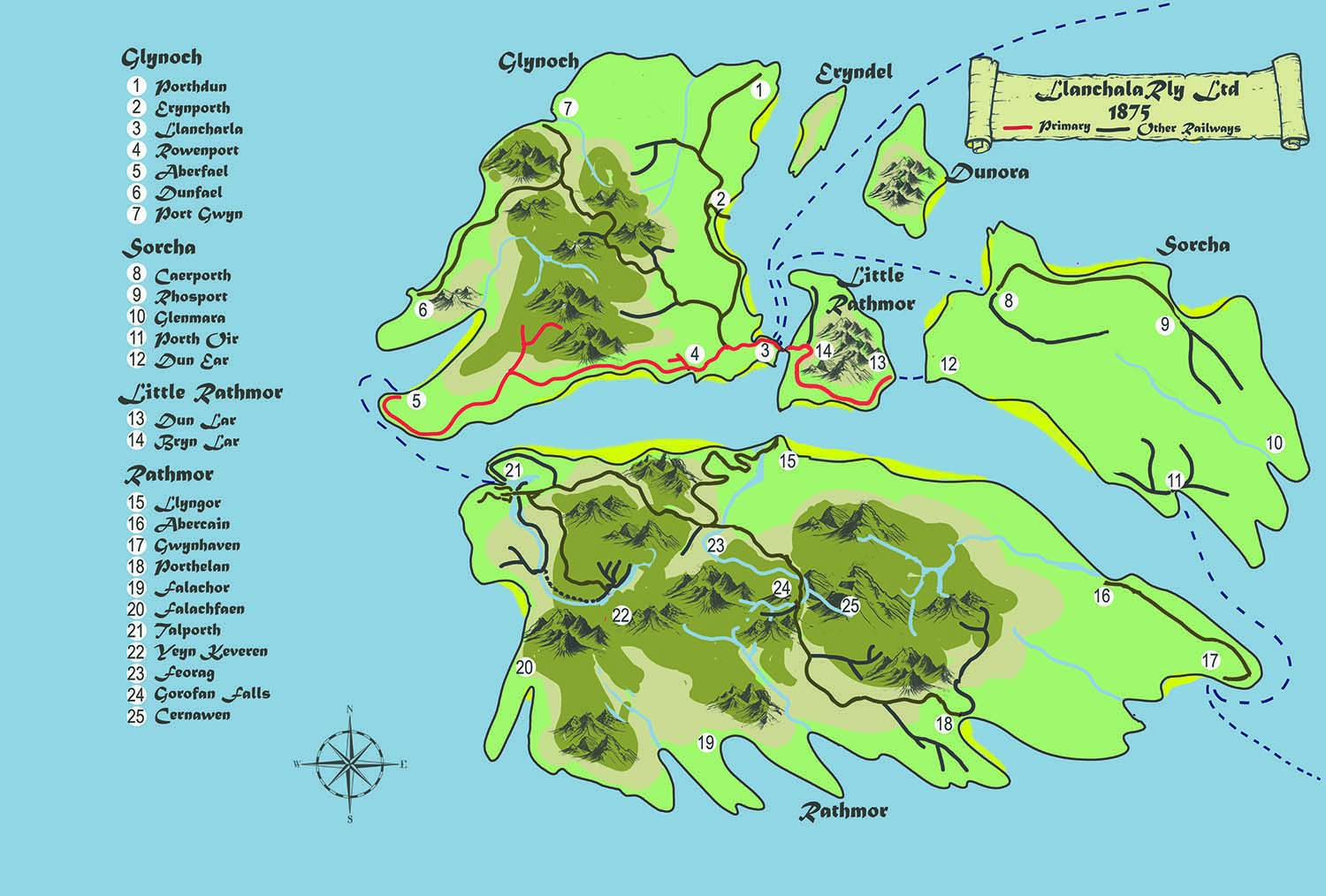
Passenger services remained a major part of the company's operations. The experience inherited from the L&SWR allowed the Llanchala Railway to develop more convenient connections, coordinated timetables and improved interchange arrangements. Its freight business was equally important. China clay continued to move towards Aberfael harbour, while mineral traffic, agricultural produce and general merchandise formed a substantial part of the company's goods operations. The Ashcombe family's shipping interests helped reinforce the commercial importance of reliable connections between the railway and the ports. For merchants and passengers alike, the distinction between a journey by rail and a journey by sea became less important than the reliability of the complete journey. The company increasingly prospered as a result. By the early 1880s, Llanchala Railway Ltd had developed into a financially secure undertaking, with established traffic, a substantial passenger business and a network of commercial relationships extending far beyond its own railway lines. Regular passenger and freight services operated from Aberfael, on the far south-western coast of Glynoch, through Llanchala and onwards across Llanchala Bridge to Bryn Lar and Dun Lar, on the eastern coast of Little Rathmor. Much of this journey was undertaken over railway lines belonging to other companies, particularly the established east–west route of the Little Rathmor Railway. At Dun Lar, passengers and merchandise could continue their journeys by ferry to Dun Ear on the island of Sorcha. The result was a remarkably effective east–west transport corridor, linking the ports and industries of southern Glynoch with the communities of Little Rathmor and the wider island network. Passenger traffic increased, goods moved more freely between the islands, and the railway's ability to coordinate journeys across several different undertakings became a major commercial advantage. The corridor developed into one of the busiest and most successful transport routes in the Caerwyn Isles. Those strengths would prove decisive when an opportunity for a much larger railway organisation emerged in 1885.
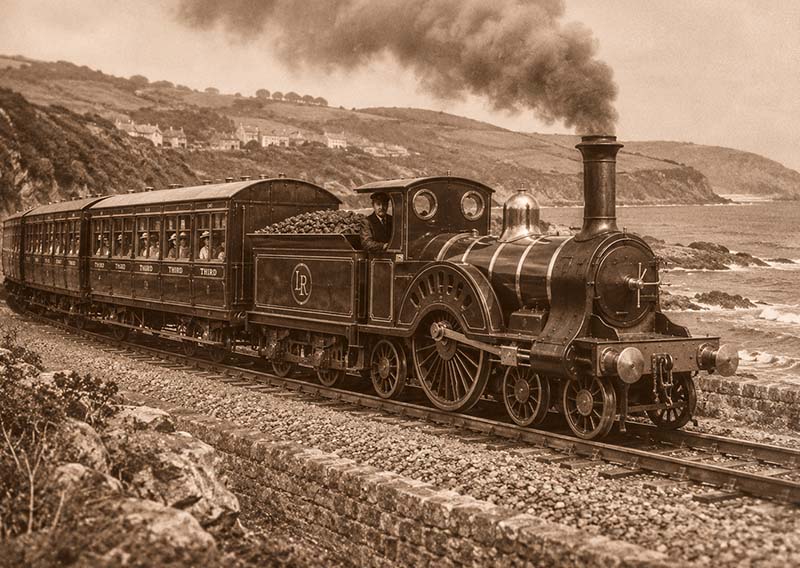
Climbing away from Llanchala on route to Rowenport c1880
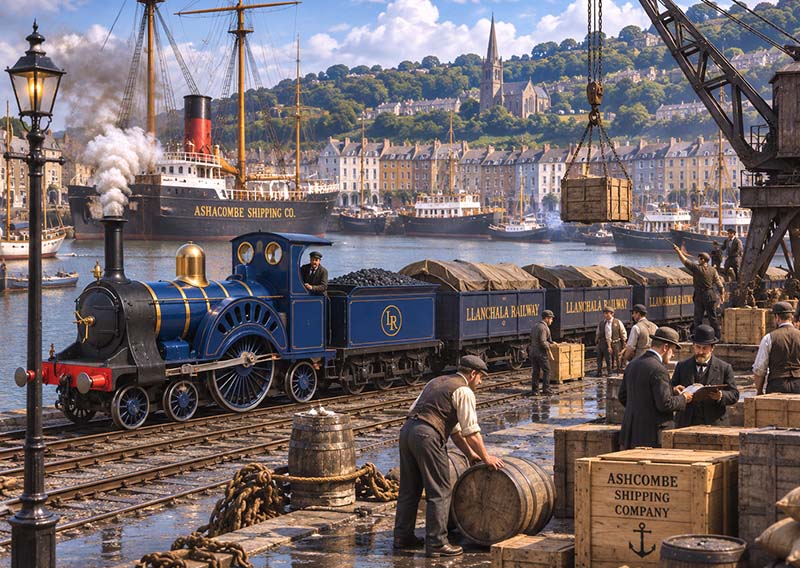
Llanchala Harbour
September 1885: The Bridge That Changed Everything
For many years, the prospect of a railway connection between Little Rathmor and Rathmor had captured the imagination of railway promoters and commercial interests across the Caerwyn Isles. The Rathmor Railway had committed considerable resources to the construction of Llyngor Bridge, an ambitious engineering undertaking intended to connect the railway systems of the two islands. However, the bridge alone would not create a functioning railway connection. A short but essential length of railway was still required on Little Rathmor to link the existing east–west route with the northern approach to the bridge. The Rathmor Railway, already facing substantial financial commitments, had explored the possibility of persuading the Little Rathmor Railway to construct this connecting line. The solution came with the establishment of the Caerwyn Junction Railway in early 1885.
The new company brought together several interested railway parties, including interests associated with Little Rathmor, Glynoch, Rathmor and Sorcha. Through a jointly financed arrangement, the CJR absorbed the entire Little Rathmor Railway, together with the railway works at Bryn Lar, ensuring long term independence of the island routes and facilities. It then immediately undertook construction of the approximately two-mile railway connecting the existing Little Rathmor system with Llyngor Bridge. The relatively flat terrain of southern Little Rathmor allowed the work to proceed rapidly. The line was completed only a few weeks before the bridge itself was officially opened on 17th September 1885. For the first time, the railway systems of Glynoch, Little Rathmor and Rathmor could be connected by a continuous route. For Edward H. Ashcombe, the significance was immediately apparent. The Llanchala Railway had spent nearly a decade developing its business through cooperation and running rights. The new bridge offered the possibility of taking that philosophy much further. Rather than simply negotiating individual agreements between separate companies, there was now an opportunity to create a railway organisation capable of coordinating services across the islands.
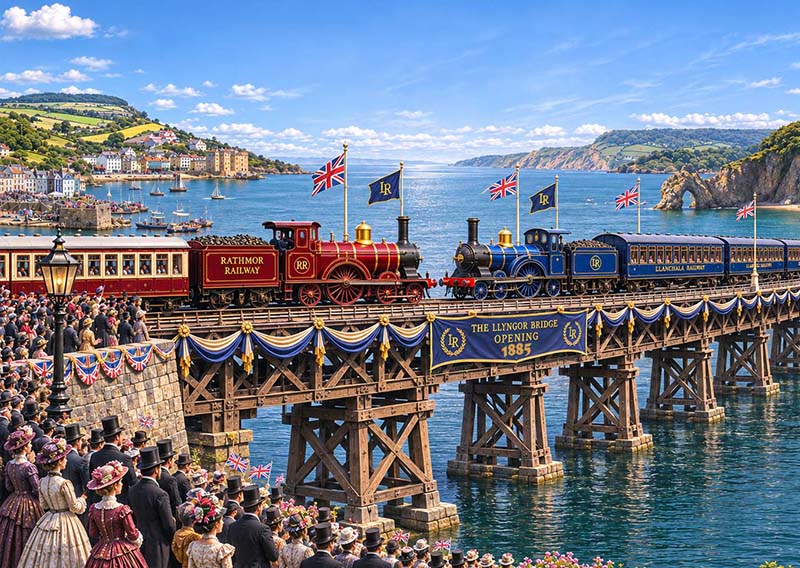
Llyngor Bridge opening day, 17th September 1885
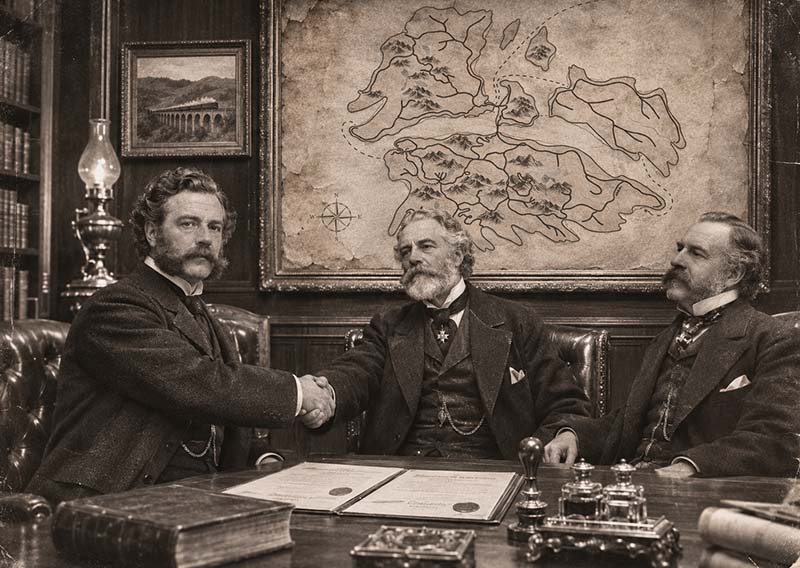
Glynoch & Rathmor Railway formed 17th December 1885
Late 1885: The Making of the Glynoch & Rathmor Railway
The opening of Llyngor Bridge transformed the commercial geography of the Caerwyn Isles. It also brought into sharper focus the financial pressures facing the Rathmor Railway. The company had pursued an ambitious programme of railway construction, including the bridge itself and the continuing extension towards Falachfaen. Although these projects promised considerable long-term advantages, they demanded substantial capital at a time when the company was already managing an extensive railway network. The Falachfaen extension remained incomplete, and the difficulties associated with its exposed coastal alignment continued to create uncertainty. The destructive storms of October 1885 added further pressure to the wider programme of railway works on Rathmor. The Rathmor Railway was not necessarily facing immediate financial collapse, but its ambitious expansion had left it with significant commitments.
Llanchala Railway Ltd was in a very different position. Its established passenger traffic, reliable freight business and comparatively modest approach to new construction had left it financially secure. Ashcombe and his fellow directors recognised that the two companies possessed complementary strengths. The Rathmor Railway controlled an extensive and increasingly important railway system, together with the engineering ambitions necessary to develop it further. The Llanchala Railway brought financial stability, commercial experience and a proven ability to coordinate services across company boundaries. The most influential figure on the Rathmor side was Edmund Keveren, the 8th Lord Keveren, whose commercial drive and determination had helped bring about the formation of the Rathmor Railway in 1879. Keveren had long recognised the importance of connecting Rathmor's railway network with the neighbouring island of Glynoch, particularly the major harbour facilities at Llanchala. The completion of Llyngor Bridge was one of the defining achievements of his railway career. His father-in-law, Lord Rathmor, had lent his standing and influence to the earlier railway consolidation and remained a respected figurehead of the Rathmor undertaking. Keveren had been particularly determined that Lord Rathmor should live to see the bridge completed, and the opening ceremony in September 1885 had fulfilled that ambition. The new connection, however, presented a further opportunity. Where Keveren had concentrated upon developing Rathmor's railway infrastructure and opening new markets, Ashcombe had built his career around the coordination of transport services and commercial relationships. Their interests were complementary. Both men understood that the bridge would achieve its greatest value when the railways on either side worked together as effectively as possible. Discussions between the two undertakings had already begun in early 1885 in preparation of the Llyngor Bridge opening, and intensified during the autumn. Ashcombe's longstanding experience in railway negotiation proved particularly valuable, while Keveren brought an intimate understanding of the Rathmor network and its ambitious programme of development. Lord Rathmor's support lent additional standing to the proposed union. The proposed merger was not simply a rescue arrangement for an overextended railway. It offered the opportunity to establish a substantial inter-island undertaking with coordinated management, shared resources and a stronger financial foundation.
The Independent Caerwyn Junction Railway
One company would remain outside the proposed consolidation. The Caerwyn Junction Railway, established earlier that year to finance and construct the Little Rathmor connection, was a jointly owned undertaking with shareholders representing several railway interests. Its independent status protected the interests of those who had contributed to the connecting line and ensured that access across Little Rathmor was not placed entirely under the control of either founding company. The new G&R would therefore depend upon negotiated arrangements with the CJR for an essential part of its inter-island route. The arrangement reflected a principle that Ashcombe had advocated throughout his railway career: cooperation between companies could be just as important as common ownership. The CJR would retain its independence for many years, eventually passing fully into G&R control in July 1939.
A New Railway for the Islands
Approximately three months after the opening of Llyngor Bridge, the negotiations reached their conclusion. In mid-December 1885, the proposed union of Llanchala Railway Ltd and the Rathmor Railway was announced. The new undertaking would be known as the Glynoch & Rathmor Railway. The announcement represented the most significant developments in the railway history of the Caerwyn Isles. For the first time, two of the principal railway systems serving the islands were to be brought together under a common organisation. The company would inherit the commercial experience and financial strength of the Llanchala Railway, alongside the extensive Rathmor network and its ambitious programme of railway development. The two undertakings had followed very different paths. Their union would establish the foundations of a railway whose influence would eventually extend across the entire Caerwyn Isles.
Legacy: The Railway That Brought the Islands Together
Llanchala Railway Ltd existed as an independent undertaking for less than a decade. Yet its influence upon the development of the Caerwyn Isles railway network was considerable. Formed in 1876 from the consolidation of three very different railway interests, it demonstrated the commercial advantages of combining passenger expertise, industrial freight and coordinated access to neighbouring railway systems. Its adoption of Caerwyn Blue created a distinctive railway identity, while its approach to passenger services and freight handling reflected a growing understanding that the islands' railways could achieve more through cooperation than through isolation. The company also demonstrated the value of sound financial management. Rather than committing itself to expensive new main-line construction, it concentrated upon making the most of the network already available. That approach allowed it to enter the negotiations of 1885 from a position of considerable strength. Edward H. Ashcombe's contribution was particularly important. Drawing upon the maritime traditions of his Llanchala shipping family, he had recognised that railways, ports and shipping services formed parts of a much larger transport system. His ability to build relationships between competing railway interests helped shape the Llanchala Railway and, ultimately, the formation of the Glynoch & Rathmor Railway. The company's greatest legacy was therefore not a particular locomotive, station or length of track. It was the principle upon which the G&R would be built.
The future of the Caerwyn Isles railways lay in connecting the islands, not merely in connecting the rails.
History
Railways
About Llanchala Rly
Llanchala Rly Maps
The Llanchala Railway
Ran from Aberfael in the south west of Glynoch through to Llanchala, with running rights onto Little Rathmor as far as Dun Lar in the east
Related Articles....
Esparto Grass Production
The reclaimed northern plains of Glynoch—flat, wind-brushed expanses stretching between […] ...


Explore More Railways of Glynoch and Rathmor....


0 Comments