

1890: Falachfaen at Last!
September 27th: After 10 long years, the railway finally reaches the isolated south west town.
On this day in 1890, after ten years of construction, financial crisis, engineering disasters and even calls for the railway to be abandoned, the first Glynoch & Rathmor Railway train finally steamed into Falachfaen.
Few railway openings in the Caerwyn Isles had been so eagerly awaited — or so hard won.
The story had begun a decade earlier, in 1880, when the ambitious Rathmor Railway began pushing south from Yeyn Keveren towards Falachfaen. The prize was considerable. Falachfaen's important slate industry remained poorly connected with the rest of Rathmor, and a railway promised to transform the movement of stone, goods and passengers.
What initially appeared to be another railway expansion soon became one of the most difficult engineering projects undertaken anywhere in the islands.
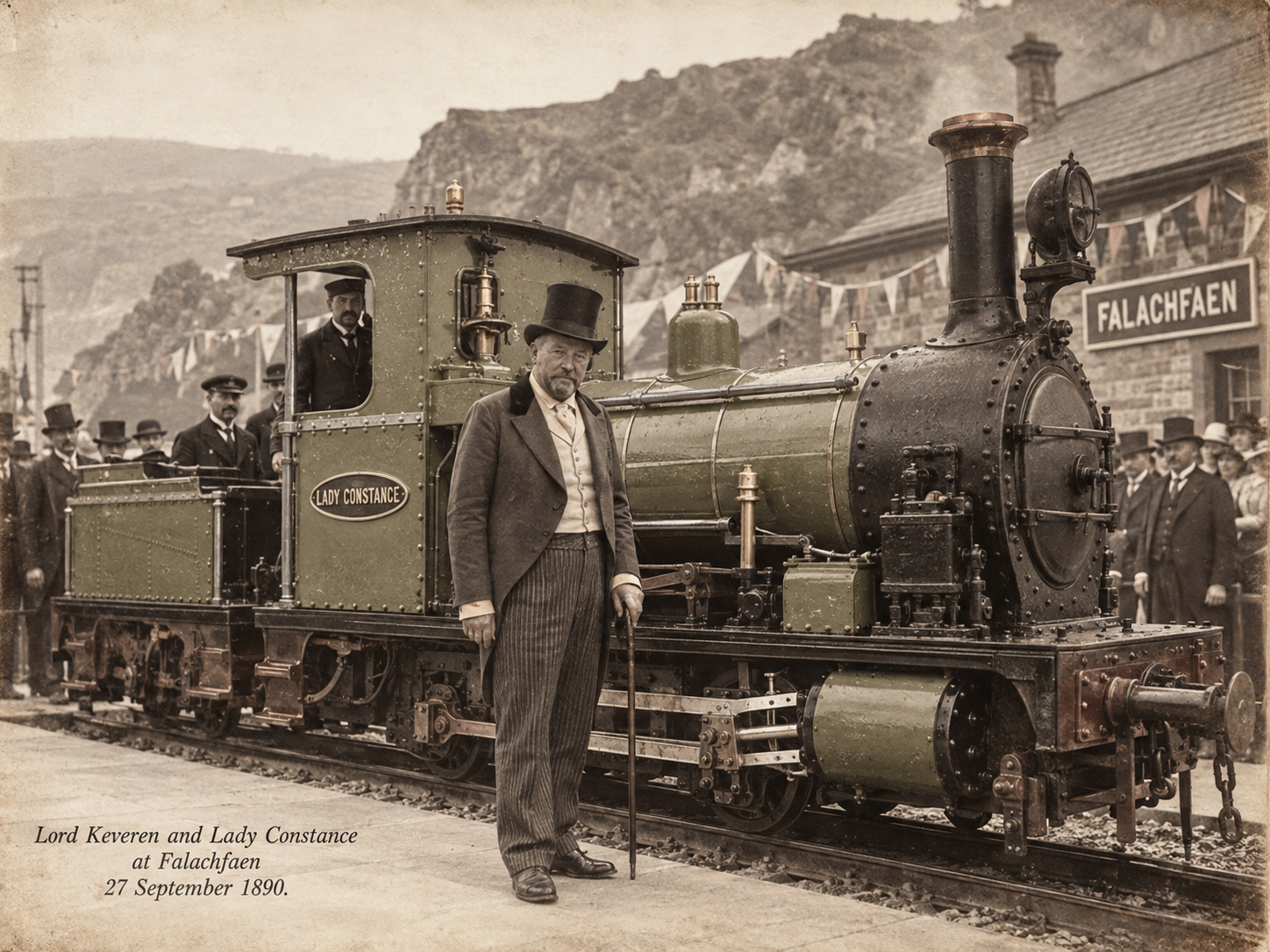
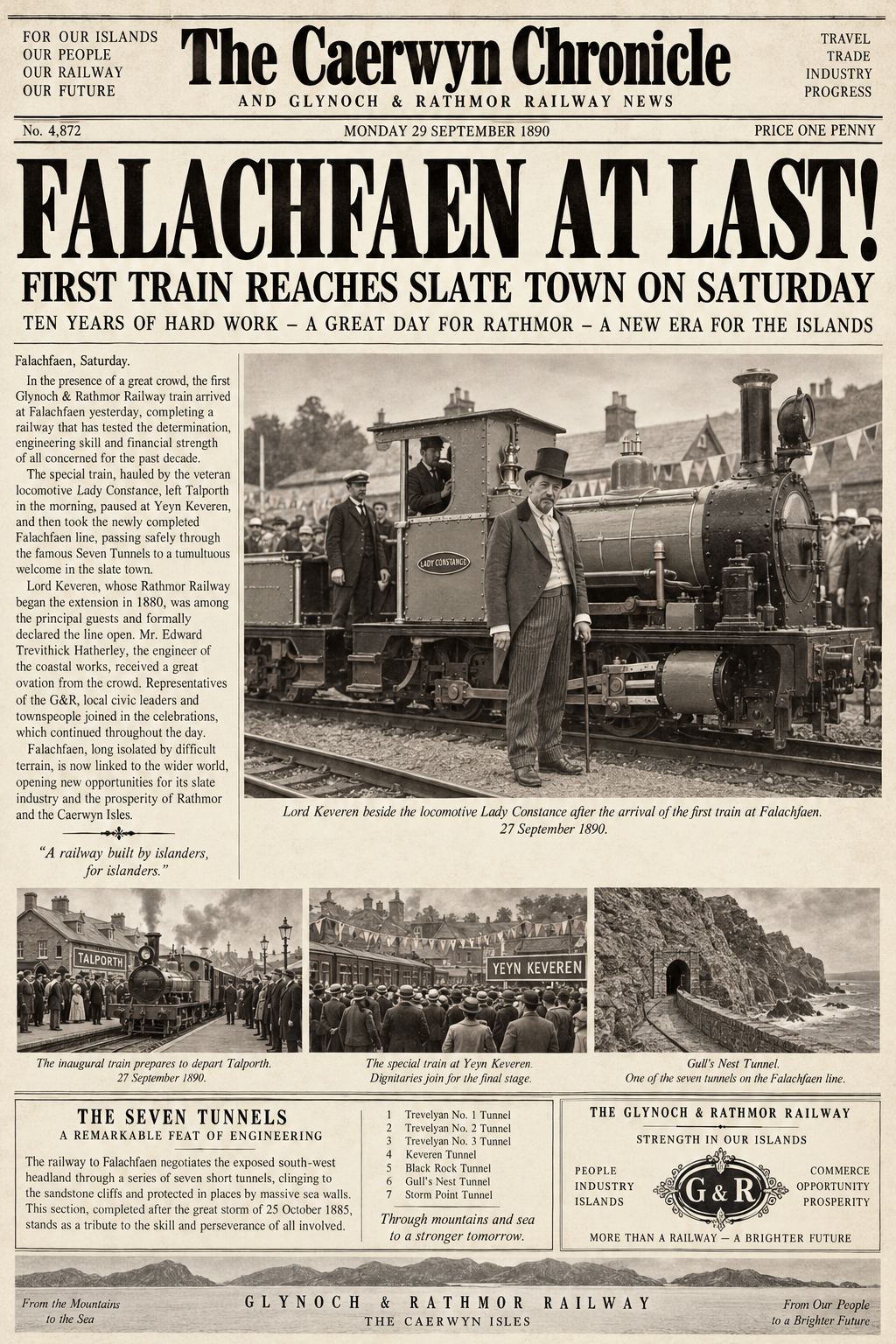
Falachfaen opening day 1890
Caerrwyn Chronical - September 29th 1890
Ten years to Falachfaen
The Rathmor Railway made reasonable progress at first, but the country became increasingly difficult as construction moved towards the exposed south-western coast.
Here the railway encountered sandstone cliffs plunging almost directly into the Atlantic. There was frequently nowhere to put a railway at all.
Veteran civil engineer Edward Trevithick Hatherley, who as a young man had gained experience working within Brunel's organisation on the famous South Devon Railway, was brought into the project. His solution was audacious. Rather than attempt to avoid the coast, the railway would cling to it. Ledges were blasted from the sandstone cliffs. Great retaining walls and sea defences were constructed above the water, while projecting headlands were pierced by seven short tunnels.
They became known collectively as the Seven Tunnels: Trevelyan Nos. 1, 2 and 3, Keveren Tunnel, Black Rock Tunnel, Gull's Nest Tunnel and Storm Point Tunnel.
The section became one of the most spectacular pieces of railway engineering in the Caerwyn Isles. It also became one of the most expensive.
Disaster at the Seven Tunnels
By 1885, the Rathmor Railway was under considerable financial pressure. Construction had slowed and there were growing questions about whether Falachfaen could ever justify the money being spent reaching it. Then came disaster. During the night of 24–25 October 1885, a violent autumn storm struck the south-west coast. Huge seas battered the unfinished Seven Tunnels section. Sea defences were breached and nearly half a mile of railway formation and works was destroyed or seriously damaged.
The worst destruction occurred around the exposed ledge between Black Rock and Gull's Nest tunnels that had become known as Hatherley's Shelf. The disaster appeared to confirm the fears of the project's critics. Calls for the railway to be abandoned grew louder, and the troubled line acquired a reputation in some quarters as the “cursed railway.”
The Rathmor Railway itself would not survive to complete it. During the railway reorganisations of 1885, the unfinished Falachfaen extension passed into the hands of the Glynoch & Rathmor Railway.
The G&R now faced a choice. Abandon an enormously expensive railway that had already consumed years of work — or finish it. They chose to finish it.
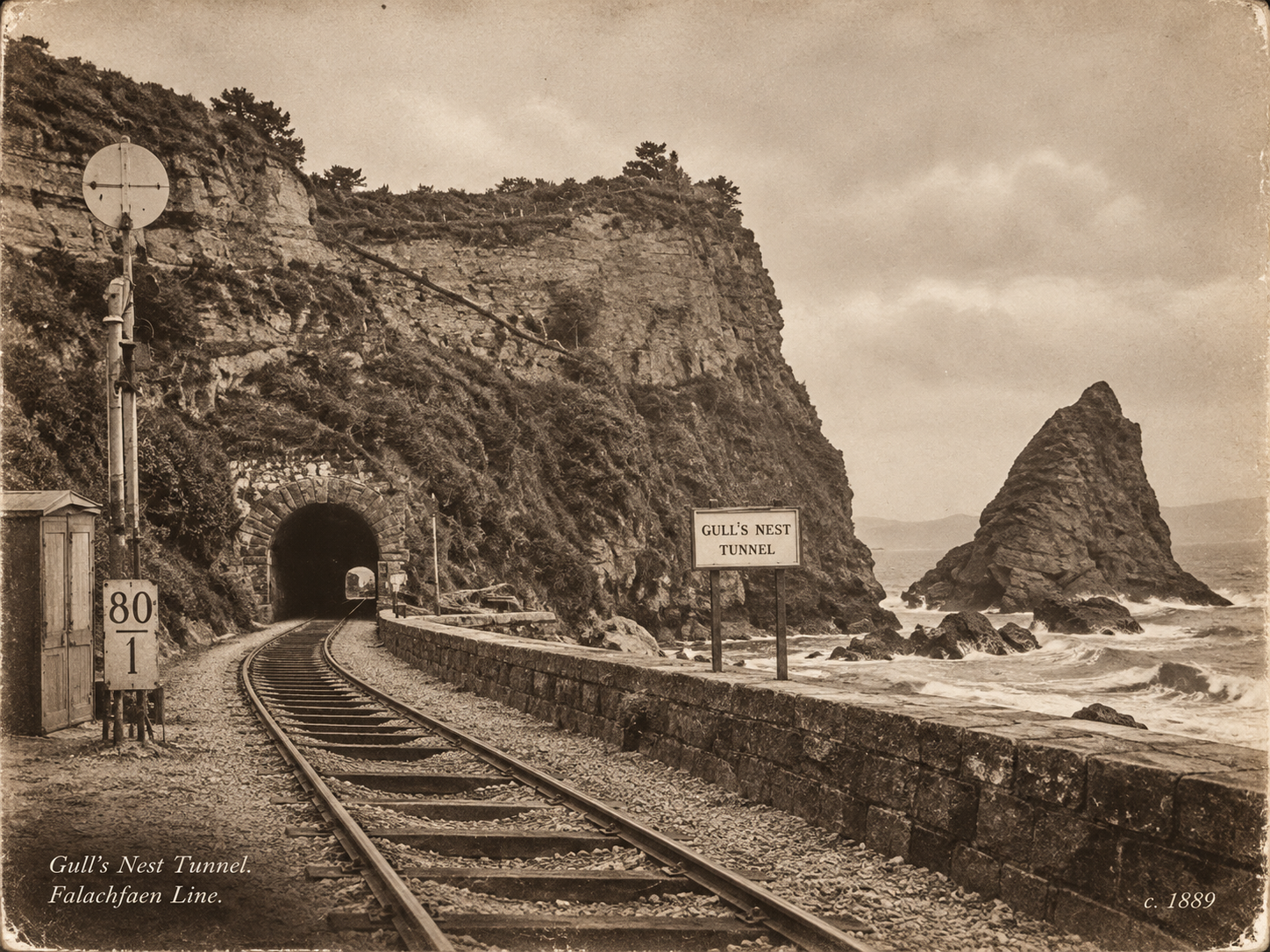
Gulls Nest Tunnel, near Falachfaen
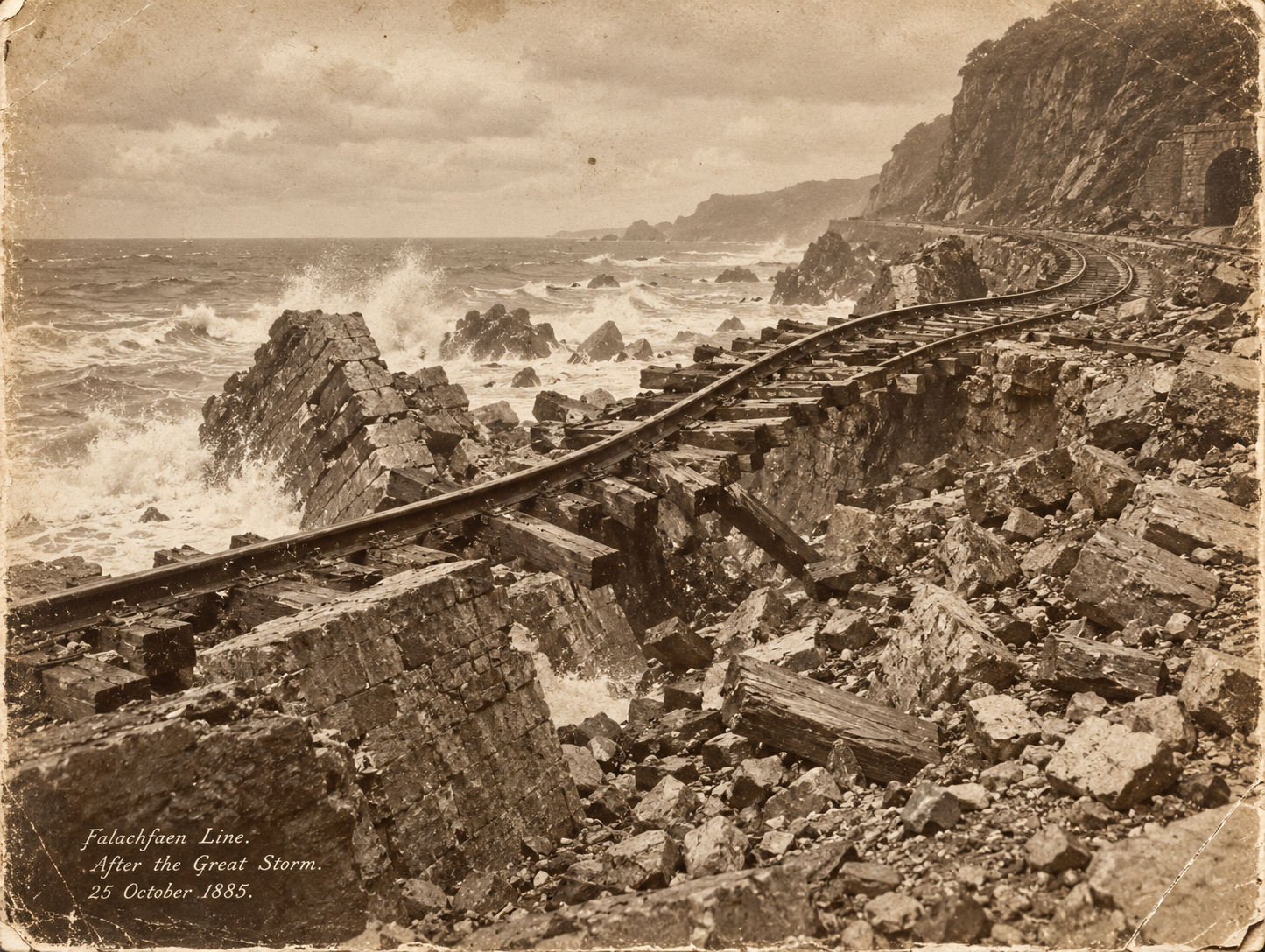
Storm Damage October 1885
Rebuilding the railway
During 1886 the G&R undertook a major reassessment of the coastal works. Hatherley's basic route was retained, but vulnerable sections were substantially strengthened. Sea walls were rebuilt, drainage improved, tunnel approaches reinforced and retaining structures made considerably more substantial. Work continued year after year. By 1889 the railway formation was finally approaching Falachfaen itself. Track laying, station construction and sidings for the slate industry followed. During 1890 the final railway was inspected and prepared for traffic.
At last, a date could be announced. Saturday, 27 September 1890. Falachfaen was finally going to get its railway.
An old locomotive receives the honour of hauling the first train. The G&R could have selected one of its newer locomotives to haul the inaugural train. Instead, it chose a veteran. Lady Constance had connections reaching back to the pioneering days of Rathmor's railways and was named after the wife of Lord Rathmor, one of the great patrons of the early Talporth railways. Both Lord and Lady Rathmor had died by the time the Falachfaen railway was completed. Lord Rathmor had lived long enough to witness the opening of the Llyngor Bridge in 1885, but not the completion of the railway to Falachfaen. The choice of Lady Constance was therefore deeply symbolic. Known affectionately to generations of railwaymen simply as “the Lady,” the old locomotive was polished for the occasion until her green paintwork and brass fittings gleamed. She would carry a new generation of railwaymen over a railway whose origins stretched back to the pioneering generation of Lord Rathmor.
The inaugural train began its journey at Talporth, where crowds gathered from early in the morning. Among the invited passengers was Lord Keveren, whose own Rathmor Railway had begun the Falachfaen extension ten years earlier. Also aboard was Edward Trevithick Hatherley, the engineer whose name had become inseparable from the notorious coastal works. Senior representatives of the G&R travelled alongside local political and civic figures and representatives of Falachfaen's slate industry. From Talporth, Lady Constance carried the special towards Yeyn Keveren, where another large crowd awaited its arrival. The stop had particular significance. It was from Yeyn Keveren that the Rathmor Railway had begun its great push towards Falachfaen in 1880. After local dignitaries joined the train and the locomotive had been prepared for the final stage of its journey, the signal was cleared.
The inaugural special left the established railway behind and turned onto the Falachfaen line. Through the Seven Tunnels. For many aboard, the next part of the journey was the highlight of the day. The train entered the exposed coastal section and passed successively through the Trevelyan tunnels before reaching Keveren Tunnel and the dramatic railway around Black Rock. Between tunnels came brief flashes of the Atlantic Ocean below.
Then Lady Constance reached Hatherley's Shelf. Five years earlier, this had been one of the scenes of devastation following the Great Falachfaen Storm. Now the rebuilt railway stood between the cliffs and the sea. The driver slowed the inaugural train so that the invited passengers could see the engineering works. According to accounts of the occasion, someone in the principal carriage began applauding Hatherley. Others joined in. For a short while, the elderly engineer who had endured years of criticism over the project found himself receiving an impromptu ovation from his fellow passengers.
Then Lady Constance disappeared into Gull's Nest Tunnel and continued towards Storm Point. The Seven Tunnels had been conquered. Falachfaen at last.
By the time word reached Falachfaen that the special had passed safely through the coastal section, the station and surrounding streets were packed. Flags and bunting decorated the new station. Railwaymen, quarry workers, businessmen, families and schoolchildren crowded every available vantage point. Then smoke appeared beyond the approaches to the station. After ten years, Falachfaen heard the whistle of an approaching passenger locomotive. Lady Constance steamed into Falachfaen. The reception was tumultuous.
Lord Keveren stepped from the train alongside Hatherley and representatives of the G&R before formally declaring the railway open. For Keveren, the occasion must have been particularly poignant. The railway his company had begun in 1880 had contributed to the financial difficulties that ultimately overwhelmed the Rathmor Railway. Now, ten years later, he had travelled its entire length.
One photograph taken following the arrival would become among the most familiar images associated with the opening: Lord Keveren standing beside the veteran locomotive Lady Constance at Falachfaen station.
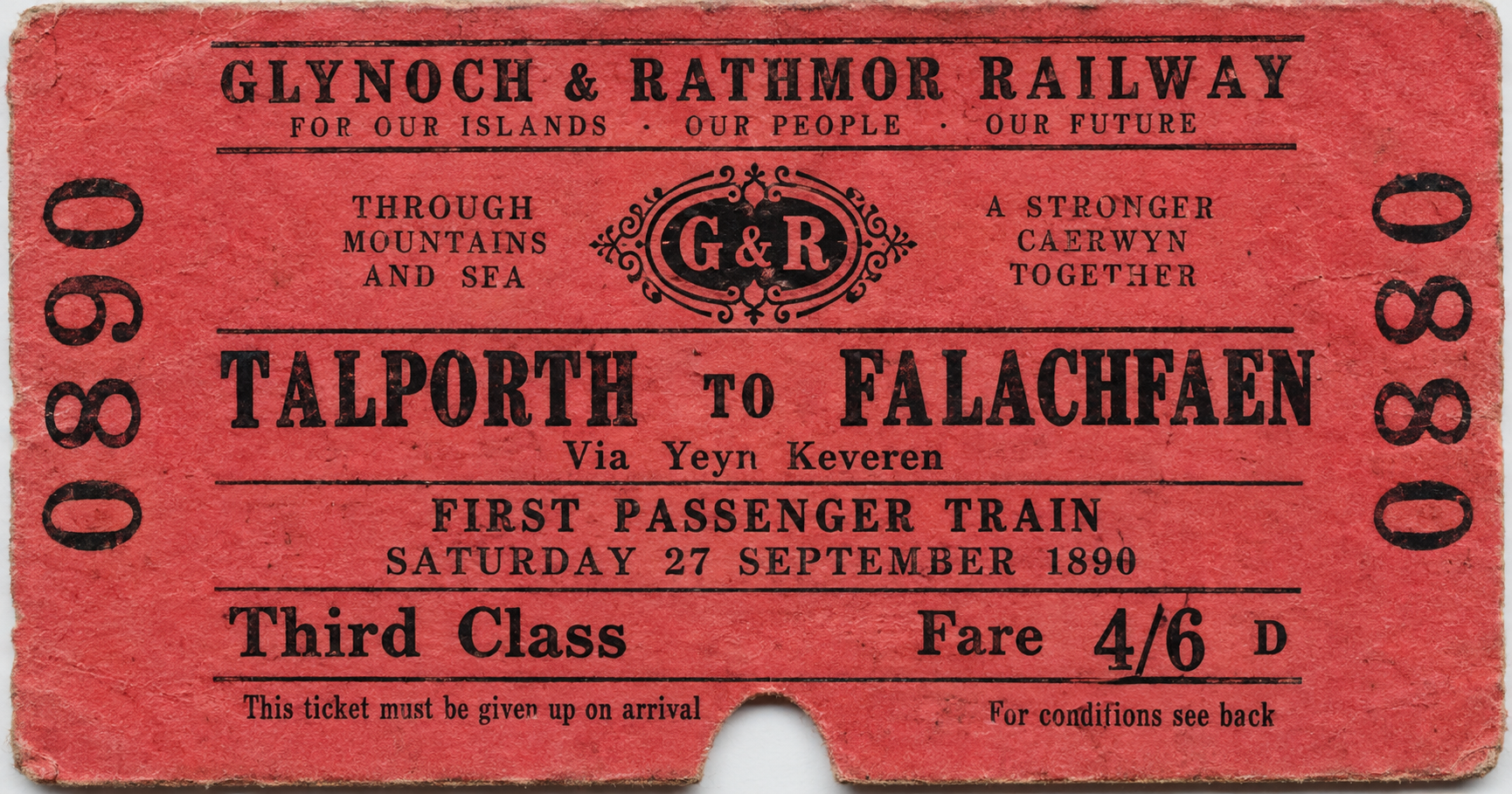
Opening day ticket
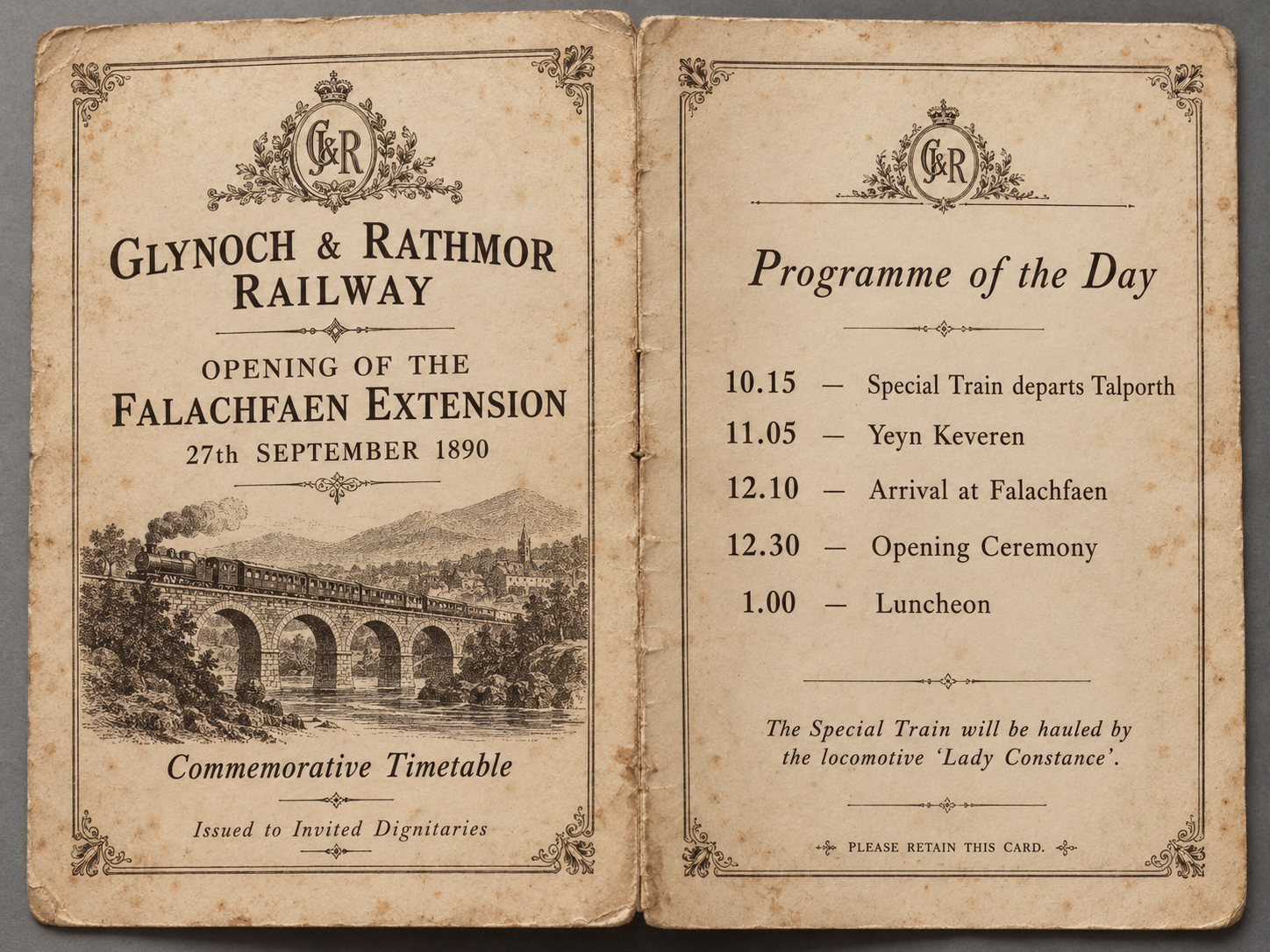
VIP programme for initial train
A new era for Falachfaen
The celebrations continued throughout the day, but the significance of the railway extended far beyond the opening festivities. For Falachfaen's slate industry, the new railway provided access to markets throughout Rathmor and beyond. For local people, journeys that had previously been difficult and time-consuming suddenly became practical.
And for the G&R, completing the line demonstrated something equally important. The company had inherited one of the most troubled railway projects in the islands and finished it. The railway that critics had once demanded should be abandoned became one of Rathmor's most celebrated routes.
More than a century later, the dramatic journey through the Seven Tunnels remains a reminder of what it took to reach Falachfaen. But on 27 September 1890, none of that history was yet known. There was simply an old green locomotive standing beneath the flags at a brand-new station, surrounded by hundreds of people who had waited ten years to see it.
Falachfaen had its railway at last.
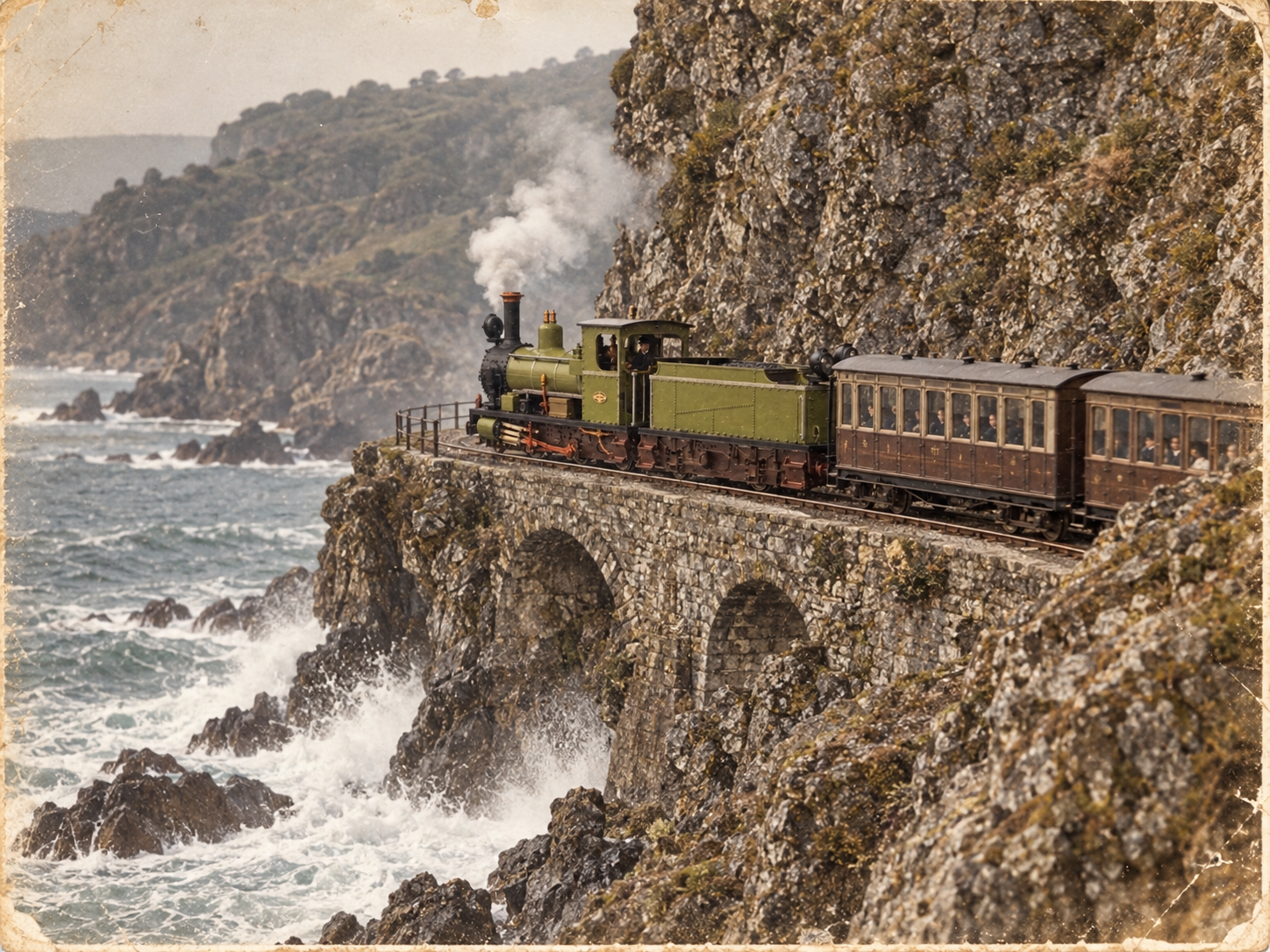
Lady Constance at Hatherleys Shelf, 1890
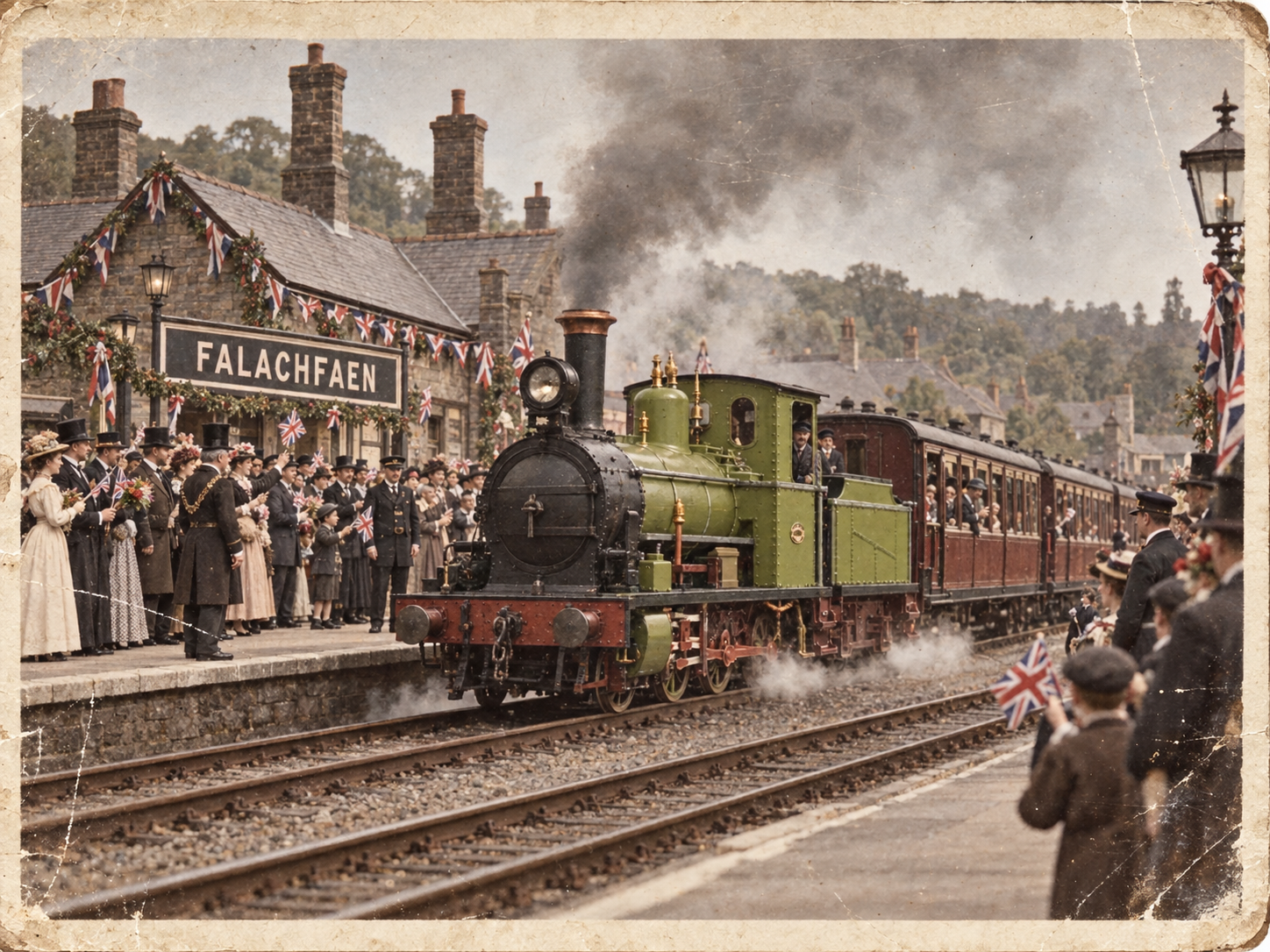
Lady Constance arriving with the first train, 1890