


1863: Talporth Funicular Railway Opens
October 3rd: NO MORE CLIMBING! Talporth's Remarkable Water Railway Opens to the Public
On this day in 1863, the people of Talporth gathered to witness the opening of one of Rathmor's most ingenious pieces of Victorian engineering. Powered not by coal or steam, but by the waters of a mountain stream known as The Dragún, the new Talporth Funicular Railway promised to solve a problem that had been troubling the town ever since the railway arrived: how exactly were passengers supposed to get up to it?
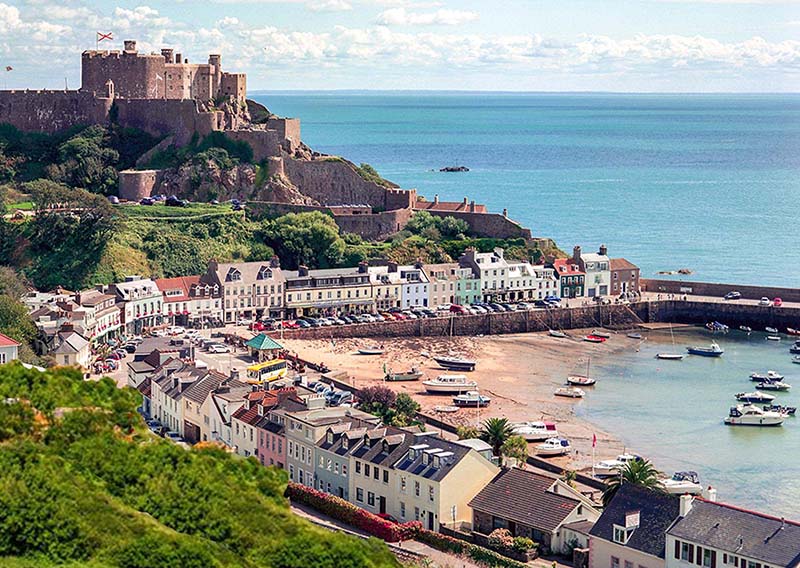
The arrival of the railway had been welcomed enthusiastically in Talporth, but its engineers had been presented with a considerable geographical problem. The old town occupied a cramped position around the harbour, hemmed in by steeply rising ground. Bringing a conventional railway down amongst its narrow streets would have required formidable engineering works. The solution was Talporth High Level station, opened in 1862 on the hillside above the town.
From the railway's point of view it was an elegant answer. From the point of view of a passenger carrying luggage uphill to catch a train, it was rather less satisfactory. Almost immediately there were demands for an easier connection between the harbour, town and station. Improved roads were considered, as was a mechanically worked incline. The solution eventually came from a local engineer named David Penhaligon.
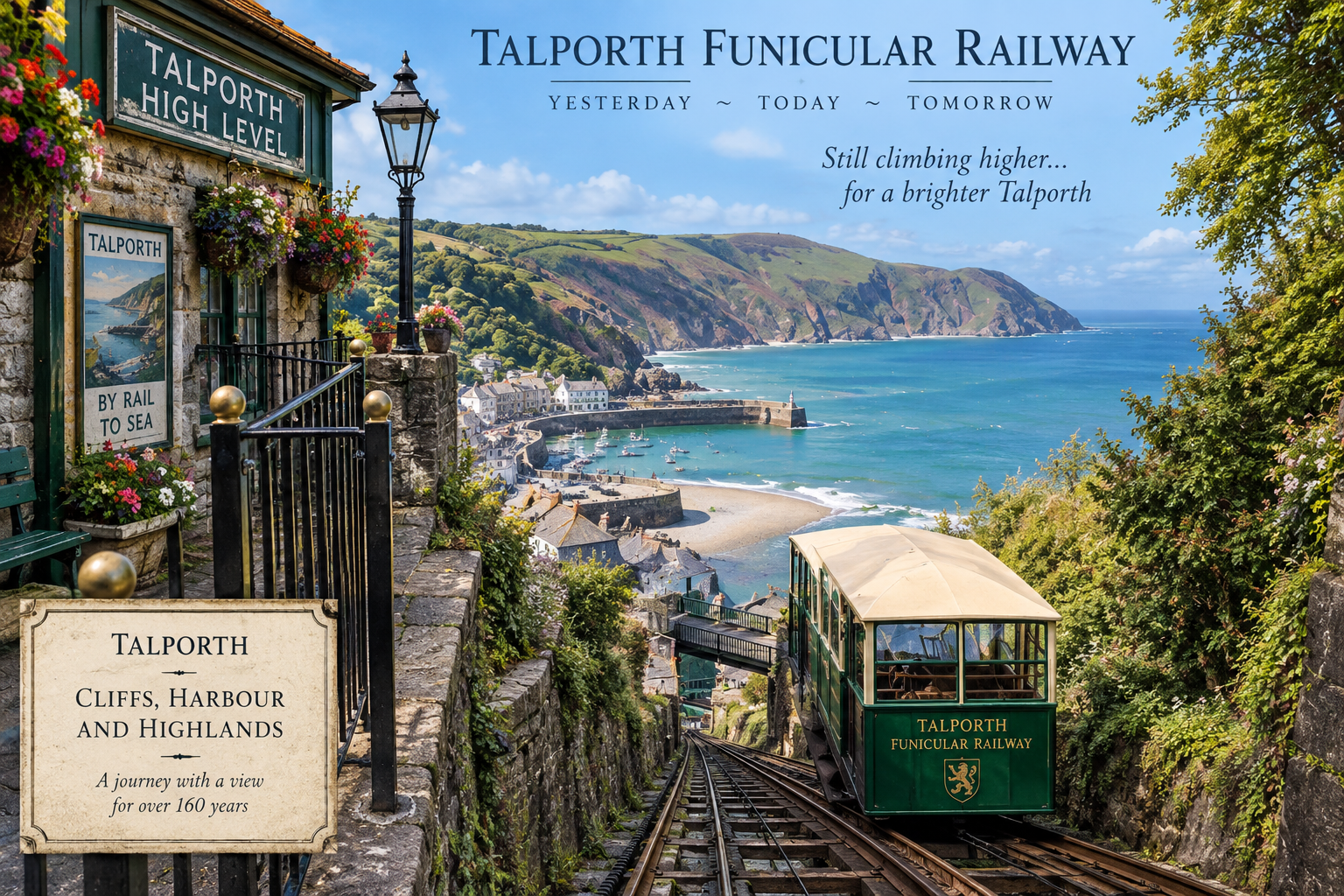
Talporth Funicular Railway
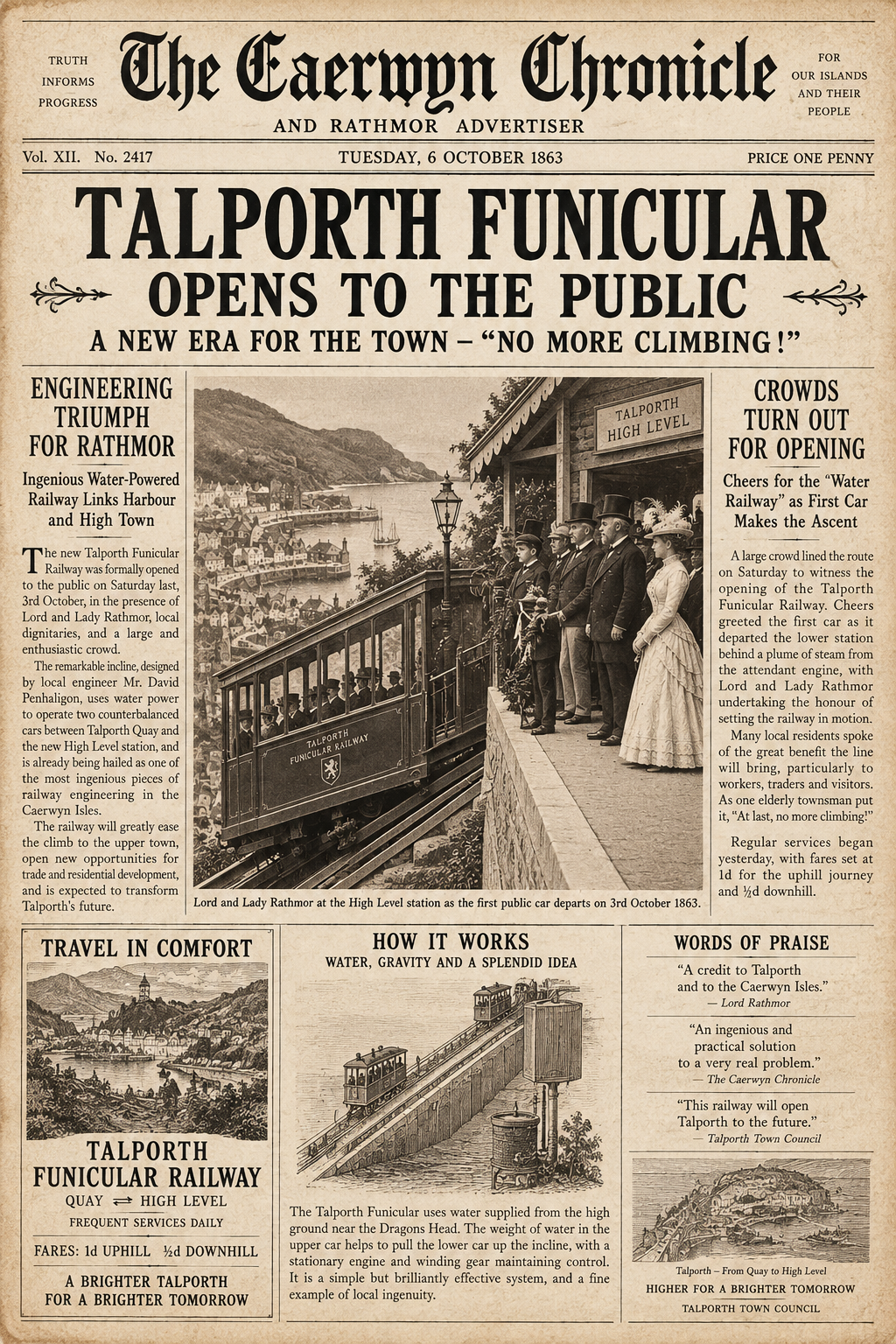
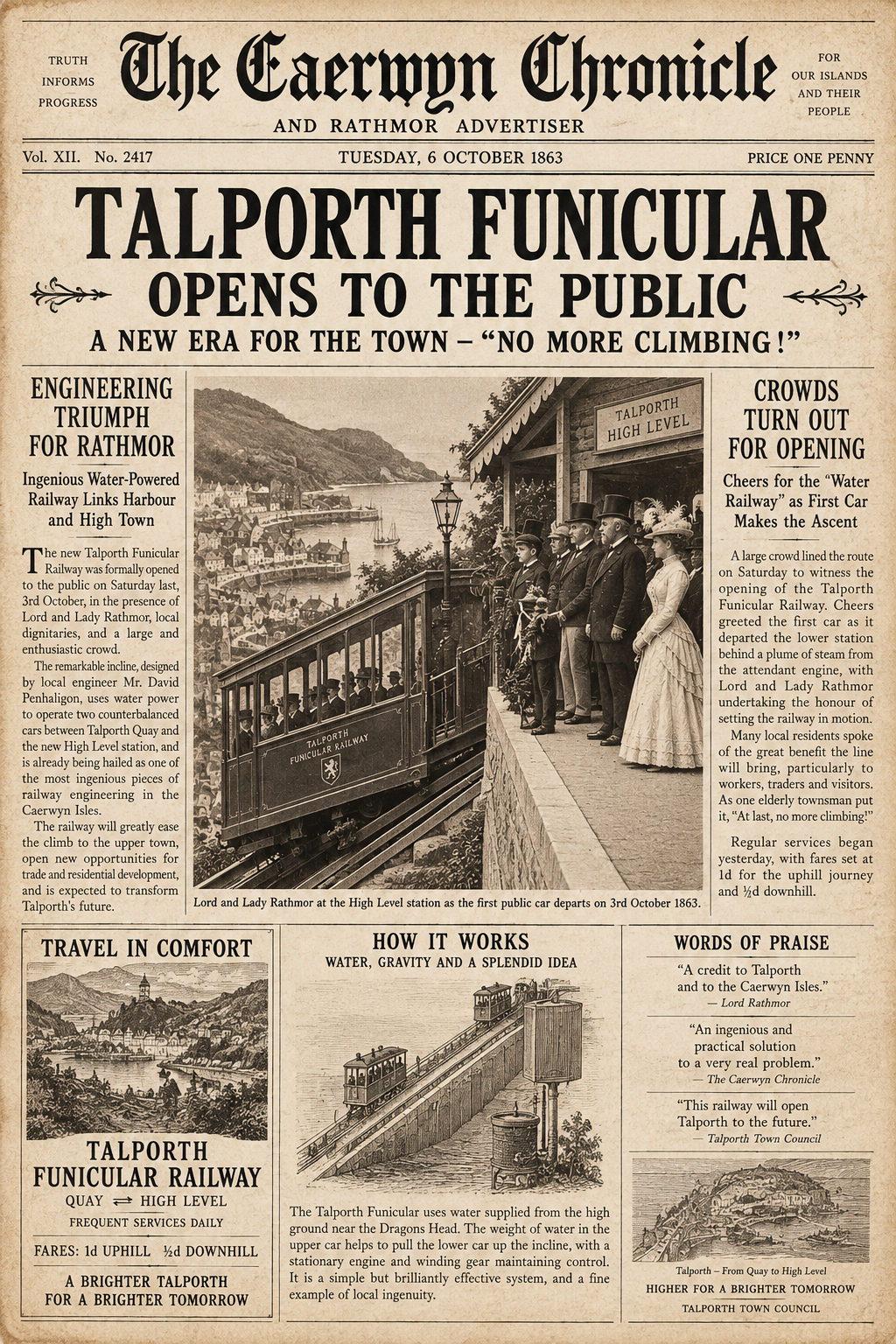
Caerwyn Chronical October 3rd 1863
The man who knew about water
Penhaligon was already familiar to the mining communities of southern Rathmor. Much of his earlier work had involved one of the perennial problems faced by the mines in the hills around Talporth and towards Yeyn Keveren: water. Penhaligon designed pumping machinery and drainage systems intended to keep workings dry. Where the terrain permitted, he also employed gravity-fed drainage tunnels to carry unwanted water away without the expense of continuously operating pumps.
At Talporth, however, he approached the problem rather differently. Instead of getting rid of water, he proposed putting it to work. Above the town, The Dragún descended from the high ground around Dragons Head. Penhaligon proposed diverting a controlled supply from the stream into a reservoir beside the proposed upper station of a new inclined railway. There would be no locomotive and no stationary steam engine. The hill itself would provide the gradient. The Dragún would provide the power. A remark traditionally attributed to Penhaligon has been repeated in Talporth ever since:
“The hill has supplied us with the gradient, and Providence with the water. It would seem rather wasteful to purchase the coal.”
Whether Penhaligon actually said it is another matter entirely. It is, however, exactly the sort of thing Talporth insists he said. How the water railway worked
The completed Talporth Funicular Railway ran for 528 feet, climbing 196 feet between Talporth Quay and High Level. Two cars were permanently connected by cable, with one ascending while the other descended. At High Level, water from The Dragún was admitted into a tank beneath the upper car. As the tank filled, the car became progressively heavier. Once sufficient weight had been added and the brakes released, gravity took over. The heavier car travelled downhill, its weight simultaneously hauling the lighter car from Talporth Quay towards High Level. On reaching the bottom, the descending car discharged its water before eventually making the return journey uphill. No coal needed to be burned simply to haul passengers up the hill. A normal journey took approximately four minutes.
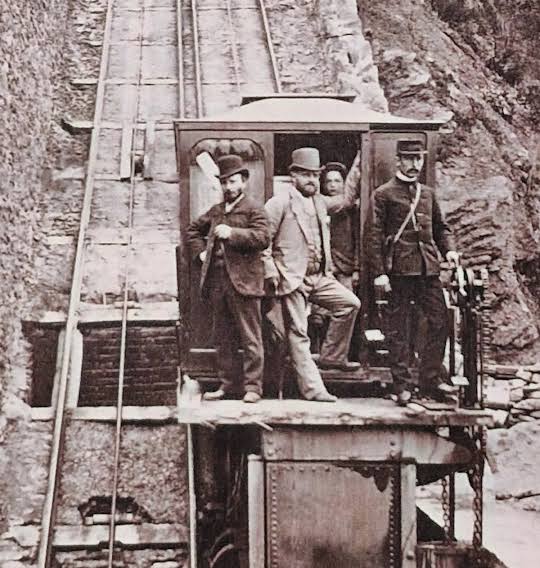
Penhaligan inspecting works c1863
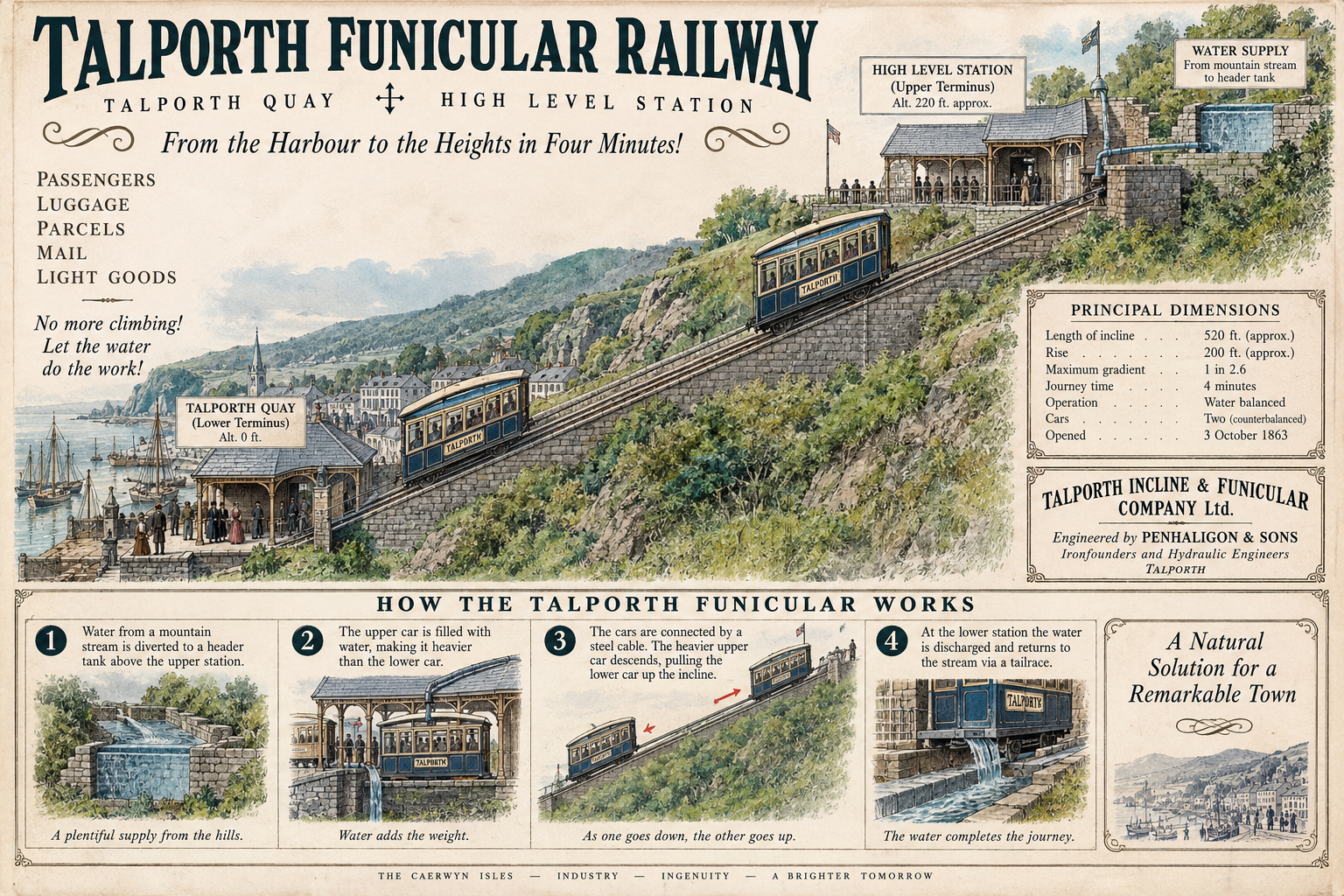
Talporth Water Powered Railway
Although primarily intended for passengers, the cars could also accommodate luggage, parcels, mail and modest quantities of light goods, making the little railway considerably more useful than its promoters had originally anticipated. The official opening took place on Saturday, 3 October 1863, attracting a sizeable crowd. Among the invited guests were Lord and Lady Rathmor, enthusiastic supporters of the developing railway system on the island and already familiar faces at important railway occasions. David Penhaligon was naturally present with members of his family. Among them was his twelve-year-old son, Samuel — better known as Sam. There was little reason for anyone in the crowd to pay particular attention to the engineer's young son that morning. Yet Sam Penhaligon would eventually establish a railway career of his own. He would grow up surrounded by his father's workshops, drawings and machinery before becoming associated with the remarkable railway expansion southwards from Yeyn Keveren. His story would ultimately carry the Penhaligon name considerably farther than Rathmor. But in October 1863, Sam was simply the engineer's boy watching his father's railway open.
The honour of inaugurating the new railway was given to Lady Constance. At High Level, the tank beneath the waiting car was filled from the reservoir while invited guests assembled around the station and crowds gathered beside the railway and far below at Talporth Quay. Following an explanation of the machinery by Penhaligon, Lady Constance ceremonially released the car. Slowly it began moving down the hillside. At precisely the same moment, its counterpart departed Talporth Quay and began climbing towards High Level.
For the first time, passengers were being carried effortlessly up the hill that the people of Talporth had spent the previous year cursing. Penhaligon's machinery performed faultlessly.
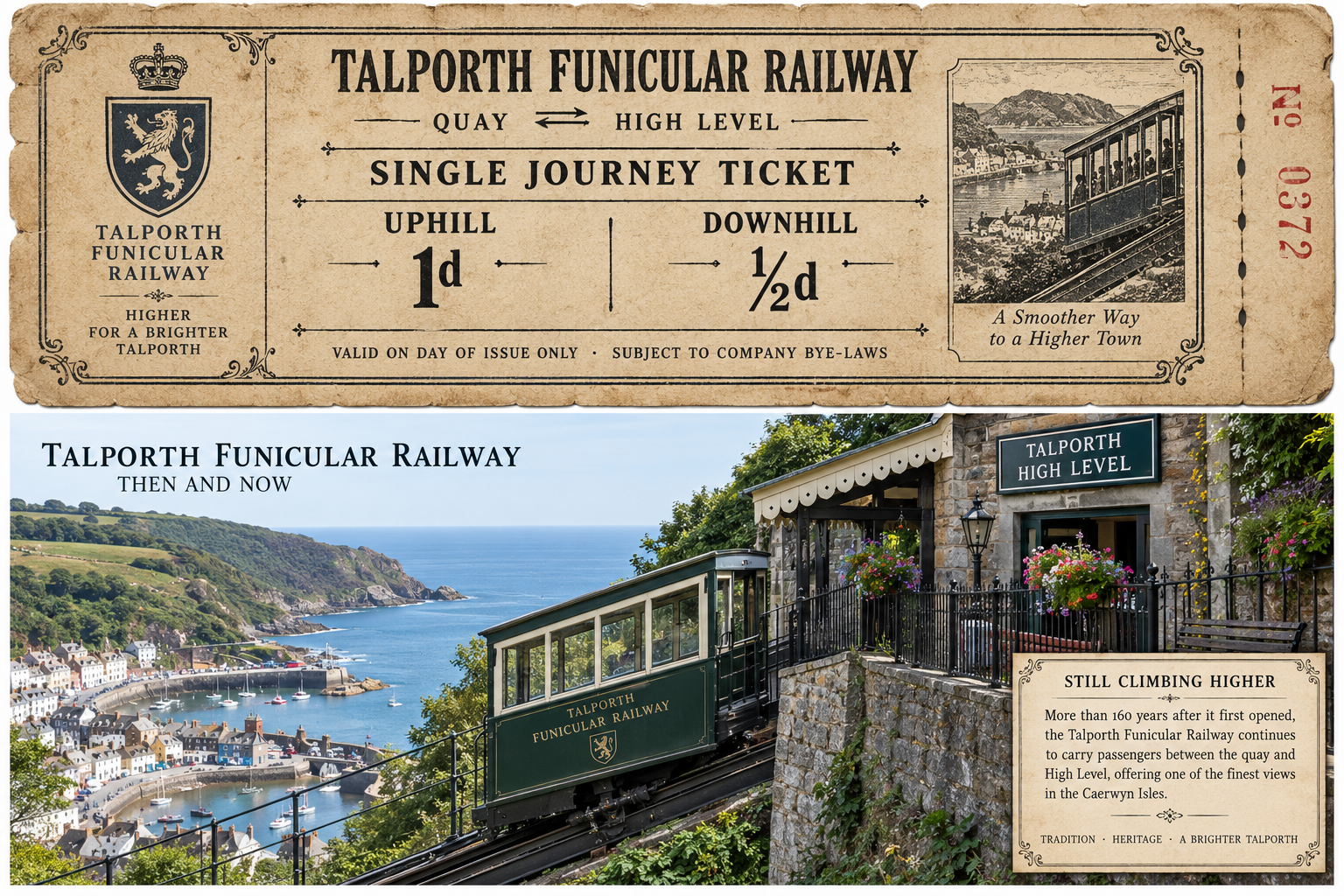
Talporth Funicular Railway Ticket
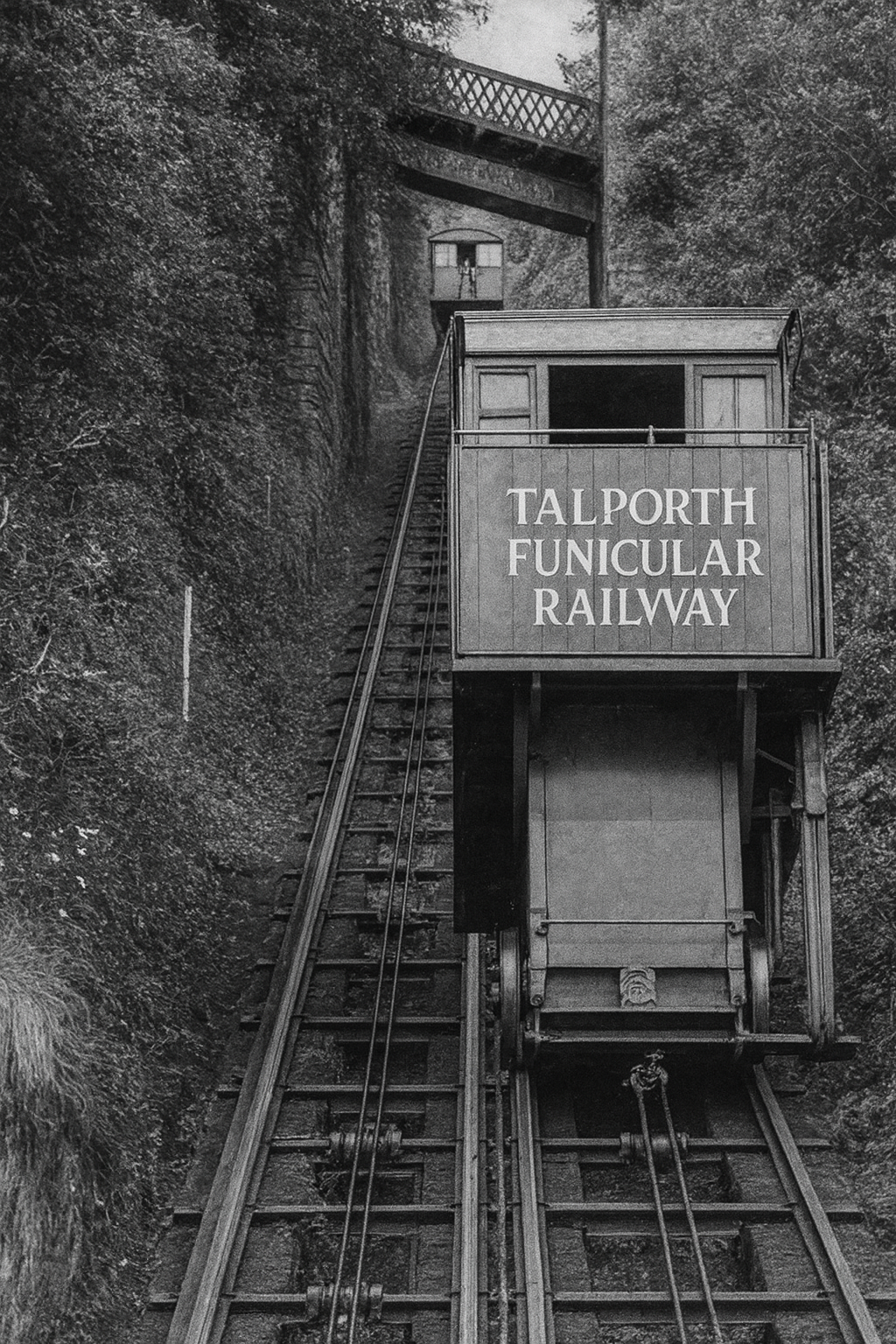
Talporth Funicular Railway c1920
Unfortunately, not everything in Talporth behaved quite so well. The baker, the band and the runaway horse. As the funicular cars began moving, the band assembled near Talporth Quay struck up another enthusiastic tune. One of the horses nearby apparently took exception to the combination of music, cheering crowds and the unfamiliar sight of railway carriages moving upon the hillside. Unfortunately, the horse concerned was attached to a local baker's delivery cart. It bolted. Nobody appears to have been seriously injured, although contemporary accounts suggest that a considerable quantity of bread was distributed across Talporth Quay rather more rapidly—and rather less profitably—than its baker had intended. One newspaper subsequently observed:
“The machinery behaved throughout with considerably greater composure than did the horses of Talporth.”
The story became part of local folklore.
Public services commenced later that day. The original fares were wonderfully straightforward:
Talporth Quay → High Level: 1d
High Level → Talporth Quay: ½d
The difference inevitably amused the locals. One resident supposedly complained that the company appeared to be “giving gravity a discount.” Another expression proved even more enduring. For Talporth residents heading towards High Level station, catching the funicular soon became known simply as:
“Spending a penny up the hill.”
The funicular solved the immediate problem for which it had been constructed. Passengers could now transfer conveniently between the lower town and High Level station, while luggage, post, parcels and smaller consignments no longer had to make the laborious journey by road. But its eventual influence would be considerably greater. Until the 1860s, Talporth had been tightly confined around its harbour. The steep slopes above remained comparatively undeveloped, despite the shortage of space amongst the crowded streets below. The opening of High Level station in 1862 had begun to change that. The arrival of the funicular changed it further. There was now a railway station at the top of the hill and a journey of approximately four minutes connecting it with the old town below. Land previously regarded as inconvenient suddenly looked rather more attractive. Few of those celebrating on 3 October 1863 could have appreciated quite how dramatically Talporth would eventually spread across the hillside. That, however, is another chapter in the town's story.
The water railway also established something of a tradition. Talporth subsequently developed an unusual enthusiasm for ingenious methods of negotiating its difficult terrain, culminating in the opening of the Dragons Head Electric Tramway in 1885. Visitors occasionally joked that Talporth's engineers were prepared to build almost anything, provided nobody asked them to construct an ordinary railway on level ground.
And there was one final legacy that nobody standing beside the funicular in 1863 could possibly have foreseen. The twelve-year-old boy watching his father's railway that morning would grow up and, nearly three decades later, would be connected to another remarkable water-powered cliff railway across the sea at Lynton in North Devon. But that is another story.
Fact Box
Opened: 3 October 1863
Route: Talporth Quay – High Level
Length: 528 ft
Vertical rise: 196 ft
Journey: approximately 4 minutes
Cars: two counterbalanced passenger cars
Power: water supplied from The Dragún
Designer/Engineer: David Penhaligon
Original fare: 1d uphill, ½d downhill
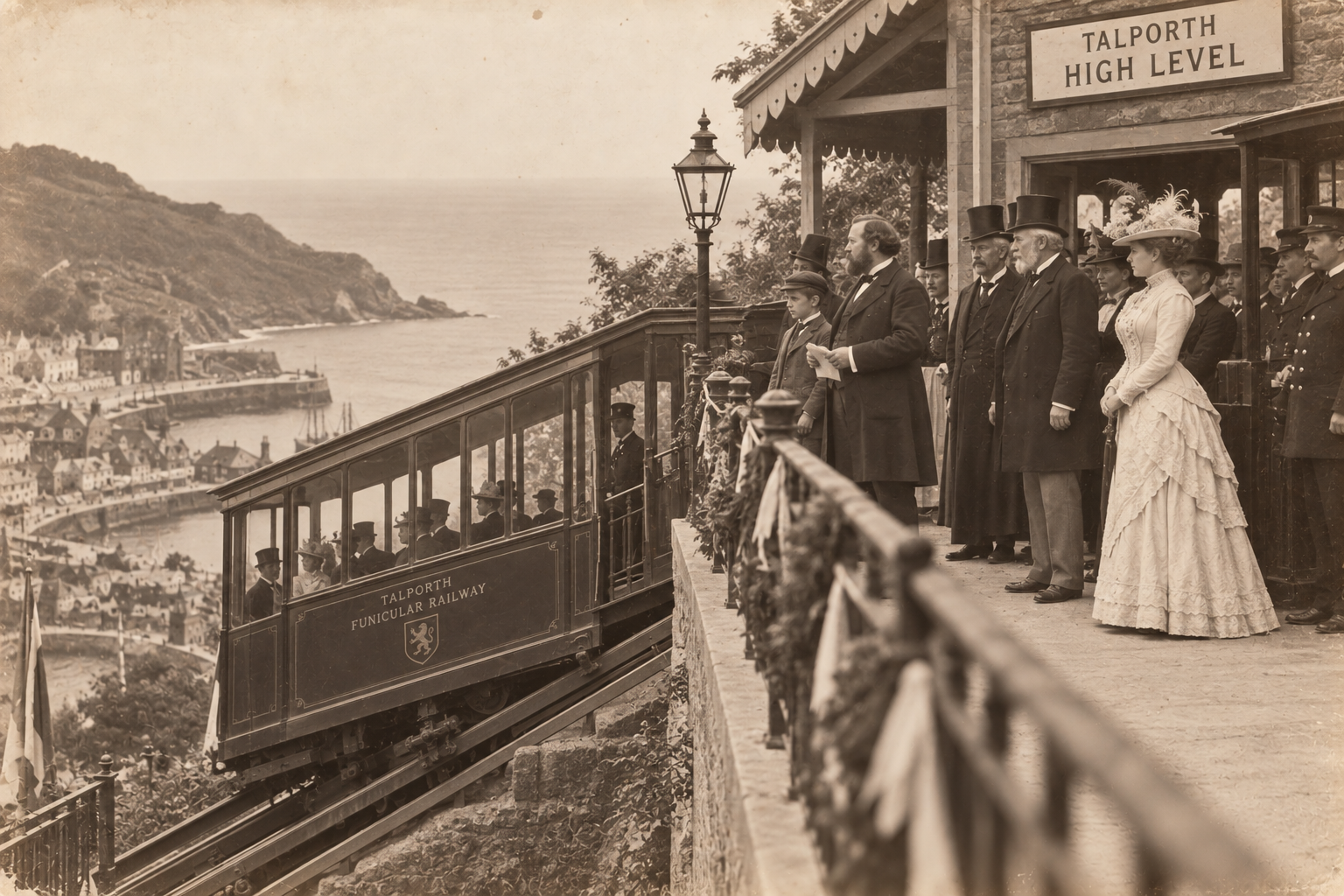
Opening day October 3rd 1863, including 12 year old Sam Penhaligon
Related Articles...
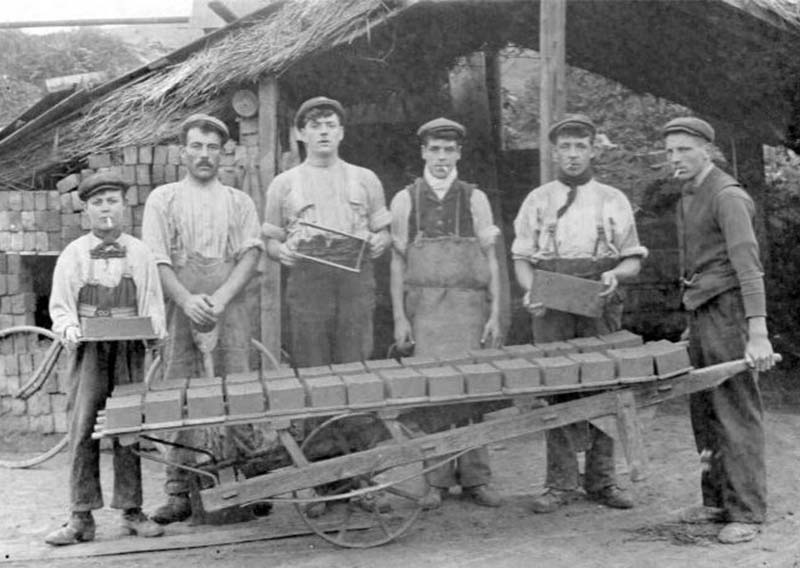

The Glassmaking Industry of Talporth
The industry owes its origins to the exceptionally pure silica […] ...
...View All