


1840s: Arwyn-Rowen Estate Plateway
Long before Rowenport appeared on the passenger timetables, the Arwyn-Rowen Estate had already discovered the usefulness of rails.
History

Railways

Arwyn-Rowen Estate
Estate Maps
Arwyn-Rowen Estate Plateway (ARP)
At a glance:
Opened: 1840s
Island: Glynoch
Location: Rowenport and the Arwyn-Rowen Estate
Type: Private estate and industrial plateway
Original traction: Horse and mule power; rope-worked incline
Principal traffic: Timber, stone, estate supplies and provisions
Passenger traffic: No public passenger service; estate staff and occasional guests carried
Successor: Parts incorporated into the Llanchala & South West Railway from 1859–60
Notable survivor: Rowenport harbour incline remained the property of the Arwyn-Rowen Estate
Origins
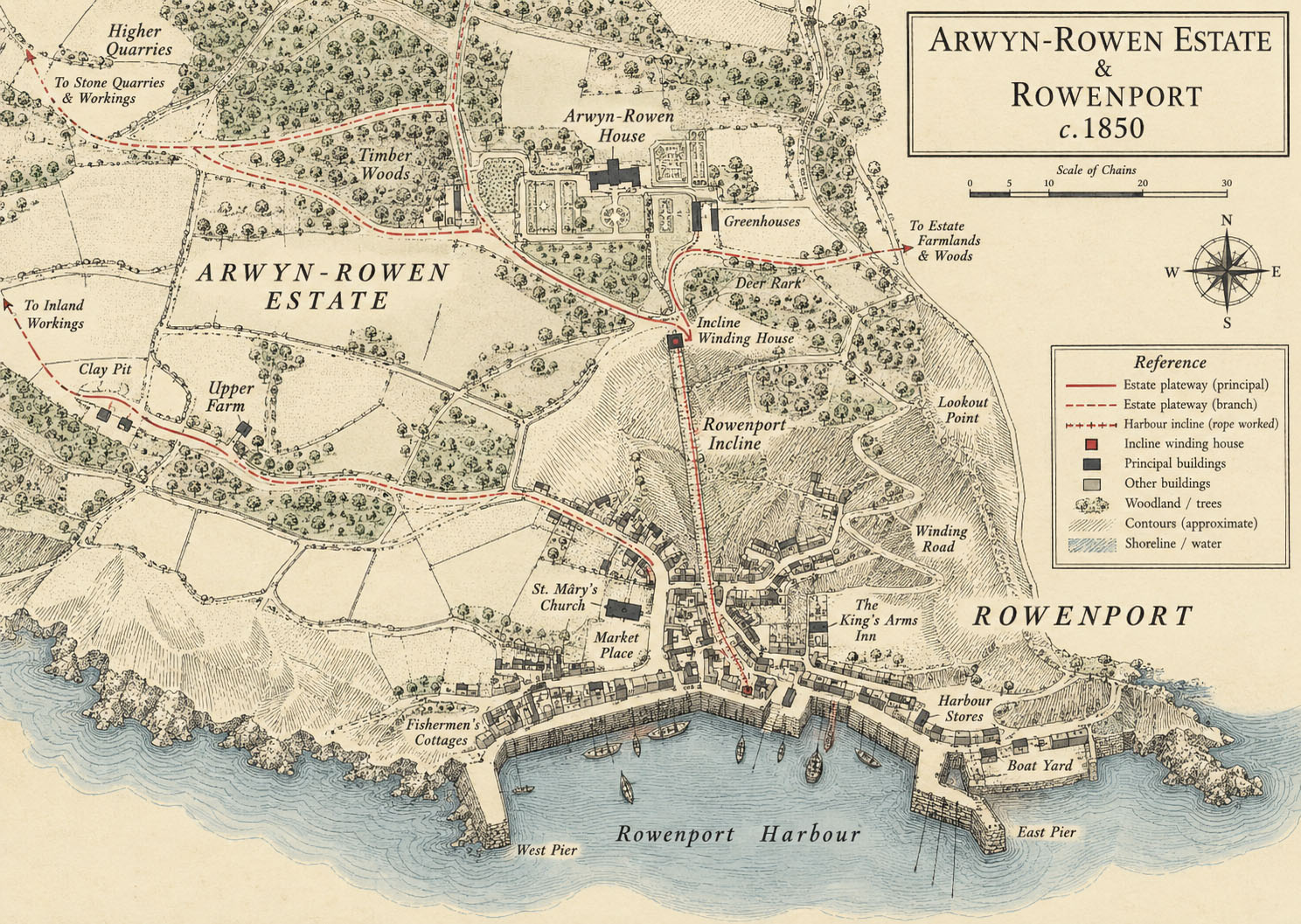
Long before Rowenport appeared on the passenger timetables of the Glynoch railways, the Arwyn-Rowen Estate had already discovered the usefulness of rails. Rowenport presented the estate with a considerable transport problem. The little fishing harbour lay at the foot of the steep southern slopes of Glynoch, connected with the higher ground by a winding track climbing between cottages, shops and inns. Almost everything required by the estate that arrived by sea had somehow to be carried up this difficult route. During the 1840s, the Arwyn-Rowen Estate provided its own solution. A simple horse-worked plateway was constructed around the estate, linking stores, woodland, stone workings and other important locations. Its most remarkable feature was a steep rope-worked incline connecting the harbour at Rowenport with the estate lands above. It was never intended to be a public railway. It was simply a practical means of moving goods through difficult country. Nevertheless, the little estate railway would ultimately have an important influence on the development of the entire south coast of Glynoch.
Timeline of the Estate Railway
Arwyn-Rowen Estate Plateway
Llanchala & South West Railway
Llanchala Railway Ltd
Glynoch & Rathmor Rly
Arwyn-Rowen Estate Crest
The Estate Plateway
The earliest Arwyn-Rowen railway was a modest affair. The track was constructed using wooden rails with iron running surfaces or flanges, providing a considerable reduction in resistance compared with hauling carts over the rough estate roads. Small wagons carried timber, building stone, tools, provisions and agricultural supplies. Horses and mules provided most of the motive power on the more level sections. There was little about the railway that would have impressed a later Victorian railway engineer. Its curves followed the landscape, its equipment was functional rather than elegant and its wagons were built principally to fulfil the needs of the estate. But it worked. For the Arwyn-Rowen family and their tenants, the railway offered a dependable transport system in an area where steep gradients and poor roads had always made the movement of heavy goods difficult.
The Rowenport Incline
The most distinctive part of the system was the incline to Rowenport harbour. The harbour stood considerably below the main estate, at the bottom of the steep valley occupied by the village. The ordinary road wound its way up the hillside, but this was slow and difficult for heavily laden carts. The estate railway took a more direct route. Small wagons were hauled along the steeply graded track by rope, controlled from winding machinery at the upper end of the incline. Mule power and counterbalancing could assist operations, particularly in the earliest years, while the winding system allowed loads far heavier than an animal could haul directly up the gradient. Its principal purpose was initially to move goods uphill. Food, household supplies, tools and other materials arriving at Rowenport by coastal vessel could be transferred directly from the harbour into estate wagons and hauled to the higher ground. The incline was primarily a goods railway, although estate workers and, on occasion, visitors to the Arwyn-Rowen family were also carried. There was never a regular public passenger service.
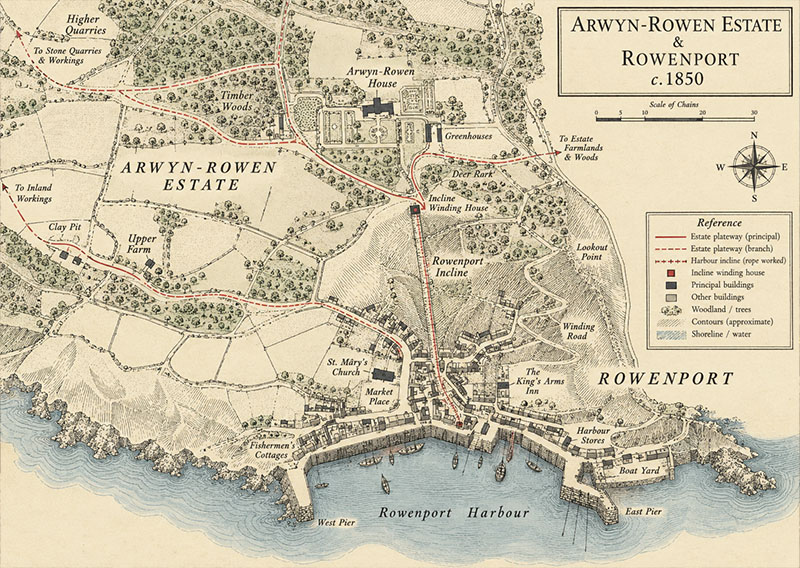
Arwyn-Rowen Estate Map 1850

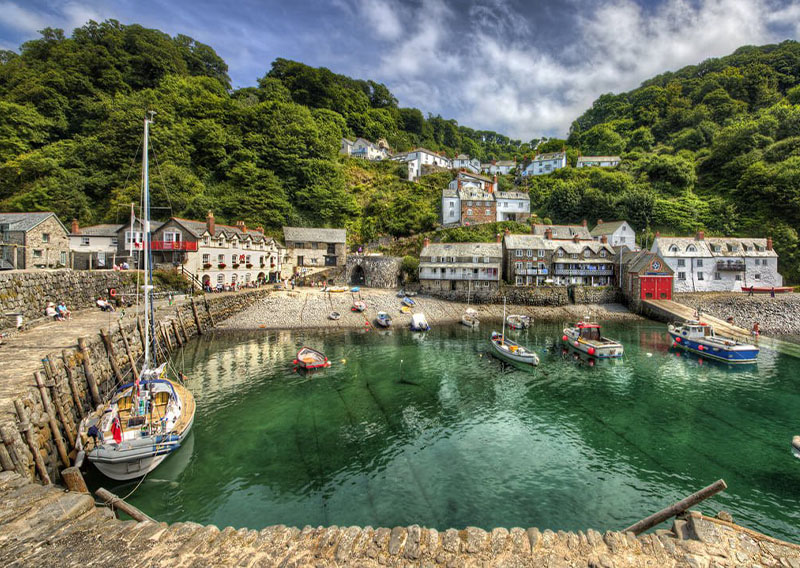
Rowenport c1870
A Railway Before the Railway
For more than a decade the Arwyn-Rowen system remained an isolated private railway. That began to change in 1855. The newly established Glynoch Mineral Railway Company was expanding westwards from Llanchala, initially seeking the mineral and industrial traffic of southern and central Glynoch. Its southern route eventually approached Rowenport. The railway promoters quickly encountered a geographical problem which the Arwyn-Rowen family understood extremely well: there were remarkably few practical routes through this part of Glynoch. The estate occupied precisely the land across which any useful railway towards Rowenport — and ultimately Aberfael — would need to pass. What had begun as a small private plateway therefore gave the Arwyn-Rowen Estate considerable influence over the next stage of railway development.
The South Coast Railway
By the end of the 1850s, the possibilities of a continuous railway along Glynoch's southern coast were becoming obvious. At the western end, the Aberfael China Clay Railway, opened in 1855, was already carrying china clay from the inland workings to Aberfael harbour. At the eastern end, railway development from Llanchala had reached towards Rowenport. Between the two lay the missing link. In 1859, the Llanchala & South West Railway was formed to complete the route. Negotiations with the Arwyn-Rowen Estate were unavoidable. The new railway needed access across estate land and could make use of parts of the transport system and alignments which had already developed around Rowenport. The resulting arrangements brought portions of the wider estate railway into the developing public network while protecting important Arwyn-Rowen interests. Most significantly, the harbour incline remained the property of the estate. In 1860, the missing link was completed and trains could operate along the south coast between Aberfael, Rowenport and Llanchala. The railway age had finally arrived at Rowenport.
A New Purpose for the Incline
The arrival of the public railway did not make the old Rowenport incline redundant. Instead, it gave it an entirely new purpose. Rowenport had long supported a small fishing fleet, with lobster fishing becoming a particular speciality of the harbour. Previously, the market for such highly perishable produce had inevitably been restricted by the difficulty of transporting it beyond the immediate district. The railway changed that. Boxes of lobster and fresh fish could now be landed at Rowenport harbour, transferred to the estate incline and hauled rapidly uphill. At the top they could be transferred to railway wagons for onward movement towards Llanchala and markets beyond. The flow of traffic worked in both directions. Fish and lobster travelled uphill from the harbour towards the railway, while coal, beer, provisions, parcels and other goods could travel downhill towards the village and fishing fleet. A piece of railway engineering created principally to supply a country estate had become Rowenport's connection with a much wider economy.
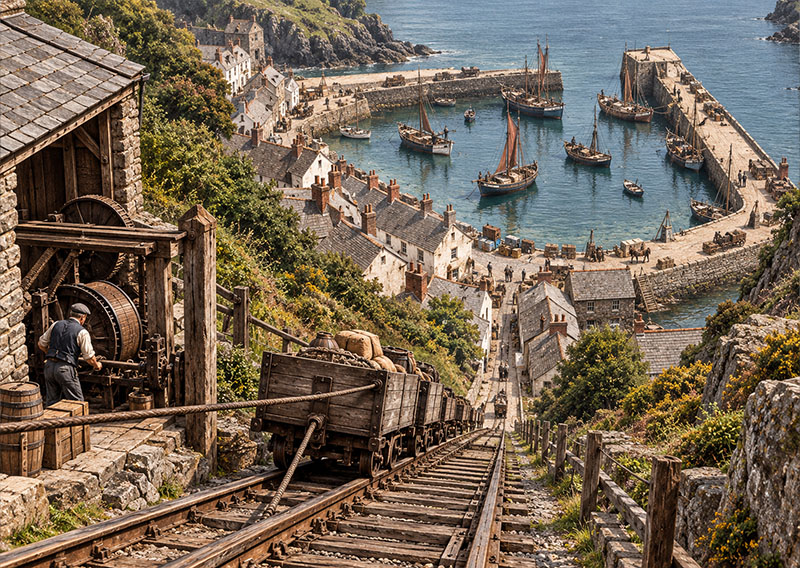
Estate Incline c1860
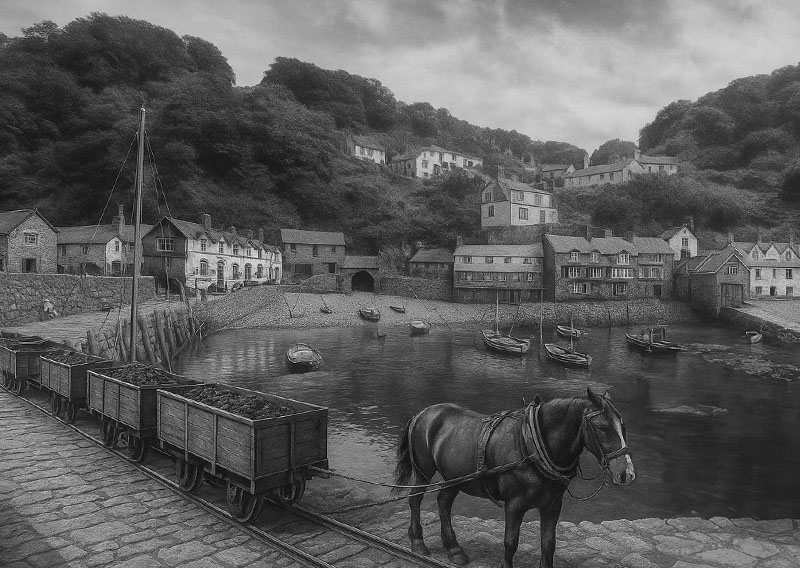
Rowenport Horse Drawn Tramway c1850
Operations
The Arwyn-Rowen Estate Plateway remained a small and essentially functional railway throughout its independent existence. Horses and mules handled wagons over the easier sections, while the Rowenport incline depended upon rope haulage controlled from the upper station. Wagons were simple estate vehicles designed for timber, stone, provisions and general merchandise rather than standard railway traffic. There was no public passenger service and no conventional passenger rolling stock. Estate employees routinely travelled where necessary, while members of the Arwyn-Rowen household and their guests could occasionally be conveyed over parts of the system. The railway's appearance was similarly practical. There is no evidence of an elaborate house livery during the plateway period, although estate ownership marks would have appeared on wagons and equipment.
Consolidation on the South Coast
The complicated collection of railway interests along southern Glynoch could not last indefinitely. In 1876, a major reorganisation created a much more coherent railway structure. The Llanchala & South West Railway, the Aberfael China Clay Railway and the southern and coastal interests of the old Glynoch Mineral Railway Company were consolidated into Llanchala Railway Ltd. At the same time, the GMRC's central and highland interests became the separate Glynoch Central Railway. For the first time, the principal railway between Aberfael, Rowenport and Llanchala was controlled as a unified south-coast system.
The remaining estate railway facilities at Rowenport increasingly became feeders to this larger railway rather than a railway network in their own right. The harbour incline, however, remained an Arwyn-Rowen Estate concern.
Later Years
In 1885, Llanchala Railway Ltd joined with the Rathmor Railway in the major reorganisation which created the Glynoch & Rathmor Railway. By then, little remained of the Arwyn-Rowen system that a visitor from the 1840s would have recognised as an independent estate railway. The public railway had transformed Rowenport. Modern railway wagons and locomotives now carried passengers and goods along the coast, while the old estate tracks had either disappeared, been modernised or become incorporated into later railway infrastructure. Yet the most improbable survivor was the very feature created to overcome Rowenport's greatest disadvantage. The harbour incline continued to connect the railway above with the village and quayside below. Its equipment would be altered and modernised over the years, but its purpose remained remarkably close to that envisaged by the Arwyn-Rowen Estate decades earlier: moving goods efficiently between Rowenport harbour and the railway above.
Legacy
The Arwyn-Rowen Estate Plateway occupies an unusual place in the history of Glynoch's railways. It was not founded by railway promoters. It did not begin with ambitions to connect towns or carry passengers. It had no grand terminus and no aspiration to become part of an island-wide network. It was built because an estate had a transport problem. Yet when the railway promoters eventually arrived, they discovered that the Arwyn-Rowen family controlled both the land they needed and a transport system which had already demonstrated how the difficult terrain around Rowenport could be conquered. The little plateway consequently became one of the foundations upon which Glynoch's south-coast railway was built. And at Rowenport harbour, its steep incline survived as a reminder that the railway had been there before the railway.
History
Railways
Arwyn-Rowen Estate
Estate Maps
Arwyn-Rowen Estate Plateway
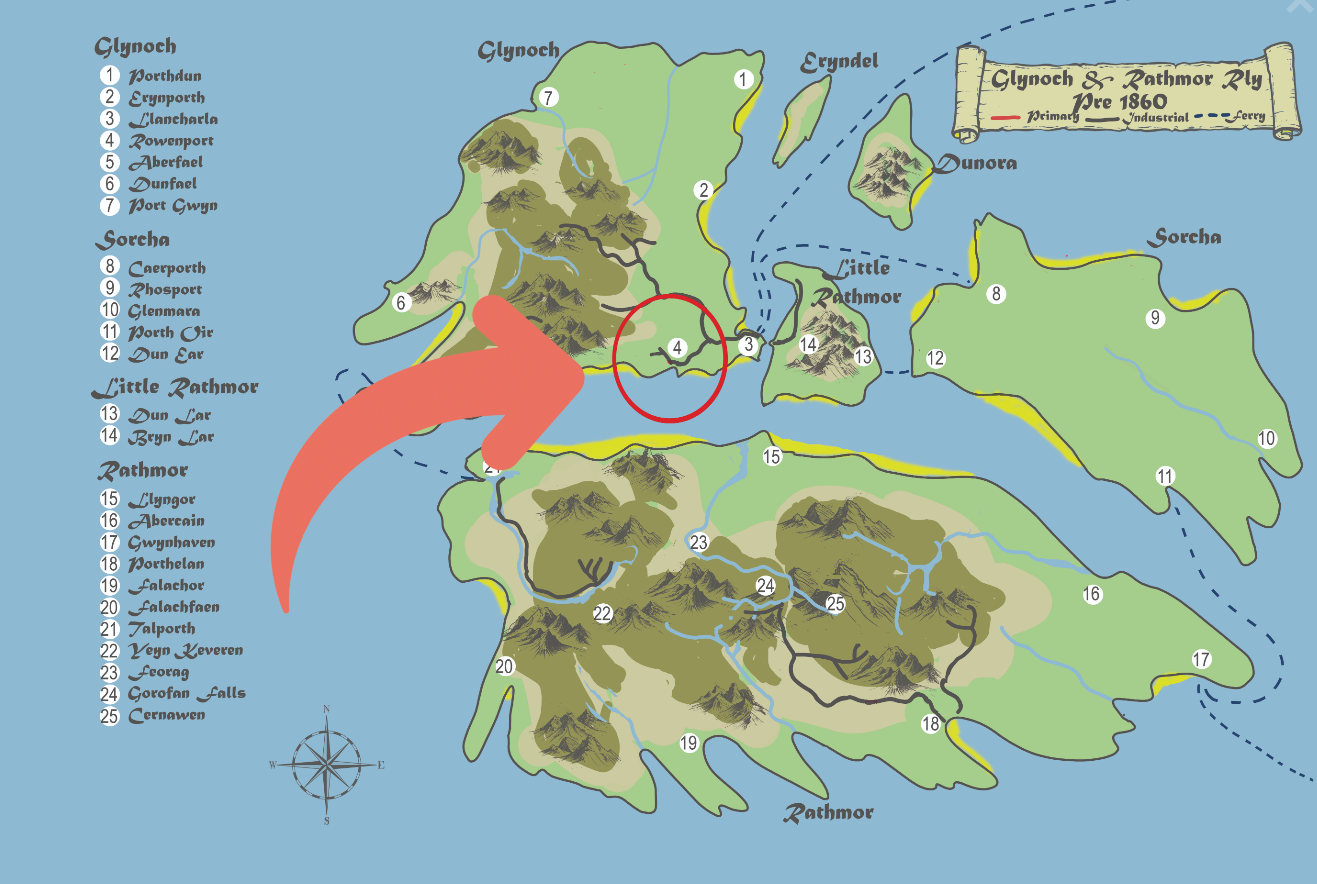
Rowenport Railways




0 Comments