


1867: Porthelan Highland Railway
The amalgamation of three independent railways around Porthelan transforming industrial lines into a fully formed railway network
History

Railways

About the PHR
PHR Maps
Porthelan Highland Railway (PHR)
At a glance:
Established: 1 January 1867
Island: Rathmor
Headquarters: Porthelan
Operating period: 1867–1879
Predecessors: Porthelan & Gorofan Timber Tramway (P>T); South Rathmor Mineral Tramway (SRMT); Southern Peninsular Railway (SPR)
Principal routes: Porthelan Harbour to Gorofan; southern highland mineral branches; agricultural lines serving the southern peninsulas
Important connection: Talporth & Feorag Railway at Gorofan, 1876
First through passenger train: 1 July 1876 — Porthelan to Talporth
Locomotive livery: Rathmor Red
Passenger carriage livery: Charcoal and cream
Principal traffic: Timber, molasses minerals, quarried stone, agricultural produce, livestock, passengers and general merchandise
Successor: Rathmor Railway, 1879
Three Railways Become One
On 1 January 1867, three established but independently operated railways serving the forests, mines and agricultural districts of southern Rathmor were united to form the Porthelan Highland Railway. The amalgamation brought together a collection of lines whose origins lay in the practical demands of local industry. Timber from the forests around Gorofan, molasses minerals from the southern highlands and agricultural produce from the coastal peninsulas had all depended upon the railway routes converging on Porthelan Harbour. What had begun as three separate industrial undertakings was now to be managed as a single railway company. Over the following twelve years, the Porthelan Highland Railway would develop from a largely freight-oriented system into an important regional railway, carrying passengers as well as goods and establishing a vital connection with the railway network of northern Rathmor. Its greatest achievement came in 1876, when the completion of a railway connection at Gorofan made possible the first through passenger journey between Porthelan and Talporth. Although the company would lose its independent identity in 1879, its routes would remain an essential part of Rathmor's developing railway network.
Porthelan Timeline
Porthelan & Gorofan Timber Tramway
South Rathmor Mineral Tramway
Southern Peninsular Railway
Porthelan Highland Railway
Rathmor Railway
Glynoch & Rathmor Rly
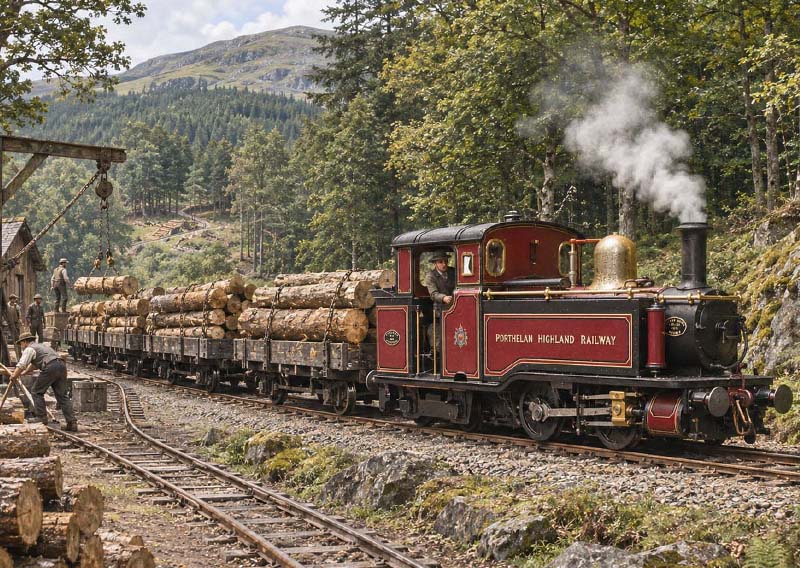
Porthelan Highland Railway
Origins
The Porthelan Highland Railway inherited a railway system whose origins stretched back to the early 1850s. The oldest of its three predecessors was the Porthelan & Gorofan Timber Tramway, which had reached the forestry district around Gorofan by 1852. Originally horse-worked, the line had been constructed to carry felled timber from the inland forests to Porthelan Harbour, where it could be transferred to coastal vessels or supplied to local merchants and workshops. The South Rathmor Mineral Tramway, established around 1855, served the increasingly important molasses mining and quarrying industries of the southern highlands. Unlike the timber line, which followed a principal route inland, the mineral railway developed numerous branches and private sidings connecting individual workings to the harbour. The third undertaking, the Southern Peninsular Railway, was established in 1859 to serve the agricultural communities of Rathmor's southern peninsulas. Its wagons carried crops, livestock and other produce towards Porthelan, while supplies and equipment travelled in the opposite direction. The Southern Peninsular Railway already shared part of the timber tramway's route into Porthelan Harbour, demonstrating the practical advantages of cooperation between the companies. By 1860, steam locomotives had begun replacing horses on the busier sections of the Porthelan railway system. The heavier trains and increasing traffic brought new demands for better track, maintenance facilities and coordinated operating arrangements. As the volume of timber, mineral and agricultural traffic increased, so too did the difficulties of managing three independent railways converging upon the same harbour. The solution was amalgamation. On 1 January 1867, the three undertakings formally became the Porthelan Highland Railway. The development of the three founding companies is described in our earlier article, The Early Railways of Porthelan
1867: A Railway of Many Parts
The directors of the new Porthelan Highland Railway inherited an unusual collection of railway assets. There were established main routes, temporary forestry branches, mineral sidings, agricultural loading points and harbour connections. Locomotives and wagons had been acquired to suit the particular requirements of their original owners, while sections of the permanent way varied considerably in age and construction. Bringing these disparate elements together was one of the company's first challenges. The railway's management could now coordinate the movement of freight across the entire system, avoiding the complicated arrangements previously required when wagons passed between different companies. Locomotives and rolling stock could be allocated according to demand, workshops could undertake maintenance for the whole network, and improvements to track and infrastructure could be planned with the interests of the entire railway in mind. At Porthelan Harbour, where the three former railways had previously competed for limited space and facilities, unified management offered particular advantages. Timber, minerals and agricultural produce could be assembled into more efficiently organised trains, while the movement of empty wagons and incoming supplies could be coordinated with the harbour's shipping activities. The new company also inherited a railway system whose traffic was far from uniform. The forestry lines carried heavy timber loads, the mineral branches handled dense and often difficult freight, and the agricultural railways experienced considerable seasonal fluctuations. The Porthelan Highland Railway had to accommodate all these requirements while maintaining a dependable service for the industries and communities upon which its prosperity depended.
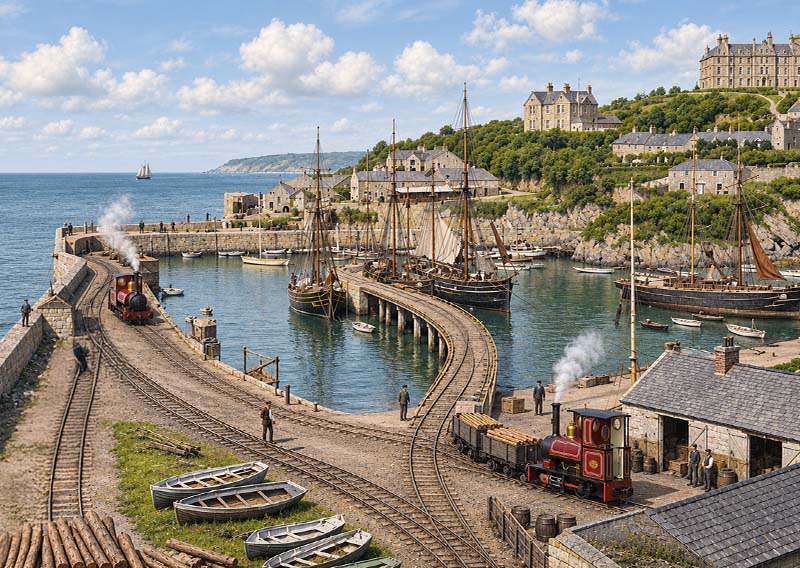
Steam at Porthelan Harbour
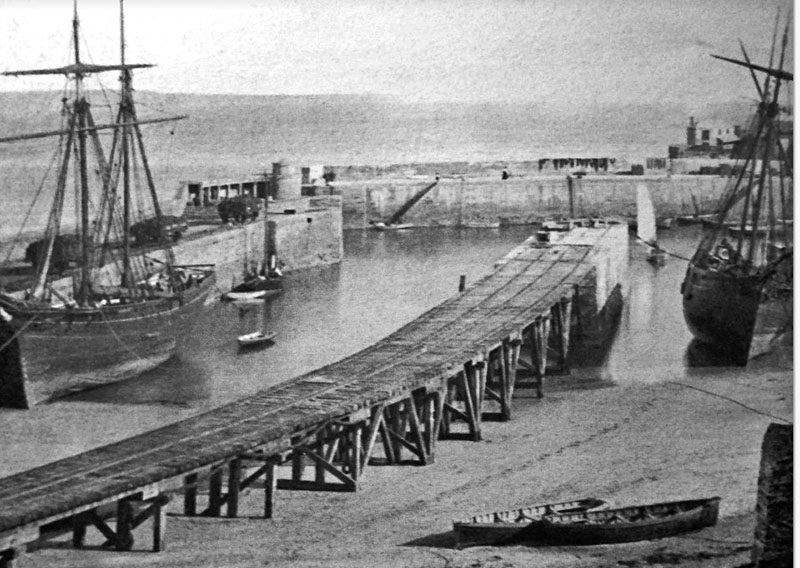
The railway jetty at Porthelan Harbour c1880
A New Identity: Rathmor Red
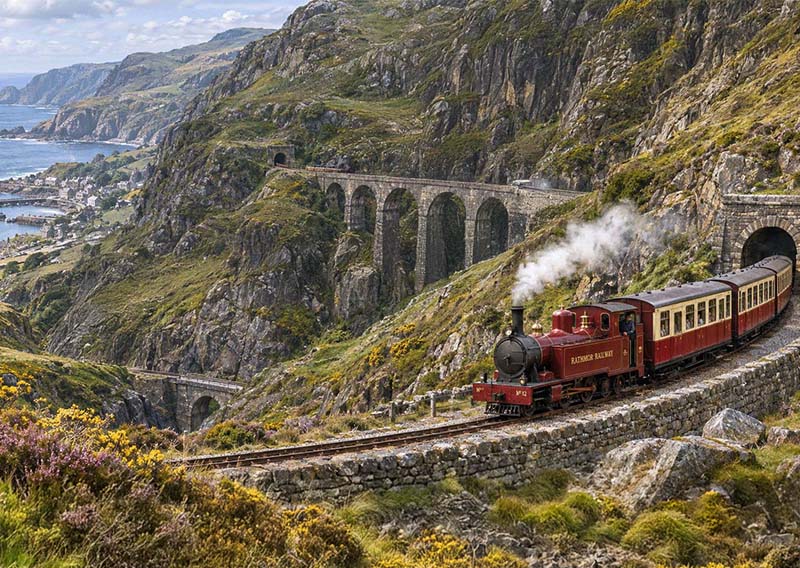
The creation of the Porthelan Highland Railway also brought an opportunity to establish a recognisable corporate identity. The company's locomotives adopted the distinctive Rathmor Red livery, a colour that was becoming strongly associated with the railways of Rathmor. Passenger carriages were finished in an attractive combination of charcoal and cream, providing a contrast with the company's red locomotives. The appearance of the PHR's trains reflected a developing regional tradition. Rathmor Red was also incorporated into the liveries of the Tal Valley Railway and the Talporth & Feorag Railway, helping establish a visual identity for the island's railway undertakings. Although industrial wagons remained predominantly practical working vehicles, the new locomotive and passenger carriage liveries gave the Porthelan Highland Railway a distinctive appearance of its own. The railway was no longer simply a collection of timber, mineral and agricultural tramways. It was becoming a recognisable regional transport company. Industry however, remained the financial foundation of the Porthelan Highland Railway throughout its independent existence.
Timber and Forestry
The original line to Gorofan continued to carry substantial quantities of timber from the forests of southern Rathmor. Logs, sawn timber, pit props and other forestry products travelled towards Porthelan, where they supplied local industries or were transferred to coastal shipping. Temporary branches continued to serve active forestry workings, with sections of track occasionally being lifted and relaid as operations moved to new areas. The railway also carried tools, provisions and equipment inland, making it an important supply route for the communities associated with the timber industry.
Molasses Mining and Quarrying
The South Rathmor Mineral Tramway's former network remained an important source of heavy freight. Molasses minerals from the southern highland workings were conveyed towards Porthelan alongside quarried stone and other industrial materials. Many of the smaller mines depended upon short private sidings and loading platforms, where their output could be collected and assembled into trains for the journey to the harbour. The railway also carried mining timber, machinery, tools and supplies in the opposite direction. For the independent mine owners and quarry operators of southern Rathmor, the Porthelan Highland Railway provided a vital connection with markets beyond their immediate district.
Agriculture and Rural Communities
Across the southern peninsulas, the former Southern Peninsular Railway continued to serve farms, estates, mills and small coastal settlements. Agricultural produce and livestock formed an important part of the traffic, particularly during the harvest season. The unified railway made it easier to move goods between the agricultural branches, Porthelan Harbour and the wider network, while rural communities benefited from more dependable access to supplies and manufactured products. Together, these industries ensured that the Porthelan Highland Railway was far more than a single route between two towns. It was an extensive network of industrial and rural connections, each contributing to the economic life of southern Rathmor.
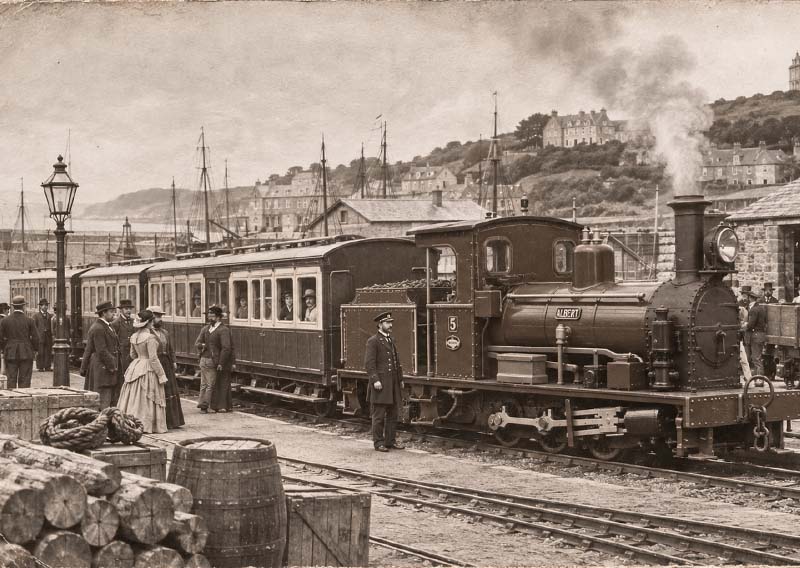
Early passenger service from Porthelan to Talporth c1876
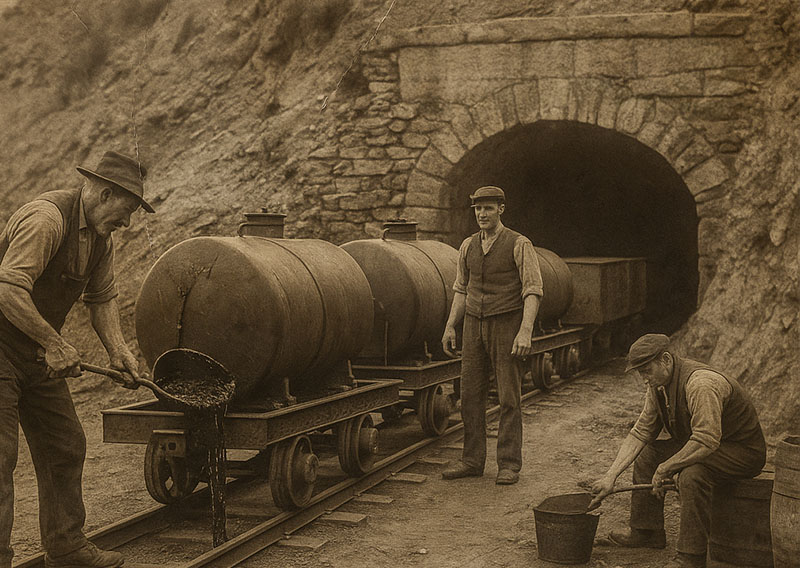
Rathmor Molasses Mine c1880
Gorofan and the Northern Connection
One of the Porthelan Highland Railway's greatest advantages was a route it had inherited rather than constructed. The original Porthelan & Gorofan Timber Tramway had reached the Gorofan district in 1852, establishing a railway corridor from Porthelan Harbour into the mountainous interior of Rathmor. For many years, this line had principally served forestry interests, although its increasing permanence and the introduction of steam traction had made it an important part of the wider railway system. Beyond Gorofan, however, the railway network remained incomplete. To the north, the Talporth & Feorag Railway was extending its own system towards the district, overcoming the considerable engineering difficulties presented by the central Rathmor landscape. The completion of the Glen Feorag Viaduct in 1875 was a major achievement in this expansion. The viaduct enabled the Talporth & Feorag Railway to continue its advance towards Gorofan, bringing the possibility of a direct connection with the Porthelan Highland Railway increasingly close. For the PHR, this was an opportunity of enormous significance. Rather than undertaking the expense of constructing an entirely new railway through the highlands, the company could connect its established route with the approaching railway from the north. The resulting junction would transform the role of the Porthelan–Gorofan line. What had originally been built to transport timber to the coast would become part of a through railway route across central Rathmor.
1876: The First Train Across Central Rathmor
On 1st July 1876, the first through passenger train travelled between Porthelan and Talporth, following the completion of the railway connection at Gorofan. It was a landmark occasion for the Porthelan Highland Railway and for the communities of southern Rathmor. The Talporth & Feorag Railway had finally reached Gorofan, where its tracks joined those of the PHR, creating a continuous railway connection between the two towns. For the first time, passengers could make the journey across central Rathmor by through train. The importance of the occasion extended well beyond the novelty of a new passenger service. Until then, the Porthelan railway system had developed primarily around the requirements of its local industries and harbour. Although passenger traffic was becoming increasingly important, its routes remained largely confined to southern Rathmor. The new connection changed that position dramatically. Passengers travelling from Porthelan could now reach Talporth by rail, while communities along the route gained access to a much wider network of destinations and commercial opportunities. The service also provided new possibilities for merchants, tradesmen and visitors, allowing journeys that had previously required lengthy travel by road or a combination of transport arrangements. For the industries of southern Rathmor, the benefits were equally significant. Timber, minerals and agricultural produce could now move northwards towards Talporth and beyond, while manufactured goods and supplies could be brought south without relying exclusively upon coastal shipping. Porthelan was a beautiful secluded and protected bay, but the harbour was prone to silting up. Only small boats and larger flat bottomed ships could get access, and even then it was tide dependent. The railways created links to deeper water at Talporth and eventually all the way to Llanchala. The opening also strengthened the importance of Gorofan, which had developed from a forestry district into a meeting point between two major railway systems. The first through train of 1 July 1876 therefore represented much more than the completion of a missing section of track. It marked the arrival of a new era in which the Porthelan Highland Railway was no longer merely an industrial railway serving a harbour, but an essential part of Rathmor's developing passenger and freight network.
1876–1879: A Railway Transformed
The years following the Gorofan connection were among the most important in the Porthelan Highland Railway's short independent history. The new through route offered opportunities for traffic that had previously been beyond the company's reach. Industrial freight could travel between southern and northern Rathmor, while passenger services provided an increasingly visible demonstration of the benefits of railway cooperation. The connection also encouraged closer working relationships between the Porthelan Highland Railway and the Talporth & Feorag Railway.
Although the two companies retained their separate identities, their operations were now linked by a route of growing regional importance. The PHR continued to serve its original industries, and Porthelan Harbour remained an essential destination for much of its traffic. Nevertheless, the railway's economic role was changing. The forests, mines and agricultural districts of southern Rathmor were no longer dependent upon a single outlet to the sea. They now possessed an overland railway connection with the northern part of the island. For passengers, the change was equally profound. The introduction of through services strengthened the relationship between the towns and communities along the route and demonstrated the advantages of a more coordinated railway system. These developments came at a time when railway interests across Rathmor were increasingly considering the benefits of consolidation. The Porthelan Highland Railway had already shown what could be achieved by combining several smaller undertakings under common management. Its experience would soon become part of a much larger reorganisation.
Legacy: What Happened Next?
In 1879, the Porthelan Highland Railway became one of the constituent undertakings of the newly formed Rathmor Railway. Its independent existence had lasted just twelve years. Yet during that relatively brief period, the company had transformed the collection of industrial tramways inherited in 1867 into a more unified and important regional railway. It had brought the forestry, mineral and agricultural lines of southern Rathmor under common management, developed a distinctive identity of its own and helped establish Porthelan as a significant railway centre. Above all, the connection at Gorofan and the inauguration of through passenger services on 1 July 1876 had given the railway a role far beyond that originally envisaged by the promoters of its predecessor companies. Under the Rathmor Railway, the former PHR routes became part of a larger network linking the island's towns, industries and harbours. Further railway expansion would follow, including the development of connections towards the eastern districts of Rathmor. In 1885, the opening of the Llyngor Bridge closely followed by the creation of the Glynoch & Rathmor Railway would bring another major stage in the consolidation of the islands' railway systems. By then, the Porthelan Highland Railway had already passed into history as an independent company. Its legacy, however, remained visible in the routes radiating from Porthelan, the industrial branches serving southern Rathmor and the railway connection through Gorofan that had transformed travel across the island. What began as three independent industrial railways had become one company in 1867. By 1879, that company had helped lay the foundations of a railway network spanning Rathmor.
History
Railways
About the PHR
PHR Maps
Porthelan Highland Railway
Related Articles....
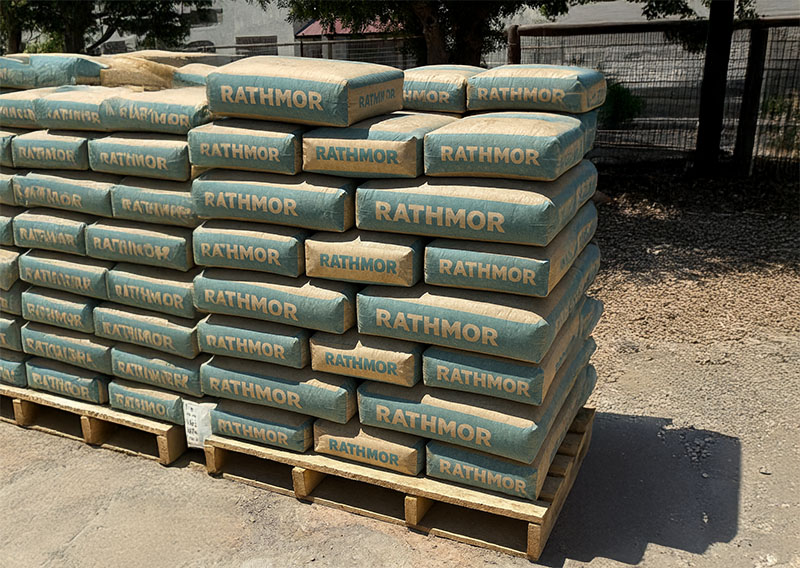
The Cement Works of Porthelan
Porthelan stands as one of Rathmor’s great industrial success stories, […] ...

1852: The Early Railways of Porthelan
From forest tramways and mineral workings to agricultural railways, the […] ...
The Molasses Mine of South Rathmor
Treacle was an unusual resource found on the islands. The […] ...

Railways of Rathmor
Rathmor’s railways are feats of daring engineering, snaking up cliff-sides, […] ...
Explore More Railways of Glynoch and Rathmor....


Island Railways PRE 1880
The railways began their transformation from scattered industrial tramways into […] ...

0 Comments