

1879: The Rathmor Railway
Four Railways Become One. The Company That Transformed Rathmor
History

Railways

About Rathmor Rly
Rathmor Rly Maps
The Rathmor Railway (RR)
At a glance:
Established: 15 August 1879
Island: Rathmor
Operating period: 1879–1885
Principal railway centre: Talporth
Founding companies: Tal Valley Railway (TVR); Talporth & Feorag Railway (T&FR); Porthelan Highland Railway (PHR); Abercain & Gwynhaven Railway (A&GR) |
Principal promoters: Edmund Trevelyan Keveren, 8th Lord Keveren, and Lord Rathmor
Track gauge: 2 ft narrow gauge
Locomotive livery: Rathmor Red
Passenger carriage livery: Cream upper panels and Rathmor Red lower panels
Principal traffic: Passengers, slate, timber, peat, charcoal, minerals, fish, oysters, agricultural produce, livestock and general merchandise |
Major developments: Great Gauge Change (1879); Porthelan–Abercain connection (1880); Falachor Railway (1882); Feorag–Llyngor direct route (1882); Llyngor Bridge (1885) |
Successor: Glynoch & Rathmor Railway, 17 December 1885
Four Railways Become One
On 15 August 1879, four of Rathmor's most important railway companies were united to create the Rathmor Railway, an undertaking whose ambitions would transform the transport geography of the island and, ultimately, the wider Caerwyn Isles. The formation was the culmination of more than two decades of railway development, cooperation and competition. From the slate-producing valleys around Yeyn Keveren to the forests of Gorofan, the harbour of Porthelan and the eastern ports of Abercain and Gwynhaven, railways had steadily extended their influence across Rathmor. Yet much of this expanding network remained divided between independent companies, each pursuing its own commercial interests. The new company was intended to change that. At the centre of the negotiations stood two men whose families had played leading roles in Rathmor's railway history: Edmund Trevelyan Keveren, the 8th Lord Keveren, and his father-in-law, Lord Rathmor. Their partnership brought together commercial ambition, established influence and a shared belief that the island's future depended upon a connected railway network rather than a collection of separate undertakings. Within six years, the Rathmor Railway would connect the island's eastern and western coasts, open new routes through some of its most difficult mountainous country and undertake the construction of the extraordinary Llyngor Bridge. These achievements came at a considerable price. By 1885, the company had created the foundations of a railway system spanning several islands, but the financial burden of its ambitions would help bring its independent existence to an end. The Rathmor Railway lasted little more than six years. Its legacy would endure for generations.
Rathmor Railway Timeline
Talporth & Feòrag Railway
Abercain & Gwynhaven Railway
Tal Valley Railway
Porthelan Highland Railway
Rathmor Railway
Glynoch & Rathmor Rly
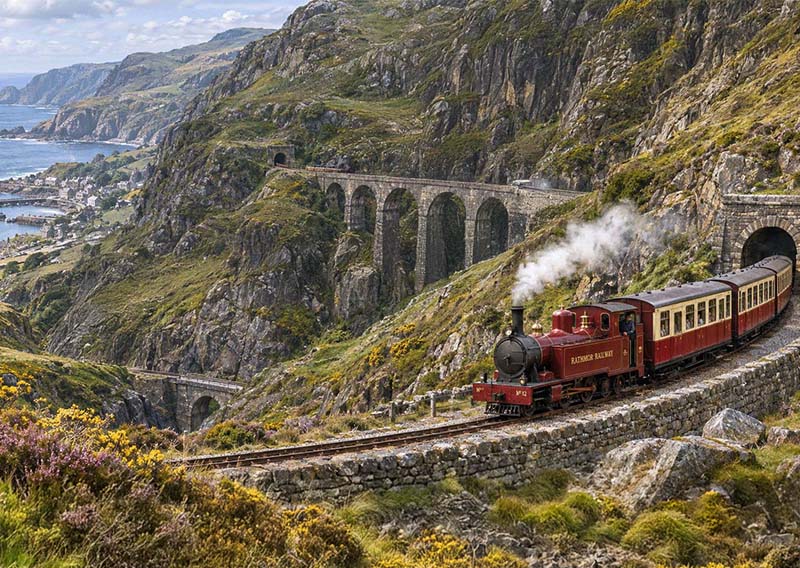
Descending towards Falachor
Origins
The Rathmor Railway did not begin with the construction of a new line. It began by bringing together four established railway systems whose histories stretched back to the middle of the nineteenth century. The first three railways were already physically connected and had already developed an established co-operative working arrangement...
1862: The Tal Valley Railway
The oldest railway tradition among the founding companies belonged to the Tal Valley. In 1845, the Keveren family had supported the construction of a horse-worked tramway carrying slate from the quarries around Yeyn Keveren towards Talporth. Although successful, its steep inclines, sharp curves and lightly constructed track increasingly restricted the growing mineral trade. Edmund Trevelyan Keveren recognised that a more substantial railway was required. Inspired by the steam-operated railways of neighbouring Glynoch, he promoted an entirely new route, designed from the outset for locomotives and passenger services. The Tal Valley Railway opened in 1862, providing a dependable mineral connection and introducing passenger trains to communities that had previously depended upon difficult roads. Its development established Edmund Keveren as one of Rathmor's most determined railway promoters.
1860: The Talporth & Feorag Railway
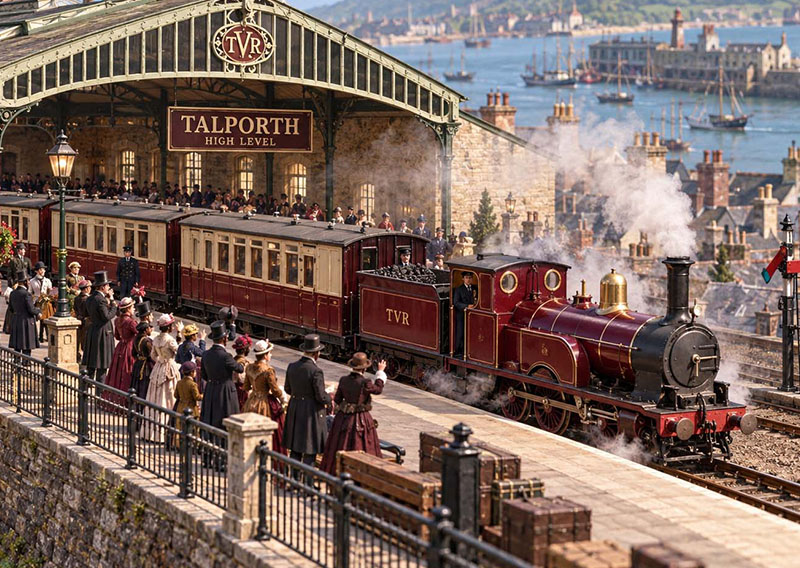
Two years earlier, in 1860, the Talporth & Feorag Railway had opened under the patronage of Lord Rathmor. Unlike the original Tal Valley Tramway, the T&FR was conceived as a public passenger and goods railway from the start. Its trains carried timber, charcoal, peat and general merchandise, while visitors increasingly travelled into the wooded valleys and uplands around Feorag. The two companies initially approached Talporth from different directions, but their interests soon converged. In 1862, the Tal Valley Railway and Talporth & Feorag Railway jointly developed a new bridge across the Tal River and established Talporth High Level station. A connecting harbour loop and tunnel also improved access to the docks. The opening of the Talporth Funicular Railway on 3 October 1863 completed another important part of the town's developing transport system. These projects demonstrated what could be achieved when independent railway companies worked together. The relationship between their principal supporters also became a family connection when Edmund Keveren married Lady Eleanor Rathmor, daughter of Lord Rathmor and Lady Constance. The partnership that would eventually create the Rathmor Railway was already taking shape.
1867: The Porthelan Highland Railway
Southern Rathmor possessed a very different railway tradition. Here, the earliest lines had been constructed to serve the forests, mines and agricultural districts surrounding Porthelan. The Porthelan & Gorofan Timber Tramway had reached the Gorofan district by 1852. The South Rathmor Mineral Tramway followed around 1855, while the Southern Peninsular Railway developed agricultural connections from 1859. These three undertakings were united on 1 January 1867 to create the Porthelan Highland Railway. The company inherited a varied network of forestry branches, mineral lines, agricultural routes and harbour connections. Its greatest breakthrough came in 1876. Following completion of the Glen Feorag Viaduct in 1875, the Talporth & Feorag Railway extended its route towards Gorofan, where it finally connected with the existing Porthelan system. On 1 July 1876, the first through passenger train travelled between Porthelan and Talporth. For the first time, southern Rathmor possessed a continuous railway route across the mountainous interior to the western harbour. The success of this connection demonstrated the advantages of cooperation on a much greater scale.
1860: The Abercain & Gwynhaven Railway
Meanwhile, over on the far east of Rathmor the fourth constituent company presented a rather different challenge. The Abercain & Gwynhaven Railway had opened in 1860, linking the two important eastern coastal towns. Its promoters, Edward P. Trevellan of Abercain and Thomas R. Curnow of Gwynhaven, had established a substantial passenger and goods railway supported by investment from the Caerwyn Isles Steam Packet Company. Unlike the other railways of Rathmor, however, the A&GR had been constructed to the British standard gauge of 4 ft 8½ in. Its larger locomotives and spacious carriages were regarded as evidence of modern engineering and passenger comfort. For almost twenty years, the railway prospered independently, carrying passengers, oysters, fish, agricultural produce, brewery products and merchandise between its two termini. But the expansion of Rathmor's narrow-gauge network gradually exposed the disadvantages of its isolation. The A&GR could not exchange locomotives or wagons with neighbouring railways, and any future connection would require expensive transshipment facilities unless the difference in gauge could be resolved. Its incorporation into the proposed Rathmor Railway became one of the most contentious parts of the consolidation.
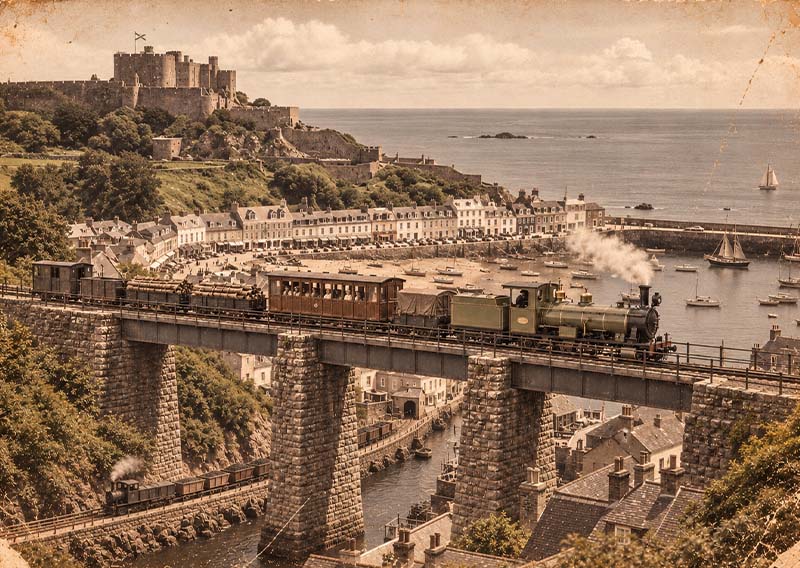
Talporth
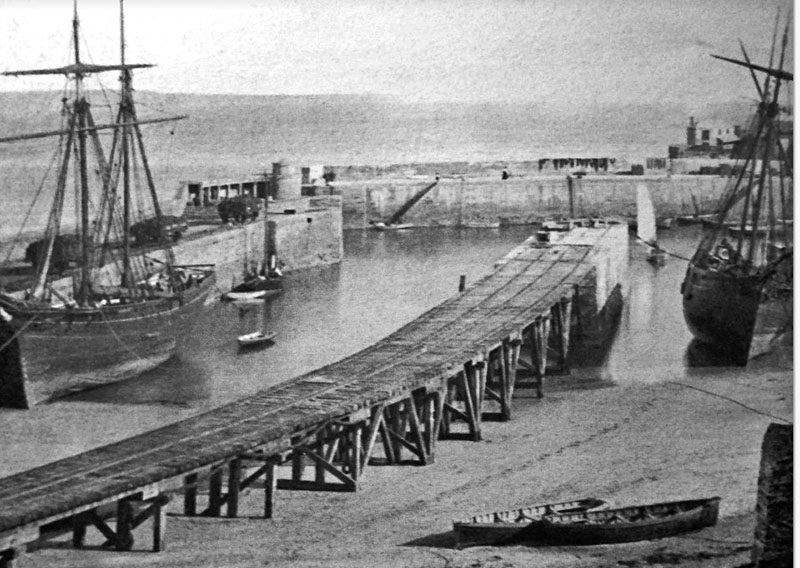
The railway jetty at Porthelan Harbour c1880
1879: The Great Railway Amalgamation
By the late 1870s, Rathmor's railway development had reached a decisive moment. The Tal Valley Railway and Talporth & Feorag Railway had already demonstrated the practical advantages of cooperation. The connection at Gorofan had linked northern and southern Rathmor, while the Porthelan Highland Railway had shown how several smaller industrial undertakings could be successfully operated under one management. Yet the island still lacked a single organisation capable of planning major infrastructure projects across the entire network. Edmund Trevelyan Keveren believed that the solution lay in consolidation. As the 8th Lord Keveren, he possessed both the influence and the commercial experience necessary to promote such an undertaking. His father-in-law, Lord Rathmor, brought the support of another prominent family whose interests had long been associated with railway development around Talporth and Feorag. Together, they championed the creation of a railway company capable of coordinating passenger services, managing industrial freight and undertaking projects beyond the financial resources of the smaller companies. The proposed amalgamation offered substantial advantages. Locomotives and rolling stock could be allocated across a larger system. Freight could travel between districts without the complications of separate company arrangements. Passenger timetables could be coordinated, and capital investment could be directed towards connections of wider regional importance. But the proposal was not without opposition.
The Shipping Company's Objections
The most determined resistance came from the Caerwyn Isles Steam Packet Company, a major shareholder in the Abercain & Gwynhaven Railway. For nearly twenty years, the Steam Packet Company had benefited from passengers and merchandise arriving at Gwynhaven by train and transferring to its vessels. A connected railway system threatened to alter that relationship. If goods could travel directly across Rathmor towards Talporth and, eventually, Llanchala, merchants might no longer require the shipping services upon which the company's business depended. The directors feared that the railway they had helped finance would become a competitor to their own vessels. Despite these objections, the movement towards consolidation continued. On 15 August 1879, the Tal Valley Railway, Talporth & Feorag Railway, Porthelan Highland Railway and Abercain & Gwynhaven Railway formally became the Rathmor Railway. Lord Rathmor lent his standing and influence to the undertaking, while Lord Keveren provided much of its commercial and strategic direction. The new company inherited an extensive railway network, substantial industrial traffic and a collection of ambitious projects. It also inherited one particularly inconvenient problem. One of its principal routes was built to the wrong gauge.
A New Identity: Rathmor Red
The formation of the Rathmor Railway brought together not only four railway networks, but four different operating traditions. Each constituent company had developed its own identity, reflected in its locomotives, carriages, working practices and relationships with the communities it served. The directors recognised the importance of establishing a distinctive appearance for the new undertaking. The chosen colour was Rathmor Red, a rich and unmistakable shade that would become closely associated with the island's railway history. Locomotives were painted Rathmor Red, while passenger carriages received an attractive two-tone finish, with cream upper panels and Rathmor Red below. The contrasting colours gave the company's passenger trains a particularly elegant appearance, especially when passing through the wooded valleys and mountainous scenery of Rathmor. The new livery also provided a visible symbol of the amalgamation. Where travellers had once encountered trains belonging to several independent companies, they would increasingly see the colours of a single railway. Repainting the inherited locomotive and carriage fleets was necessarily a gradual process, and the colours of the former companies would not disappear overnight. Nevertheless, Rathmor Red soon became the defining colour of the new undertaking. The distinctive livery would remain an important part of the railway's identity during its brief independent existence and provide a lasting reminder of the company that had brought Rathmor's railways together.
November 1879: The Great Gauge Change
The conversion of the former Abercain & Gwynhaven Railway was among the new company's earliest and most remarkable achievements. For nineteen years, the railway had operated to standard gauge, entirely separate from the 2 ft narrow-gauge system developing elsewhere on Rathmor. With a new connection from Porthelan towards Abercain already planned, this difference could no longer be tolerated. The Rathmor Railway therefore authorised the conversion of the entire Abercain–Gwynhaven route to the island's established narrow gauge. Rather than undertaking the work gradually, the company planned an extraordinary operation. The railway would be closed for a single weekend, during which its track would be converted for narrow-gauge operation. The undertaking required careful preparation. New sleepers and track materials had to be assembled, work gangs organised and arrangements made for the removal or alteration of existing rails. Stations, sidings and operational facilities also required attention. The final standard-gauge services ran before the weekend closure, and on Saturday 15 November 1879, teams of railway workers descended upon the line. Throughout Saturday and Sunday, platelayers, engineers and labourers worked to transform the railway. Rails were repositioned, points and crossings adapted, and the route prepared for the smaller locomotives and rolling stock that would operate over it. Much of the success of the operation depended upon the extensive preparations made during the preceding weeks. By Sunday evening, the work was sufficiently advanced for the railway to prepare for reopening. On Monday 17 November 1879, the first narrow-gauge train successfully travelled over the converted route. The achievement was greeted as a remarkable demonstration of railway engineering and organisation. An entire railway had been transformed in a single weekend.
The following day, Tuesday 18 November 1879, the *Caerwyn Chronicle* celebrated the accomplishment under the headline:
THE GREAT GAUGE CHANGE!
The conversion also marked the end of the A&GR's distinctive original standard-gauge locomotives and passenger rolling stock, which could no longer operate over the altered track. For the people of Abercain and Gwynhaven, the change represented far more than a technical adjustment. Their railway was no longer an isolated coastal undertaking. It was preparing to become part of a network stretching across Rathmor. The Great Gauge Change would enter railway history as one of the most memorable achievements of the company's early years.

The great regauging, November 1879

Caerrwyn Chronical - November 1879
1880: Rathmor Connected from Coast to Coast
The purpose of the gauge conversion became clear the following year. In 1880, the Rathmor Railway completed the new line from Porthelan eastwards to Abercain, where it joined the recently converted Abercain & Gwynhaven route. The connection created a continuous railway corridor between Rathmor's western and eastern coastal districts. Passengers could now travel from Gwynhaven or Abercain, through Porthelan, continuing northwards into the central highlands at Gorofan and onwards to Feorag and Talporth. For the first time, the island's principal ports were connected by a unified railway system. The commercial consequences were considerable. Fish and oysters from Abercain could be carried westwards towards new markets. Agricultural produce from Gwynhaven and the eastern districts could travel inland, while slate, timber, minerals and manufactured goods moved across the island without the need for repeated transfers between separate railway companies. The new connection also integrated smaller mineral and industrial tramways serving the hills behind Abercain. Porthelan benefited particularly from the development. Although its harbour occupied a sheltered bay, silting and tidal restrictions limited the vessels able to use it. The new railway connections offered access to alternative ports and larger markets, reducing the town's dependence upon its own harbour facilities. The east–west route was an important commercial success, demonstrating the advantages that Lord Keveren and Lord Rathmor had envisaged when promoting the amalgamation. But the new company had already begun looking towards more difficult country.
The Southern Ambition: Falachor and Falachfaen
The southern and south-western districts of Rathmor had long occupied an important place in Edmund Keveren's railway ambitions. Even before the opening of the Tal Valley Railway in 1862, he had considered the possibility of extending railway transport beyond Yeyn Keveren into the remote coastal districts. The region possessed valuable slate deposits, mineral workings and fishing communities, but its mountainous geography made transport difficult. The Rathmor Railway now possessed the organisation and resources necessary to attempt the project. In 1880, a new bridge at Yeyn Keveren enabled construction to proceed southwards from the established Tal Valley route. The ultimate objective was Falachfaen, whose slate workings and harbour promised substantial commercial traffic. Before reaching Falachfaen, however, the railway would have to descend from the highland plateau towards Falachor.
1882: The Railway Reaches Falachor
The descent to Falachor presented formidable engineering difficulties. The country was dominated by steep valleys, ridges and cliffs, leaving little opportunity for a conventional railway alignment. The engineers adopted an extraordinary solution. Three tunnels were driven through the mountainous terrain, while two great spiral loops allowed trains to lose altitude gradually as they descended towards the coast. These loops became among the most remarkable features of the Rathmor railway system. Passengers could look across the valleys and glimpse the same railway far above or below them, sometimes watching their train curve around a hillside before crossing a viaduct on another level. In late 1882, the line finally reached Falachor. The opening transformed the isolated fishing community. Fish could now be transported inland by rail, while supplies, merchandise and passengers reached the town without depending upon the difficult coastal roads or sea transport. For the Rathmor Railway, the achievement demonstrated its ability to undertake major engineering works in some of the island's most challenging terrain. Yet Falachor was never intended as the only route to the south west. The company remained determined to find a route to Falachfaen.
The Troubled Falachfaen Extension
Beyond Falachor, the engineering difficulties became even greater. The route towards Falachfaen branched off the Falachor route about half way along the journey from Yeyn Keveren. It was forced along the southern coast beneath the jagged Trevelyan Heights, where cliffs, unstable rock and narrow ledges made construction exceptionally hazardous. The project suffered repeated setbacks. Rockfalls buried completed sections of formation. Tunnels collapsed during excavation. Bridges, retaining walls and protective works consumed increasing sums of money. The railway became notorious for its difficulties. Some local inhabitants began describing the project as cursed, while petitions were raised calling for its abandonment. Nevertheless, the Rathmor Railway continued construction, convinced that the mineral traffic and commercial opportunities at Falachfaen would eventually justify the expense. By 1885, the project had become a considerable financial burden. During the night of 24–25 October 1885, the Great Falachfaen Storm struck the exposed southern coastline. The storm caused catastrophic damage to the railway works around the Seven Tunnels section and Hatherley's Shelf, destroying or seriously damaging approximately half a mile of formation. Sea walls were breached, sections of trackbed scoured away, and completed engineering works left in ruins. The disaster brought further delays and enormous additional costs. The Rathmor Railway would not survive as an independent company long enough to complete the line. It would fall to its successor, the Glynoch & Rathmor Railway, to persevere with the project. On 27 September 1890, almost ten years after construction had begun, the railway finally reached Falachfaen. The achievement was one of the great engineering triumphs of the islands, but its origins lay firmly in the ambitions of the Rathmor Railway.

Hatherleys Ledge severely damaged 1885

Caerwyn Chronicle, October 26th 1885
1882: A Faster Route to Llyngor
While the southern extensions were progressing, another major project was taking shape in northern Rathmor. The existing railway connection between Feorag and Llyngor had developed from the Feorag Forestry Company's railway, originally constructed in 1862. Although valuable for timber, stone and local passenger traffic, the route was winding and relatively slow. Its alignment reflected its industrial origins rather than the requirements of a major passenger and freight corridor. Lord Keveren had a much more ambitious objective. For years, he had considered the possibility of connecting Rathmor directly with the neighbouring island of Little Rathmor, opening a railway route towards the deep-water harbour at Llanchala. The existing line to Llyngor was poorly suited to the traffic such a connection would generate. Thanks to the existence of the Glen Feorag Viaduct, the Rathmor Railway saw an opportunity to construct a faster route between Feorag and Llyngor, avoiding the heavy gradients and winding valley route of the Llyngor Valley Railway, designed to provide a more suitable approach to the proposed inter-island bridge. The new railway opened in 1882. It offered a more direct route to the northern coast, bypassing the slower and more circuitous alignment of the independent Llyngor Valley Railway. Although the bridge itself remained unfinished, the new route represented an important investment in the future. The Rathmor Railway was constructing the railway infrastructure required for an inter-island connection before the connection itself existed. Both routes between Feorag and Llyngor would remain important, with the older line continuing to serve local and industrial traffic. The new route, however, was destined to become one of the principal arteries of the expanding railway network.
Llyngor Bridge: Lord Keveren's Great Ambition
Of all the projects undertaken by the Rathmor Railway, none was more ambitious or consequential than Llyngor Bridge. The proposed crossing would link Rathmor with Little Rathmor, connecting the railway systems of the two islands and opening the possibility of through services towards Glynoch. For Lord Keveren, the project had considerable commercial importance. The slate and mineral industries associated with his family's interests required dependable access to export markets. Talporth had long served as an important outlet, but its harbour was increasingly restricted by shallow water and the growing size of merchant vessels. Llanchala, by contrast, offered substantial deep-water harbour facilities and established international shipping connections. A railway bridge across The Straights promised to transform the movement of freight between the islands. Rather than relying upon coastal vessels or complicated transfers, goods could travel directly by rail towards Llanchala. The bridge also offered enormous opportunities for passenger traffic. For the first time, a continuous railway journey between Rathmor and Glynoch would become possible.
A Bridge Against the Odds
The construction of Llyngor Bridge proved extraordinarily difficult. The waters and seabed of The Straights presented major engineering challenges. Piles intended to support the structure sank into unstable quicksands, while storms repeatedly interrupted work. The project also encountered opposition from shipping interests concerned that the crossing might obstruct navigation or divert traffic away from established maritime services. Twice during construction, vessels struck the bridge works. Whether these incidents were accidents or deliberate acts of sabotage became a subject of local speculation, particularly among those who believed shipping companies were determined to prevent the railway connection. The greatest tragedy came when a violent storm in December 1883 destroyed a substantial portion of the unfinished structure, claiming the lives of railway workers. The disaster cast a shadow over the undertaking. Even after construction resumed, stories circulated about the men lost beneath the waters of The Straights. The bridge would eventually acquire a reputation for being haunted, a legend that persisted long after its opening. But neither the engineering difficulties nor the mounting costs persuaded Lord Keveren to abandon the project. He was determined that the connection should be completed. There was also a deeply personal reason for his determination. Lord Rathmor, his father-in-law and fellow railway promoter, had supported the development of Rathmor's railways for decades. Keveren wanted him to live long enough to witness the completion of the great bridge.
17th September 1885: The Islands Are Joined
On Thursday 17th September 1885, the long-awaited Llyngor Bridge officially opened. The achievement marked a turning point in the history of the Caerwyn Isles. For the first time, trains could cross directly between Rathmor and Little Rathmor, connecting with the wider railway network towards Glynoch. The new faster route from Feorag to Llyngor, completed three years earlier, now fulfilled the purpose for which it had been constructed. At the opposite end of the bridge, the newly established Caerwyn Junction Railway provided the essential connection to Little Rathmor's existing east–west railway system. The bridge transformed the commercial possibilities of the islands. Minerals from Yeyn Keveren, timber from Gorofan, fish and oysters from the eastern ports, and agricultural produce from across Rathmor could now reach the railway routes towards Llanchala. Passengers gained new opportunities for longer journeys across the islands, while the railway companies involved began coordinating services on an unprecedented scale. The Rathmor Railway's distinctive red locomotives and red-and-cream carriages now had the opportunity to travel beyond their home island, providing a striking contrast with the liveries of neighbouring railway companies. Lord Rathmor lived to see the bridge opened, fulfilling one of Edmund Keveren's most cherished ambitions. Yet the celebrations concealed a serious financial problem. The Rathmor Railway had invested heavily in the bridge, the new northern approach, the eastern connection and the difficult southern extensions. Its network had expanded dramatically, but so had its financial obligations. The company had achieved much of what its founders had envisaged. The question was whether it could continue independently.
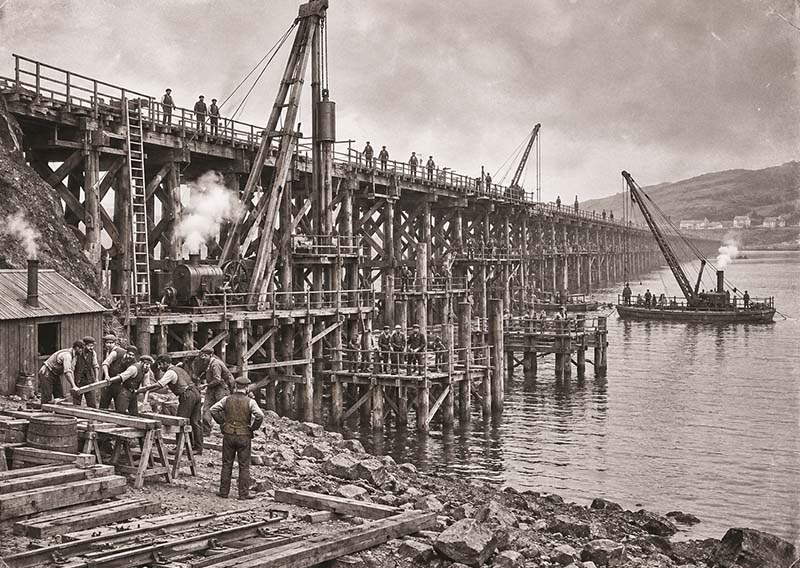
Llyngor Bridge under construction c1884
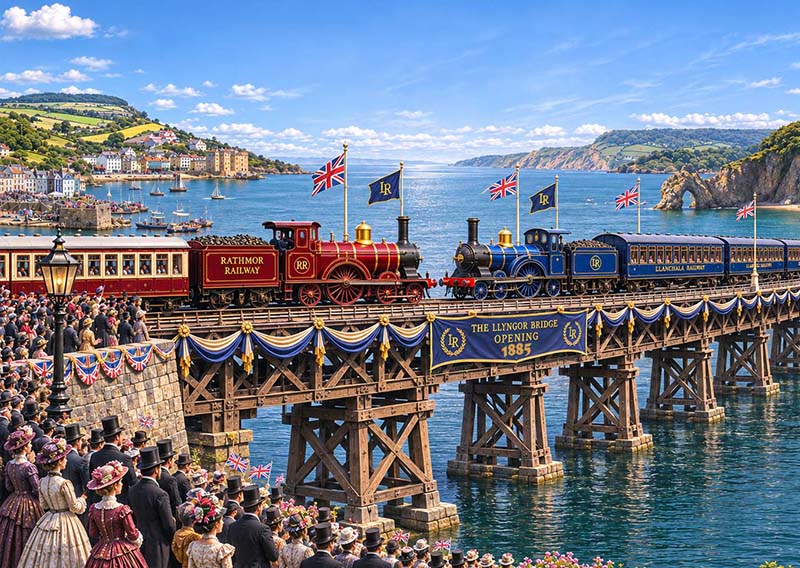
Llyngor Bridge opening day, 17th September 1885
17th December 1885: The Birth of the Glynoch & Rathmor Railway
The opening of Llyngor Bridge created a new railway geography. For the first time, the principal railway systems of Rathmor and Glynoch could operate as parts of a connected transport network. The Rathmor Railway possessed extensive routes, valuable industrial traffic and major infrastructure, but it also carried the financial burden of its ambitious construction programme. On Glynoch, Llanchala Railway Ltd occupied a very different position. Formed in 1876 under the leadership of Edward H. Ashcombe, the company had developed into a financially successful passenger and freight undertaking. Its strength lay partly in its ability to negotiate running rights and coordinate services across railway lines belonging to other companies. The Llanchala Railway also enjoyed close commercial relationships with the shipping interests serving Llanchala's important harbour. The completion of Llyngor Bridge brought the two companies into a much closer relationship. For the Rathmor Railway, cooperation offered access to established commercial markets and a financially stronger railway partner. For the Llanchala Railway, the Rathmor network offered extensive new passenger destinations and valuable mineral and agricultural traffic. Informal discussions had started in early 1885 as the bridge neared completion. After the bridge opened the advantages of consolidation became increasingly clear. Within three months of the bridge opening, the two companies agreed to unite their interests. On 17th December 1885, the Rathmor Railway and Llanchala Railway Ltd formally united to create the Glynoch & Rathmor Railway. The merger was not simply a rescue of a financially overextended company. It brought together two complementary railway systems, each possessing assets and commercial strengths that would benefit the other. The Rathmor Railway's independent existence had lasted just over six years. But its achievements had laid the foundations for an undertaking that would eventually become one of the defining institutions of the Caerwyn Isles.
Legacy: The Railway That United Rathmor
The Rathmor Railway was one of the most ambitious railway undertakings in the history of the Caerwyn Isles. Its existence was comparatively brief, but the scale of its achievements was extraordinary. In 1879, it inherited four separate railway companies whose origins lay in different industries, communities and commercial ambitions. By 1885, it had transformed them into a connected network serving much of Rathmor. The Great Gauge Change of 15–17 November 1879 had brought the eastern railway into the island's narrow-gauge system. The Porthelan–Abercain connection had created a continuous route between the eastern and western ports. The difficult southern extension had reached Falachor and continued towards Falachfaen, while the new Feorag–Llyngor route prepared the northern railway system for a much greater transformation. Above all, the opening of Llyngor Bridge on 17 September 1885 had connected Rathmor with the neighbouring islands and opened the way for through railway services towards Llanchala. The company's Rathmor Red locomotives and distinctive red-and-cream carriages had become familiar throughout the island, providing a unified identity for a railway system that had once been divided between independent undertakings. These achievements were inseparable from the ambitions of Lord Keveren and Lord Rathmor. Their partnership had begun with the cooperation of two railway interests at Talporth and developed into a vision of an island-wide transport system. Yet the history of the Rathmor Railway also demonstrated the dangers of excessive ambition. The same projects that transformed the island placed enormous demands upon the company's finances, ultimately encouraging the consolidation that brought its independent existence to an end. The Glynoch & Rathmor Railway inherited not merely the tracks, locomotives and rolling stock of its predecessor, but an extraordinary collection of engineering achievements and unfinished ambitions. The Rathmor Railway had connected the island. Its successor would carry that network into a new era.
History
Railways
About Rathmor Rly
Rathmor Rly Maps
The Rathmor Railway
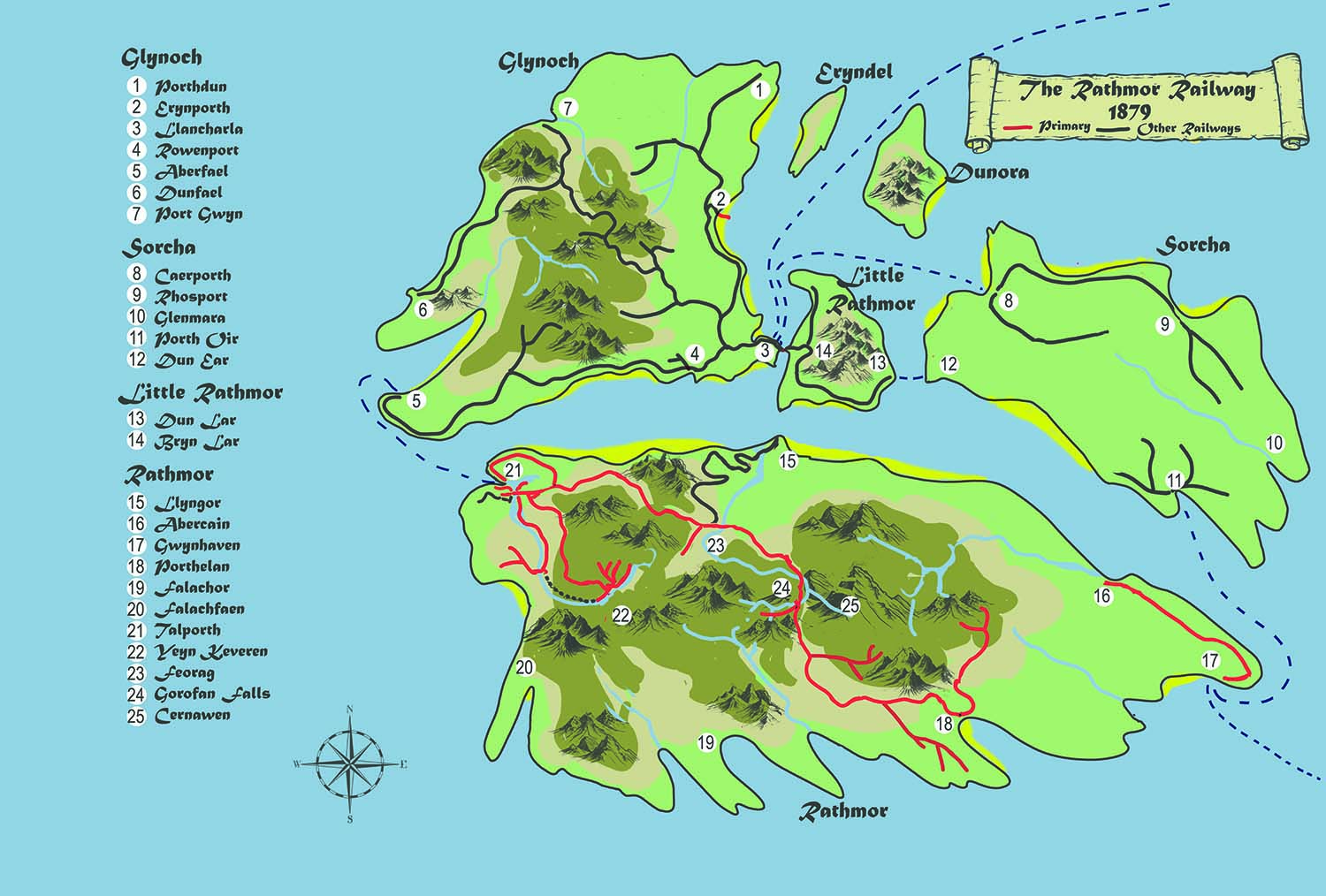
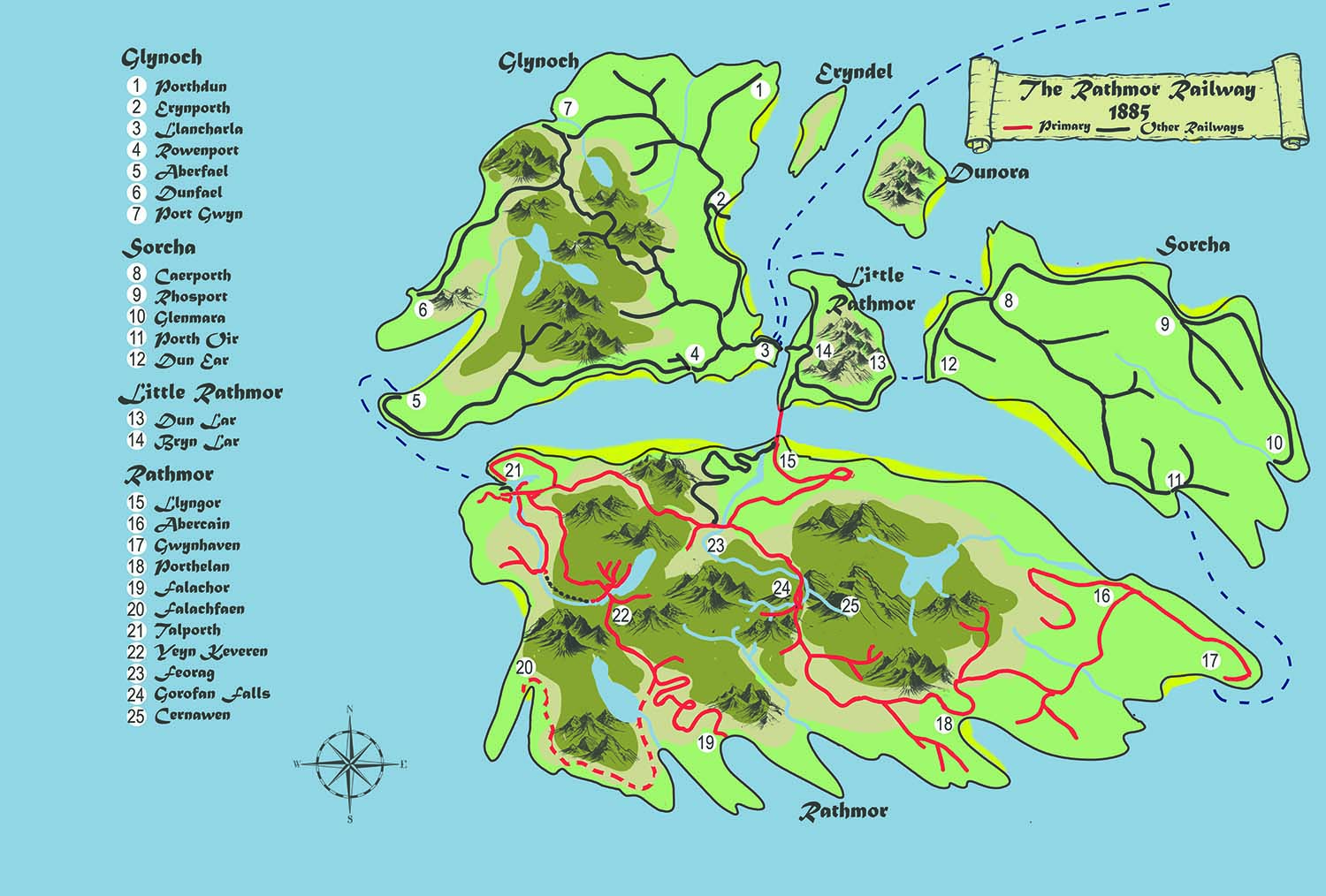
The railway map when the Rathmor Railway was created in 1879
The Rathmor Railway
The railway map in 1885. The Falachfaen extension was still under construction when the RR became a founding member of the Glynoch and Rathmor Railway
Related Articles....
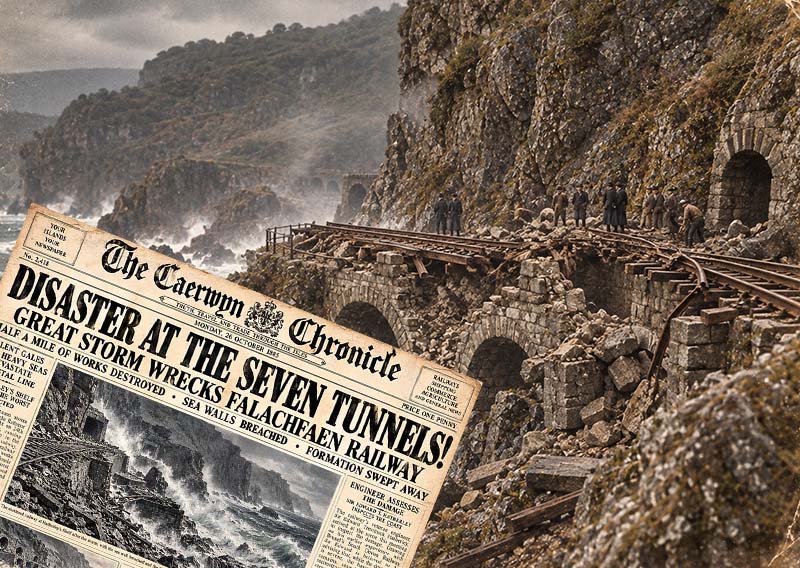
1885: Disaster at the Seven Tunnels!
25th October: Saturday night’s extraordinary storm destroys nearly half a […] ...

Railways of Rathmor
Rathmor’s railways are feats of daring engineering, snaking up cliff-sides, […] ...
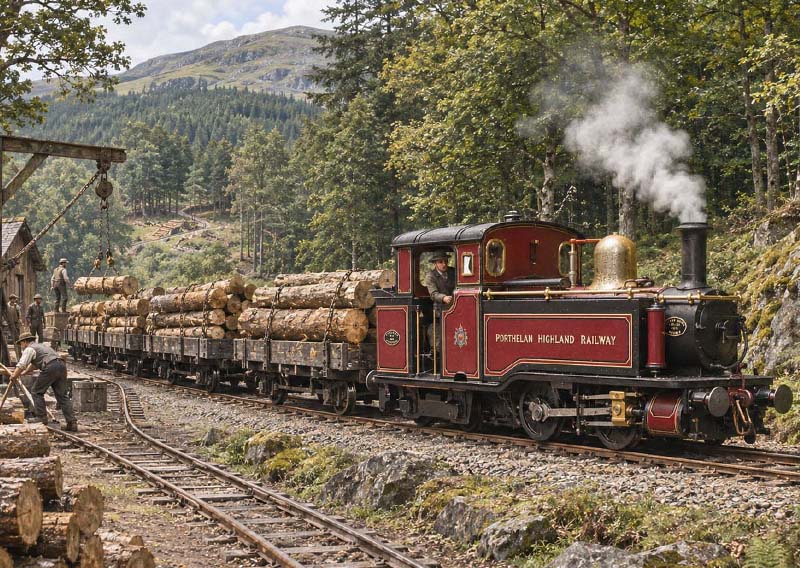
1867: Porthelan Highland Railway
The amalgamation of three independent railways around Porthelan transforming industrial […] ...
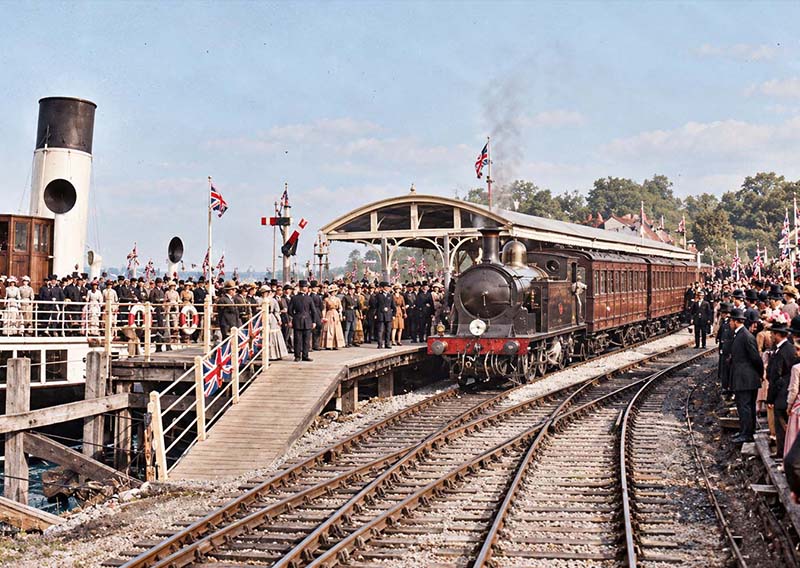
1860: Abercain & Gwynhaven Railway
Rathmor’s standard-gauge experiment. A railway built to serve the shipping […] ...
Explore More Railways of Glynoch and Rathmor....


0 Comments