



1951: The Big Beast Takes to the Hills
29th October: Just seven days after arriving the enormous new NGG16 Garratt locomotive undertook its first major loaded proving run.
The Big Beast Takes to the Hills
On this day in 1951, just seven days after arriving in the Caerwyn Isles from South Africa, the Glynoch & Rathmor Railway's enormous new NGG16 Garratt locomotive undertook its first major loaded proving run. Known affectionately as The Big Beast, G&R No. 138 had been reassembled at Bryn-Lar Works following its arrival aboard SS Cape Meridian. Now it faced the test for which it had been purchased: hauling a formidable 240-ton freight train from Llanchala, across Llyngor Bridge, through Feorag and into the hills towards Yeyn Keveren. The journey would take the locomotive from the comparatively level coastal railway onto sustained gradients averaging 1 in 50 to Feorag, followed by the more demanding climb towards Yeyn Keveren at an average of 1 in 40, with short sections reaching 1 in 38. For the railway's engineers, the question was not simply whether the locomotive could complete the journey, but whether it could transform the economics of freight transport across the islands.
Our reconstructed newspaper report, dated 30 October 1951, tells the story as readers of the time might have encountered it.

Garratt 138 towards Yeyn Keveren
Caerrwyn Chronical - September 27th 1890
Giant Garratt Conquers Rathmor Gradients: Engineers Praise First Trial
The Glynoch & Rathmor Railway's extraordinary new locomotive, already christened "The Big Beast" by railwaymen, yesterday completed its first major loaded proving run through the hills of Rathmor. The enormous articulated engine, officially numbered 138, hauled a formidable freight train weighing approximately 240 tons from Llanchala, across Llyngor Bridge and through Feorag to Yeyn Keveren, demonstrating the remarkable hauling capabilities for which it was purchased. The trial attracted considerable interest among railway employees and residents along the route, many of whom had never seen a locomotive of such unusual proportions. With its long central boiler carried between two separate power units, the Garratt presents an appearance quite unlike the conventional steam locomotives familiar to passengers and railwaymen throughout the islands. Yet its remarkable construction is no mere novelty. The locomotive has been acquired to answer one of the most pressing difficulties facing the G&R: how to move increasing quantities of freight over a railway where the provision of additional tracks and passing facilities would involve enormous expenditure. Yesterday's performance suggests that the company's engineers may have found an answer.
From Cape Town to Caerwyn
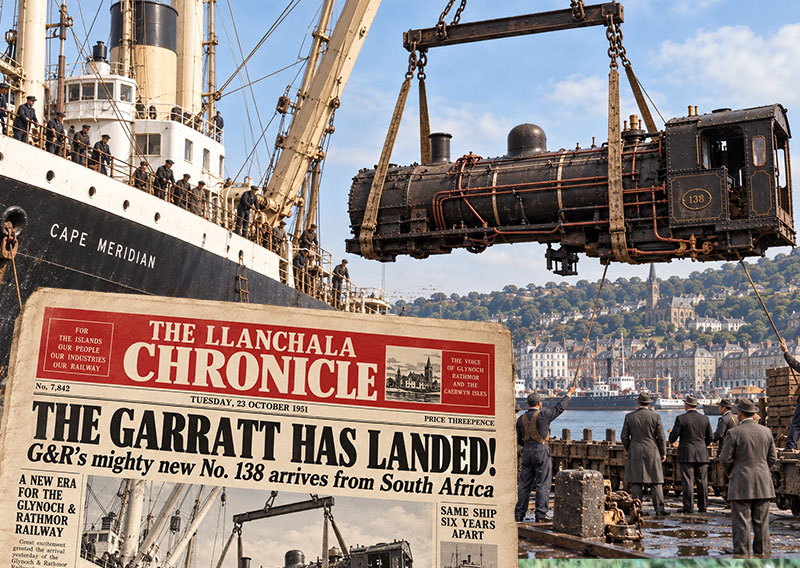
Only a week ago, No. 138 was still being prepared for service following its arrival from South Africa. The locomotive reached Llanchala on Monday, 22 October, aboard the cargo steamer SS Cape Meridian, having travelled from Cape Town in three principal sections. Its two power units and central boiler assembly were landed separately before being transported to Bryn-Lar Works, where the railway's mechanical staff undertook the considerable task of reassembling the machine. The work included reconnecting the locomotive's steam and control systems, examining its motion and bearings, and preparing the completed engine for its first trials upon G&R metals. That such a substantial undertaking should have been accomplished in little more than a week reflects considerable credit upon the men of the railway's mechanical department. No. 138 was constructed by Messrs. Beyer, Peacock & Company of Manchester in 1945 and has already seen service upon the narrow-gauge railways of South Africa. Its arrival has brought to the Caerwyn Isles a locomotive of a type developed specifically for the demanding conditions of narrow-gauge railways carrying heavy traffic through difficult country.
A Railway Running out of Room
The reasons behind the purchase are of considerable interest. During recent years, the G&R has experienced growing demands upon its freight services, particularly those serving the islands' industrial and mineral districts. On several important routes, the railway has reached a point where the introduction of additional trains would require substantial alterations to its infrastructure. Longer passing loops, improved signalling and the provision of additional running lines have all been considered. Such works, however, would involve considerable expense, particularly in the difficult country through which much of the railway passes. The company's alternative has been to investigate whether heavier trains might be hauled over the existing system. If a single locomotive can convey considerably more freight in one journey, the railway may increase its carrying capacity without a corresponding increase in the number of trains. It is a proposition of considerable importance to the future prosperity of the undertaking.

The route taken from Llanchala to Yeyn Keveren
The Colonel's South African Solution
Much of the credit for introducing the Garratt to the Caerwyn Isles belongs to Lieutenant-Colonel Arthur Penrose Davenant, RE, whose experience during the recent war brought him into contact with similar locomotives in South Africa. While serving with the Royal Engineers, Colonel Davenant observed the ability of the NGG16 class to haul substantial loads over narrow-gauge railways. Their articulated construction enables the locomotive to distribute its weight across two powered units while accommodating curves and track formations that would present considerable difficulties to a conventional engine of comparable power. Recognising the possible advantages for the G&R, Colonel Davenant subsequently encouraged the company's board to investigate the purchase of such a locomotive. After enquiries and technical examination, No. 138 was acquired second-hand from South Africa. Yesterday's proving run was therefore a particularly important occasion for the Colonel, who accompanied the trial to observe the performance of the machine he had championed.
The Great Test Begins
The trial commenced at Llanchala, where No. 138 was coupled to a substantial train of loaded mineral and merchandise wagons assembled for the occasion. The trailing load amounted to approximately 240 tons, a formidable burden for a narrow-gauge railway and a deliberate test of the new locomotive's capabilities. Representatives of the railway's locomotive and operating departments were present, together with mechanical staff responsible for recording the engine's performance. The purpose was to examine the Garratt under conditions representative of the heavier freight duties for which it is intended. Particular attention was paid to its ability to start a loaded train, maintain progress upon rising gradients and negotiate the curves encountered along the route. The engine's two power units, working beneath the long central boiler, presented an impressive sight as the train departed. As the locomotive gathered speed, the exhaust from its cylinders rose above the wagons, while the unusual movement of its articulated machinery attracted the attention of railwaymen stationed along the line. For the first part of the journey, the train proceeded along the comparatively level coastal railway towards the Llyngor Bridge over to the hilly testing ground of Rathmor. Here the locomotive had an opportunity to settle into its work before the more demanding stages of the journey began.
Two Hundred and Forty Tons Against the Hills
Beyond Llyngor Bridge, the character of the railway changes considerably. Leaving the low-lying coastal country behind, the line begins its long ascent towards Feorag, climbing at an average gradient of approximately 1 in 50. It was here that the Garratt faced its first sustained examination. The heavy train imposed a considerable demand upon the locomotive, but No. 138 maintained steady progress, its two power units working together to lift the substantial burden towards the higher country. Observers stationed along the route reported the unusual spectacle of the great articulated engine drawing its long procession of wagons steadily uphill. At Feorag, the locomotive replenished its water tanks while the mechanical department's representatives reviewed the observations recorded during the climb. The results were encouraging. But the greatest challenge still lay ahead. Beyond Feorag, the railway continues its ascent towards Yeyn Keveren upon gradients averaging approximately 1 in 40, with several short stretches steepening to the formidable inclination of 1 in 38. It was upon one of these sharper banks that the locomotive faced its sternest examination. As the long train entered the incline, the exhaust became noticeably more forceful and the engine's speed gradually diminished. For several anxious moments, observers wondered whether the enormous load would prove too great. But No. 138 continued steadily upwards, its exhaust echoing across the valley as the last of the loaded wagons cleared the steepest section. The result was greeted with considerable satisfaction by the mechanical department's representatives. Although further trials will be necessary before the railway establishes its official load limits, yesterday's performance provides compelling evidence that the new Garratt will substantially increase the freight-carrying capacity of the G&R.
A Giant Arrives at Yeyn Keveren
At Yeyn Keveren, the arrival of the unusual freight train caused considerable excitement. Railway employees, local traders and townspeople gathered to inspect the enormous machine, whose appearance and proportions differ so greatly from the locomotives ordinarily seen upon the line. The town, long associated with Rathmor's slate industry, has particular reason to welcome any improvement in the railway's ability to move heavy goods. For the district's industries, reliable and economical transport remains essential. A locomotive capable of conveying greater tonnages without requiring additional train movements could provide substantial benefits to producers and merchants alike. The Garratt's arrival was therefore more than a spectacle. It represented a possible new chapter in the industrial development of the region.
A Promising Result, but More Work Ahead
The railway's mechanical department is understood to be satisfied with the general outcome of the first major loaded trial. Detailed examination of the locomotive and its recorded performance will continue, and further running will be necessary before No. 138 can be considered fully proven under the varied conditions encountered across the G&R system. Among the matters requiring attention are fuel and water consumption, the behaviour of the locomotive upon curves, braking arrangements and the practical limits of the loads it may be authorised to haul. The successful completion of the journey does not mean that every question has been answered. Nevertheless, the hauling of a 240-ton train over the sustained gradients between Llyngor, Feorag and Yeyn Keveren represents a significant achievement for the railway's engineering staff. The locomotive which arrived at Llanchala in three great pieces only seven days ago has now hauled a heavy train into the hills of Rathmor. For Colonel Davenant and the men who supported his proposal, it is an encouraging vindication of their confidence. For the G&R, it may prove to be the beginning of an important change in the way freight is conveyed across the islands. And for the railwaymen who have already bestowed upon No. 138 its memorable nickname, there can be little doubt. The Big Beast has taken to the hills and appears entirely at home amongst them.

Glynoch Railway Locomotive Trial Report
What Happened Next
The proving run of 29 October 1951 marked an important step in the introduction of the NGG16 Garratt to the Glynoch & Rathmor Railway. The locomotive had been purchased to address a growing problem: the need to increase freight capacity without undertaking prohibitively expensive infrastructure improvements across difficult and often mountainous terrain. No. 138's articulated design offered the possibility of hauling substantially heavier trains over existing routes, reducing the pressure to provide additional train paths. The successful 240-ton proving run from Llanchala to Yeyn Keveren demonstrated the potential of this approach. Particularly significant was the locomotive's performance on the sustained climb from Llyngor to Feorag, averaging 1 in 50, and the still more demanding ascent towards Yeyn Keveren, averaging 1 in 40 with short sections reaching 1 in 38. Following its initial trials, the Garratt entered G&R service and became particularly associated with heavy freight duties and, in later years, Ministry of Defence traffic. Its extraordinary appearance and impressive hauling capabilities made it one of the railway's most recognisable locomotives. The success of the Big Beast resulted in a number of other large locomotives arriving on the islands, including a second NGG16, a K1 Garratt, an NGG15, and even a Gwalior Pacific, but without these successful early trials of No. 138 none of that would have been possible.
Decades later, No. 138 would enjoy another remarkable chapter in its career when it was loaned to the Welsh Highland Railway during the late 1990s. Following restoration work at Boston Lodge, the locomotive appeared in a striking emerald-green livery and subsequently returned to the Caerwyn Isles retaining its Welsh Highland Railway branding. The exchange also brought two notable locomotives to the G&R: a Double Fairlie and a small quarry hunslet locomotive by the name of Britomart. For all its later adventures, however, the journey of 29 October 1951 remained a defining moment. It was the day the railway's bold South African experiment first demonstrated its promise in the hills of Rathmor.
Related Articles...

1951: The Garratt has Landed!
22nd October: The most extraordinary locomotives ever to join the […] ...

NGG16 Garratt – First Run and Sound Test in 009 Gauge
An early milestone for the NGG16 Garratt project as the […] ...
...View All
More Headlines...
0 Comments