


1951: The Garratt has Landed!
22nd October: The most extraordinary locomotives ever to join the Glynoch & Rathmor Railway arrived at Llanchala
On this day in 1951, G&R No. 138 arrived at Llanchala from South Africa in three enormous pieces. Within days, the NGG16 would become known as the Big Beast.
The cargo steamer SS Cape Meridian had sailed north from Cape Town carrying G&R No. 138, a Beyer, Peacock NGG16 Garratt built in Manchester in 1945. For the sea voyage the locomotive had been separated into its three principal sections: its two powered end units and the great central boiler and cradle section. As the Cape Meridian came alongside at Llanchala, dock workers, railwaymen, G&R officials and curious townspeople gathered to see the unusual cargo brought ashore. Among them was the man largely responsible for No. 138 being there at all: Lieutenant-Colonel Arthur Penrose Davenant RE.

138 arriving at Llanchala, 22nd October 1951

Llanchala Chronical October 23rd 1951
A railway running out of room
By the end of the 1940s, the G&R faced an increasingly awkward problem. Freight traffic was growing, while some of the railway's principal routes were becoming difficult to fit more trains onto. The obvious solution was more infrastructure: longer loops, signalling improvements and, on the busiest sections, additional or double track. But such works would be enormously expensive. Running the trains faster offered little practical answer either. There remained a third possibility. If the railway could not economically provide many more train paths, it could carry more freight in each one. That idea particularly appealed to Davenant.
The Colonel's South African solution
Davenant had served with the Royal Engineers during the Second World War, eventually reaching the rank of Lieutenant-Colonel. His military background gave him a particular interest in transport, infrastructure and the practical business of moving large quantities of men and material efficiently. During wartime service he spent time in South Africa, where he encountered the NGG16 Garratts working on narrow-gauge railways. What impressed him was not simply their unusual appearance or their size. It was their ability to haul substantial trains while spreading their weight across two articulated powered units. Years later, when the G&R board found itself discussing the cost of increasing freight capacity, Davenant remembered what he had seen. His argument was straightforward. Before spending heavily on building more railway, the G&R should investigate whether it could put bigger loads into each train. The mechanical department was asked to examine the idea. Enquiries in South Africa eventually identified No. 138, a 1945-built NGG16 that could be made available second-hand. Following technical examination and negotiations, the board authorised its purchase.

G&R Documentation for the Garratt purchase

Cargo manifest showing the same cargo 6 years apart.
No. 138 was coming to the Caerwyn Isles.
There was a remarkable coincidence in the arrangements made to bring the locomotive home. When No. 138 had left Britain as a new locomotive in 1945, SS Cape Meridian had carried it south to South Africa. Six years later, the same cargo vessel was allocated to carry the same locomotive north again. The Garratt that had left British waters aboard Cape Meridian in 1945 therefore returned aboard her in 1951. This time, however, the locomotive's destination was not Manchester but Llanchala.
The unloading operation became a spectacle in its own right. No. 138 had travelled in three major sections. First were the two enormous powered traction units; the boiler and central cradle formed the third. Each had to be carefully lifted from Cape Meridian and landed at Llanchala under the supervision of dock workers and G&R engineers. Standing with the railway's senior officials was Davenant. For most spectators, the machinery hanging above the quay was something entirely unfamiliar. For the former Royal Engineer, it was the physical arrival of an idea first formed thousands of miles away. Only when all three sections stood ashore could onlookers begin to appreciate the scale of the locomotive the G&R had purchased. Railway tradition later credited an unidentified dock worker with staring at the components and declaring that the thing was less an engine than a “bloody great beast”. Whether those were the precise words is impossible to establish. The name survived. No. 138 would become “The Big Beast”.

On shed at Bryn Lar

At Bryn Lar works shortly after arriving, 1951
Off to Bryn-Lar
Getting the Garratt ashore was only the beginning. The three sections were transferred from Llanchala to Bryn-Lar Works, where G&R engineers began reuniting them and inspecting the locomotive after its voyage. Connections and pipework had to be restored, motion and bearings examined, controls checked and the completed locomotive prepared for steaming. The work attracted considerable attention around Bryn-Lar. No. 138 looked unlike almost anything previously seen on the G&R, and not everyone was convinced that Davenant's South African solution would prove equally successful in the Caerwyn Isles. They would not have long to wait.
A date was set for the first major proving run: Monday, 29 October 1951 — exactly one week after the locomotive arrived. The G&R had no intention of giving its new engine an easy test. The Big Beast would take a substantial freight train from Llanchala, through Feorag and into the hills towards Yeyn Keveren. It was precisely the work for which No. 138 had been purchased. Davenant would be aboard to see whether the locomotive he had championed could deliver what he had promised. On the evening of 22 October, however, that challenge still lay ahead. At Llanchala docks, three enormous pieces of machinery had arrived from South Africa.
Within a week, they would become the Big Beast. But that is story for another day...
FACT BOX — G&R No. 138
Manufacturer — Beyer, Peacock & Co.
Built — Manchester, England
Year built — 1945
Class — NGG16 Garratt
Running number — 138
Length — 14.76 m
Weight — approx. 62 tonnes
Tractive effort — 21,553 lbf
Original service — South Africa
Arrived Caerwyn Isles — 22 October 1951
Ship — SS Cape Meridian
Port — Llanchala
G&R service — From 1951
Principal G&R duty — Heavy freight; later MOD traffic
Railway nickname — The Big Beast

Original build plate of the 138
What Happened Next?
The arrival of No. 138 at Llanchala was only the beginning. Over the following seven days, the three enormous sections of the Garratt were transported to Bryn-Lar Works, where G&R engineers worked to reassemble the locomotive and prepare it for its first major trial. On 29 October 1951, just one week after arriving from South Africa, The Big Beast set out from Llanchala hauling a formidable 240-ton freight train. Its destination was Yeyn Keveren, reached via Llyngor and Feorag, where the locomotive would face sustained gradients of 1 in 50 and 1 in 40, with short stretches as steep as 1 in 38. Could Colonel Davenant's ambitious South African experiment really transform freight transport across the Caerwyn Isles?
Read the next chapter: 1951 — The Big Beast Takes to the Hills!

Garratt 138 towards Yeyn Keveren
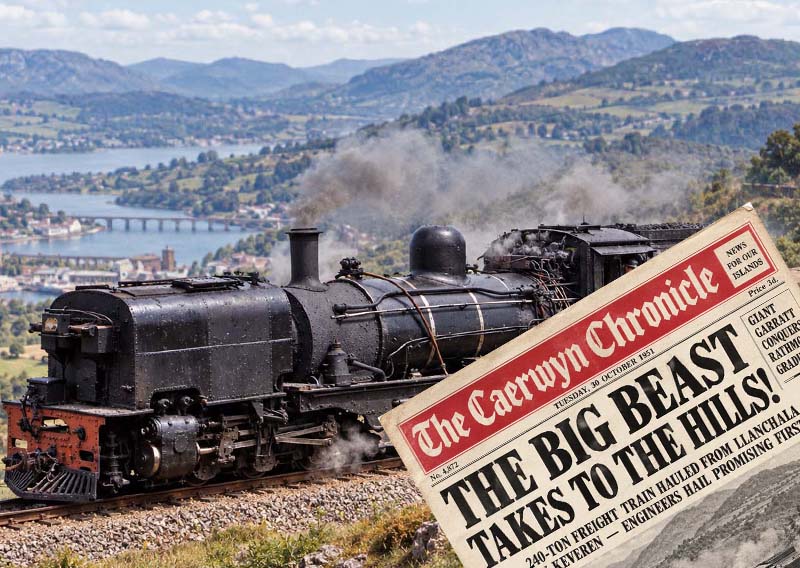
1951: The Big Beast Takes to the Hills
29th October: Just seven days after arriving the enormous new […] ...
Related Articles...


More Headlines...
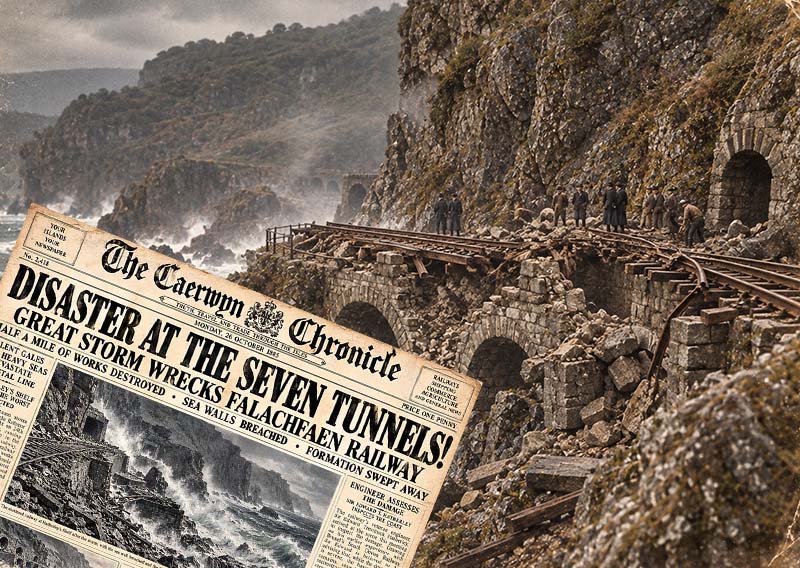
1885: Disaster at the Seven Tunnels!
25th October: Saturday night’s extraordinary storm destroys nearly half a […] ...
0 Comments