


1855: Glynoch Mineral Railway Company
From Llanchala's industrial districts to the mountains and western shores of Glynoch.
History

Railways

About the GMRC
GMRC Maps
Glynoch Mineral Railway Company (GMRC)
At a glance:
Formed and opened: 1855
Island: Glynoch
Headquarters and eastern terminus: Llanchala
Type: Steam-operated mineral railway; central route later mixed-traffic
Southern route: Llanchala to the outskirts of Rowenport, opened 1855
Central route: Progressive highland extensions from 1855; Port Gwyn reached 18 June 1864; Dunfael connected c.1870
Principal traffic: Coal, iron ore, minerals and industrial goods; workers' trains; central-route public passengers from 1864
Southern passenger operation: LSWR under running-rights agreement; GMRC barred from competing on the southern corridor
Original traction: Steam locomotives from opening
Reorganised: 1876
Successors: Llanchala Railway Ltd (southern interests); Glynoch Central Railway (central/highland interests)
Origins: The Minerals of Glynoch
By the middle of the nineteenth century, Llanchala had become a principal industrial and commercial centre of the Caerwyn Isles. Its harbour provided access to coastal shipping, while workshops and merchants created growing demand for coal, iron and other raw materials. Beyond the town, the hills and valleys of southern and central Glynoch offered valuable mineral resources, but heavy cart traffic struggled over poor roads.
Formed in 1855, the Glynoch Mineral Railway Company promised a substantial improvement. Unlike the earlier horse and gravity-worked tramways elsewhere in the islands, the GMRC was planned as a steam railway from the outset. Its original purpose was industrial: to move minerals and supplies efficiently between inland workings and Llanchala. A public passenger railway was not among its founders' original ambitions.
Timeline of the GMRC
Glynoch Mineral Railway Company
Llanchala Railway
Takes over the Southern route to Rowenport
Glynoch Central Rly
Takes over the central and highland routes to the west coast
Glynoch & Rathmor Rly
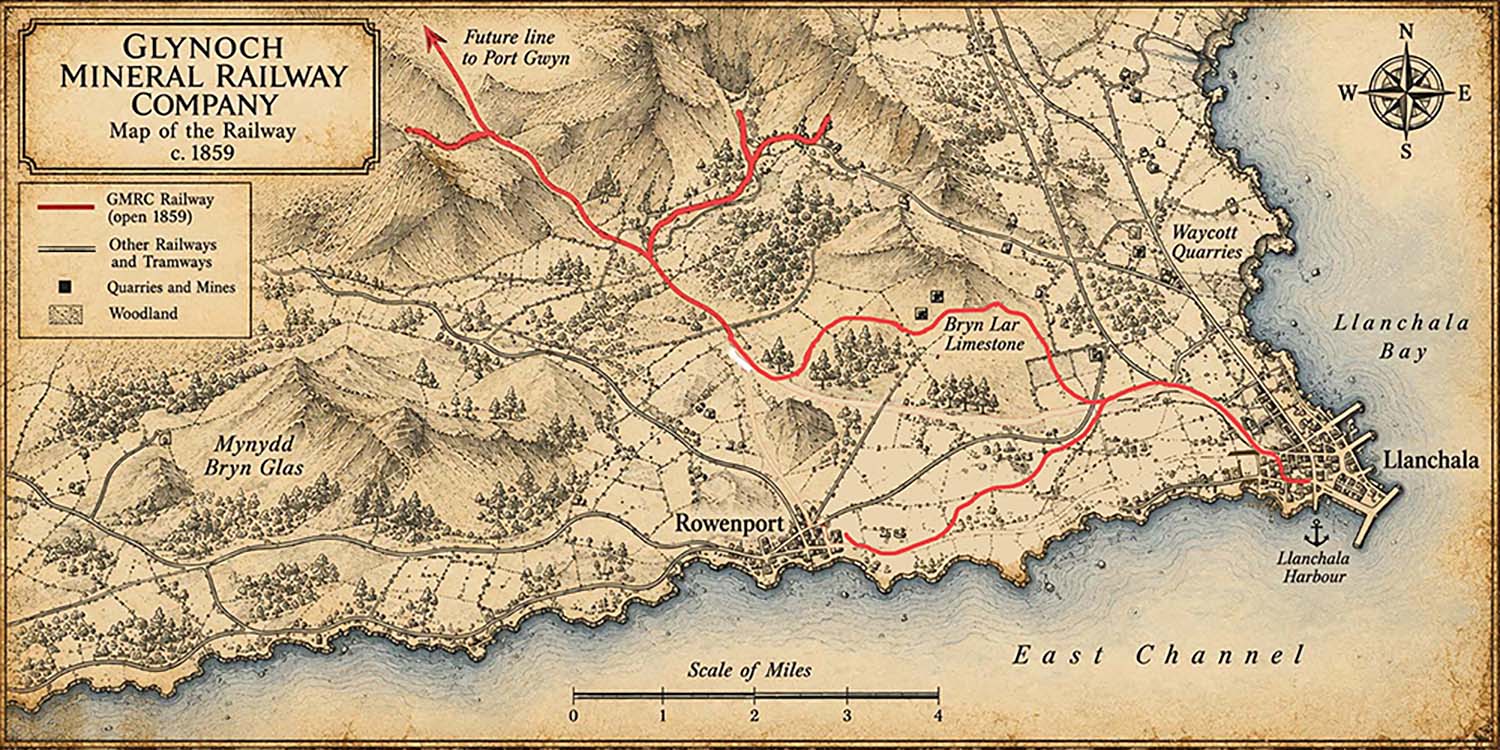
Glynoch Minerals Railway Co - 1859
The Southern Railway to Rowenport
The GMRC's first major achievement came in 1855, when its southern line opened westwards from Llanchala to the outskirts of Rowenport. Following relatively accessible country, the railway linked industrial and agricultural districts while remaining distinct from the estate-owned harbour incline and its associated facilities. Steam locomotives hauled minerals, coal, iron ore and industrial supplies along the new line. The rapid opening demonstrated that the company could build and operate a conventional railway, and it placed GMRC metals in a strategically important position for subsequent south-coast developments. The line did not initially reach Rowenport harbour itself. That distinction mattered when the Llanchala & South West Railway (LSWR) later developed the coast route towards Aberfael, negotiating access and running rights over existing railway infrastructure.
The Passenger Railway That Never Was
The GMRC's founders had concentrated on minerals and industrial traffic, leaving public passenger transport out of their original plans. That decision had an unexpected consequence. When the LSWR secured running rights over the GMRC's southern route between Llanchala and Rowenport, the agreement also prevented the GMRC from running competing passenger services along that corridor and its onward coastal connections. The LSWR could develop passenger traffic over infrastructure the mineral company had helped establish, while the GMRC received running-rights fees but could not operate its own rival passenger trains. The fees were valuable, yet the directors came to recognise the revenue they had surrendered. As the central highland line expanded, the company determined not to repeat the mistake. The southern restriction did not extend into the highlands: the LSWR had no interest in that route, and the GMRC retained the right to introduce passenger trains there when circumstances justified them.

Glynoch Minerals Railway Company
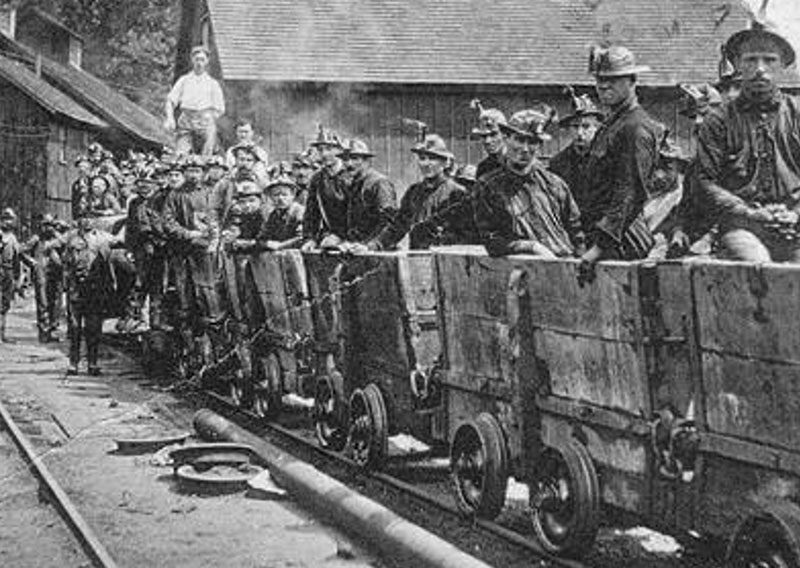
Iron ore workers on Glynoch
Into the Central Highlands
Alongside the southern railway, construction began in 1855 on a second route westwards from the Llanchala district into the central highlands. The terrain presented a very different challenge. Rocky slopes, narrow valleys and changing elevations demanded substantial cuttings, embankments, bridges and careful grading. Rather than completing a single immense project at once, the company advanced progressively. Early sections reached accessible mineral workings; further extensions opened as engineering works were completed and additional traffic became available. By the later 1850s the route had penetrated significantly into the highlands, as shown on maps of Glynoch before 1860, although the railway had not yet reached the western coast. For the moment this was still principally a mineral railway. Trains carried coal, iron ore and other products down from the workings, together with equipment and supplies in the opposite direction. The GMRC also operated workers' trains taking miners and quarrymen from Llanchala towards the highland workings. These were occupational services, not public passenger trains.
Steam traction was central to the GMRC from its first day. The highland extensions placed increasing demands on its locomotives and crews. Steeper gradients and restricted alignments made mineral working more difficult than on the comparatively gentle southern route, while the growth of traffic required additional sidings and maintenance arrangements.
From Mineral Line to Coast-to-Coast Railway
As construction moved westwards, the GMRC's ambitions broadened. New sections could serve timber, agricultural produce, merchants and settlements as well as the mineral workings. A through connection to the western coast offered the prospect of moving goods between ports without long mountain-road journeys or a voyage around the island.
The directors also remembered the missed passenger opportunity on the southern route. The highland line remained under the company's own commercial control, and a future public passenger service was increasingly seen as an important source of revenue.
FROM SEA TO SEA! — Port Gwyn, 18 June 1864
On Saturday 18 June 1864, the GMRC completed and ceremonially opened its railway to Port Gwyn. The achievement established a continuous railway connection from the Llanchala district across the central highlands to Glynoch's western coast. The opening was a landmark not only in engineering but in the company's business. Public passenger services began on the central route following the Port Gwyn connection, joining the mineral traffic and existing workers' trains. The GMRC had become a genuine mixed-traffic undertaking, even though its southern line remained subject to the LSWR passenger restriction. The new railway offered Port Gwyn access to inland and eastern markets, while Llanchala gained a direct connection with western coastal commerce. Mineral traffic remained important, but the company could now carry passengers and general merchandise across the island under its own name.
Why the Mineral Name Survived
After 1864, the company's activities had grown far beyond its original mineral business. Its central route carried passengers, workers, merchandise and industrial freight, while the southern line continued to earn income from its own freight operations and LSWR running-rights payments.
A new name might have better reflected this wider purpose. Nevertheless, the founders insisted that the Glynoch Mineral Railway Company name should be retained. It remained in use throughout the company's final twelve years, until the reorganisation of 1876.
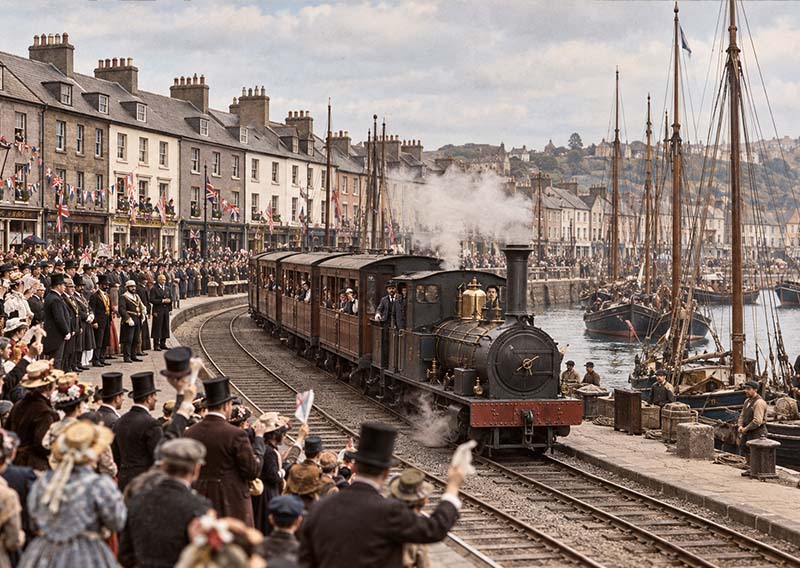
First train to Port Gwyn 1864
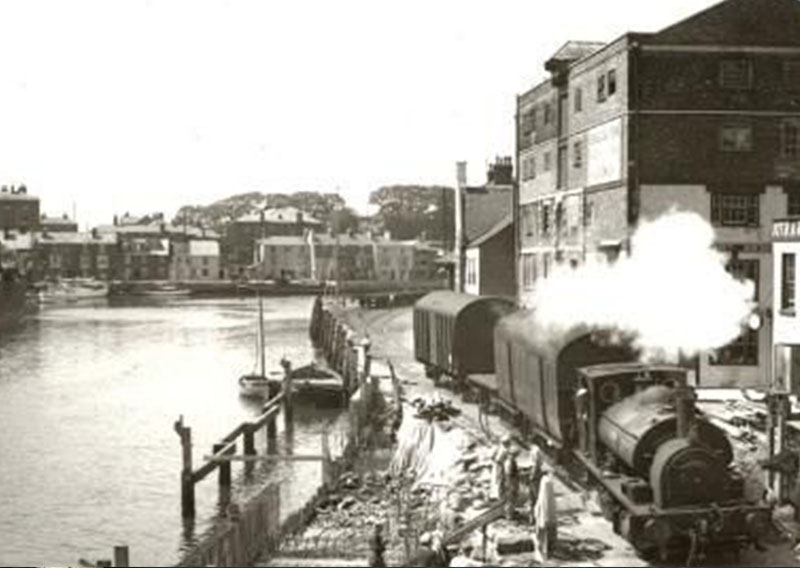
Port Gwyn c1905
The Dunfael Connection
During 1870 the western network expanded to connect with Dunfael, strengthening the railway's position along Glynoch's west coast. The connection offered further opportunities for fishing, agricultural and commercial traffic, as well as passengers travelling between the coast and the island's interior.
Two Railways Within One Company
By the early 1870s, the GMRC controlled two increasingly different businesses. Its southern route was closely tied to Llanchala's industries, the south-coast railway network and the LSWR's passenger-running rights. Its central route crossed the highlands to Port Gwyn and Dunfael and had developed into a railway carrying its own public passengers alongside mineral and general goods traffic. The different operating arrangements and commercial priorities helped create pressure for reorganisation. The southern railway had a natural affinity with the other lines serving the coast; the central system had its own demanding engineering, passenger market and ambitions.
The Reorganisation of 1876
In 1876 the GMRC's southern and coastal interests were consolidated into Llanchala Railway Ltd, together with the Llanchala & South West Railway and the Aberfael China Clay Railway. The central and highland interests became the Glynoch Central Railway. The division ended the GMRC as a unified undertaking, but its network survived in both successor companies. Llanchala Railway Ltd would join the Glynoch & Rathmor Railway in 1885. The Glynoch Central Railway later adopted the Great Central identity and remained a separate railway for decades. The central route's later history would include competition with the North Glynoch Railway, which opened in 1901. During the First World War, closer coordination with the Glynoch & Rathmor Railway developed for operational and administrative reasons. Formal G&R ownership of the central and northern railways followed after the war in 1919.
Legacy
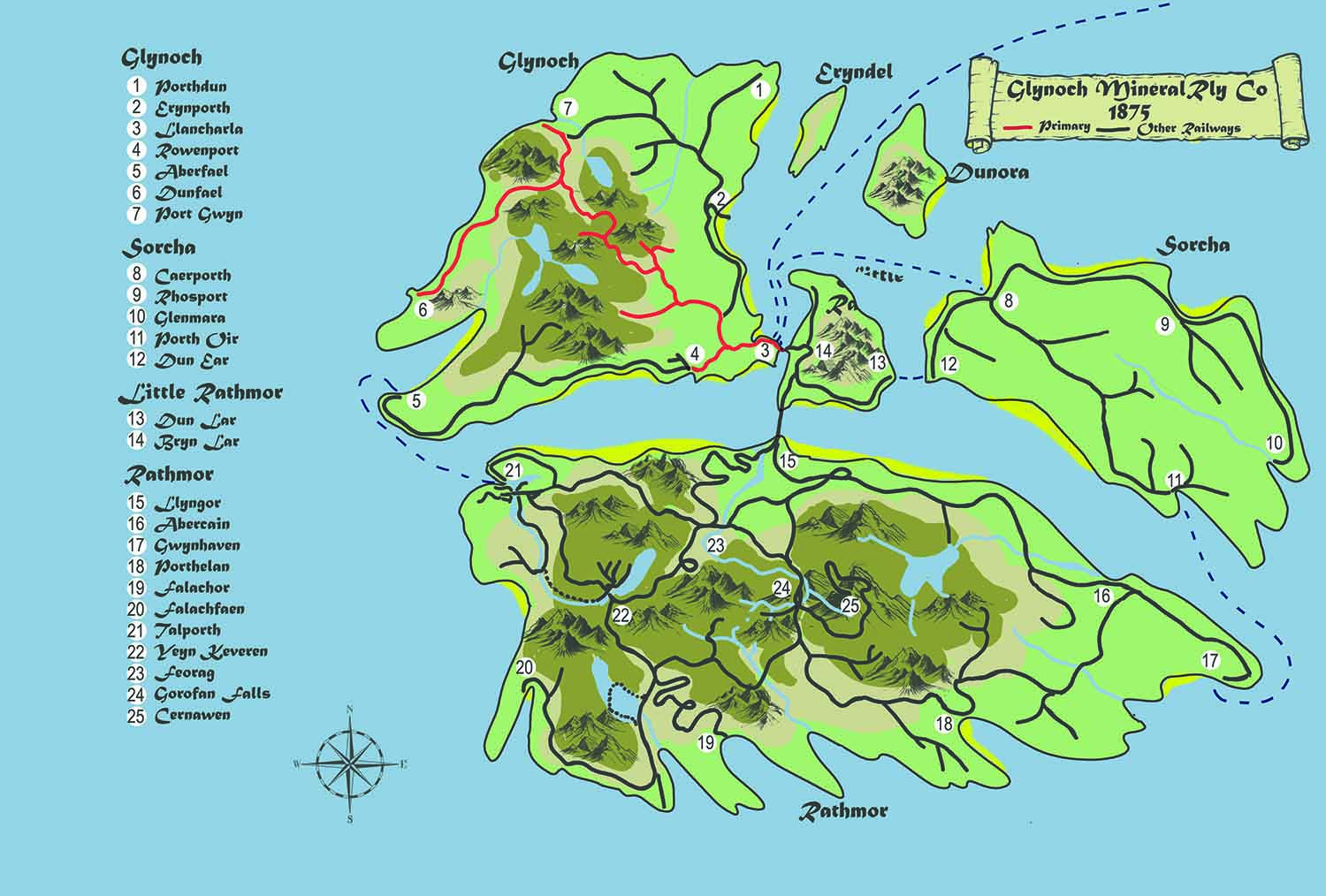
The Glynoch Mineral Railway Company transformed the geography of transport on Glynoch. Its 1855 southern line brought steam railway operation to the districts west of Llanchala and reached the outskirts of Rowenport. Its highland route advanced through difficult country to Port Gwyn in 1864 and Dunfael around 1870. The company also learned a commercial lesson that shaped its history. Its early exclusion from southern passenger traffic left that market to the LSWR, but its directors retained passenger rights on the highland route and introduced public services when the coast-to-coast railway opened. By the time the company divided in 1876, its founders' mineral railway had become the parent of two major railway families. The southern system would become a founding partner of the G&R in 1885, while the central system would maintain a separate identity and rivalry well into the twentieth century. The GMRC name disappeared, but the lines it built continued to shape the island's railways.
History
Railways
About the GMRC
GMRC Maps
Glynoch Mineral Railway Company
GMRC in 1959
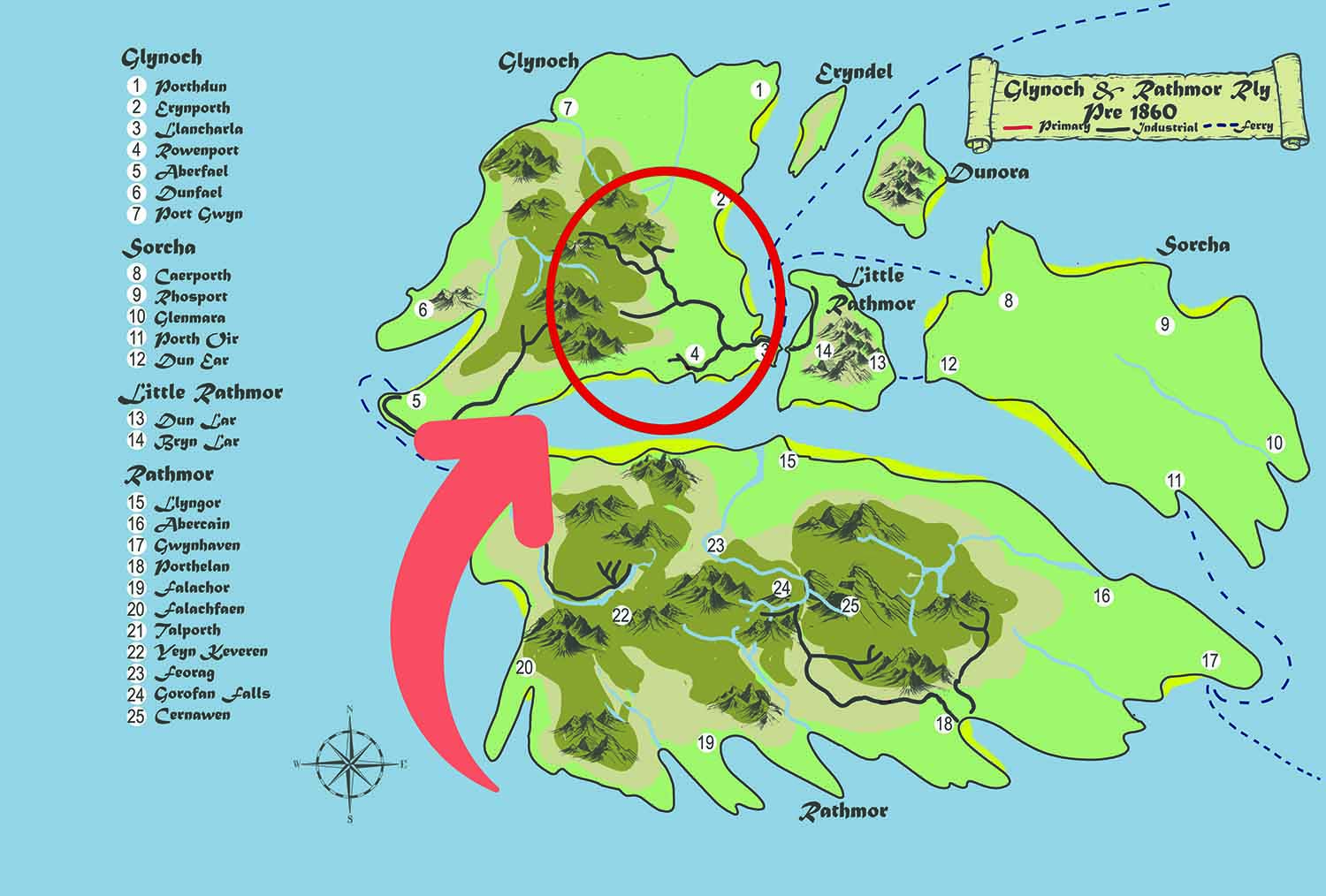
GMRC at it s greatest size 1875
Related Articles....

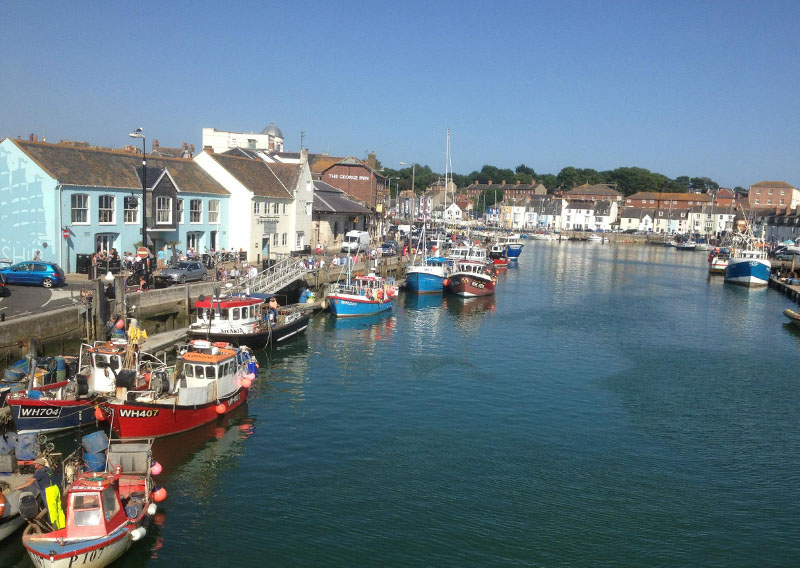

Explore More Railways of Glynoch and Rathmor....

Island Railways PRE 1880
The railways began their transformation from scattered industrial tramways into […] ...


0 Comments