

1862: Llyngor Valley Railway
Opened as the Feorag Forestry Company Railway, it was renamed after just two years as passenger services become increasingly important
History

Railways

About the LVR
LVR Maps
Llyngor Valley Railway (LVR)
At a glance:
Original name: Feorag Forestry Company Railway (FFCR)
Later name: Llyngor Valley Railway (LVR)
Opened: 1862
Renamed: 1864
Island: Rathmor
Route: Llyngor–Feorag
Original purpose: Forestry and timber transport
Later services: Passengers, excursions, tourism and general goods
Locomotive livery: Dark Green
Passenger carriage livery: Chocolate and Cream
Notable services: Grouse Specials and seasonal tourist trains
Important contribution: Transport of timber supplied by the Feorag Forestry Company for Llyngor Bridge
Acquired by G&R: 1912
Later identity: Continued as a distinctive G&R scenic and tourist route
Advertising identity: The Visitors' Choice
From timber trains to the Visitors' Choice
The Llyngor Valley Railway began life as a modest forestry railway, established to protect the valuable timber trade between the forests of Feorag and the harbour at Llyngor. Yet the little line would become one of Rathmor's most celebrated scenic railways, carrying holidaymakers, shooting parties and excursion passengers through some of the island's most beautiful countryside. Opened in 1862 as the Feorag Forestry Company Railway, it was renamed the Llyngor Valley Railway just two years later as passenger traffic became an increasingly important part of its business. For half a century the railway remained independent, surviving competition, changing trading patterns and the development of faster routes across Rathmor. When it finally passed into the ownership of the Glynoch & Rathmor Railway in 1912, its distinctive identity was preserved. Long after the original forestry company had established its railway, the winding journey between Llyngor and Feorag continued to be promoted under a familiar description: The Visitors' Choice.
Llyngor Valley Timeline
Feorag Forestry Company Railway
Llyngor Valley Railway
Glynoch & Rathmor Rly
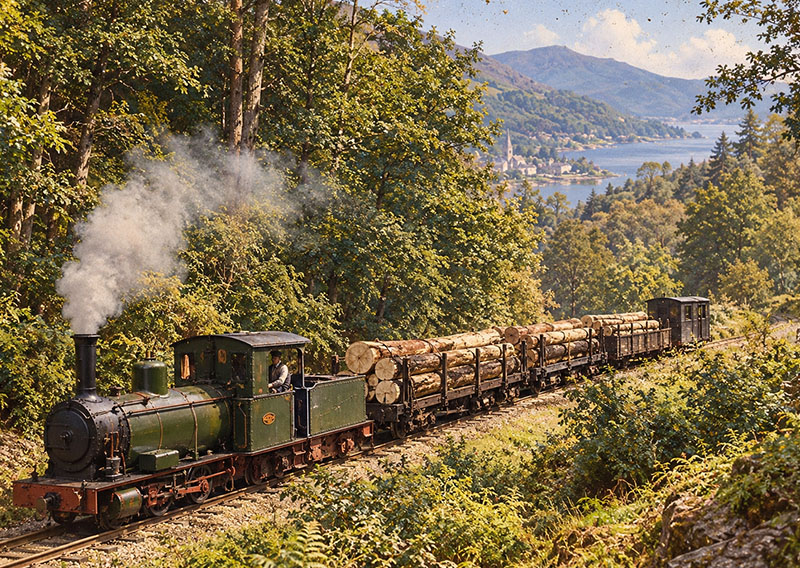
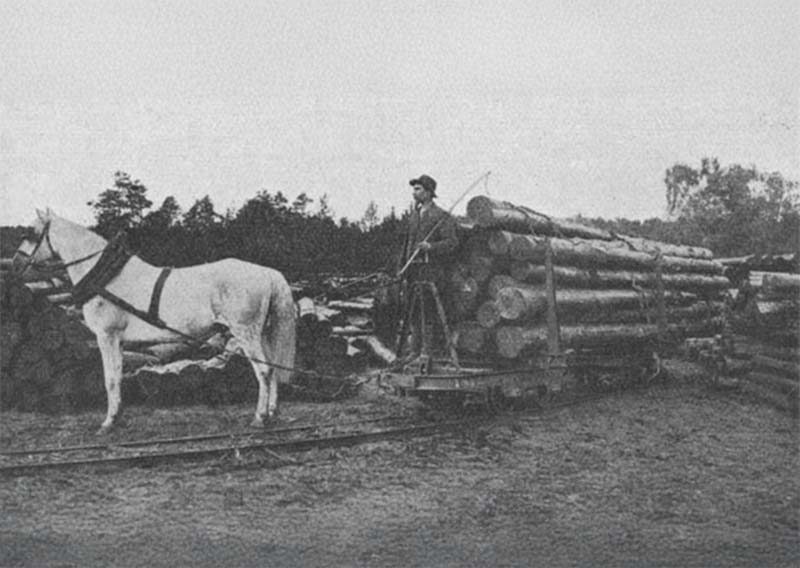
Feorag Forestry on the Llyngor Valley Railway
Origins: A Railway Born of Competition
Long before the arrival of the railway, the forests surrounding Feorag provided an important source of timber for the industries and shipyards of the Caerwyn Isles. Much of this timber traditionally travelled downriver towards Llyngor, where it was gathered, processed and shipped from the harbour. The system had served the district for many years, but it was far from dependable. Water levels, seasonal conditions and the difficulties of controlling large quantities of floating timber could all interfere with deliveries. As the timber trade expanded, the limitations of river transport became increasingly apparent. The greatest threat, however, came not from the river but from a rival railway. In 1860, the Talporth & Feorag Railway opened between Talporth and Feorag. Supported by Lord Rathmor and the Rathmor family, this new undertaking offered the forestry interests of Feorag an alternative outlet for their products. Timber that had traditionally made its way towards Llyngor could now be carried by rail to Talporth harbour. Among those who recognised the danger was Thomas Llewellyn, a prominent figure within the Feorag Forestry Company and a man closely associated with the district's timber trade. Llewellyn understood that the company's prosperity depended not simply upon producing timber, but upon ensuring that it could reach its markets economically and reliably. If Talporth possessed a railway while Llyngor remained dependent upon the river, the balance of trade could gradually shift away from the established northern harbour. Llewellyn therefore became a leading advocate of a railway connecting Feorag directly with Llyngor. The proposal was ambitious, but its commercial purpose was straightforward: to protect the forestry company's established trade and secure its independence from the competing railway interests at Talporth. With the support of fellow directors, Llewellyn helped persuade the Feorag Forestry Company to finance the undertaking. The railway would initially operate as part of the forestry business, its primary responsibility being the movement of timber and supplies. Yet its promoters were about to discover that the line possessed considerably greater potential.
1862: The Feorag Forestry Company Railway
Construction of the new railway presented considerable engineering challenges. The valley between Llyngor and Feorag was characterised by winding watercourses, wooded slopes and scattered communities. Rather than following a direct alignment, the engineers worked with the natural contours of the landscape. The resulting railway followed a twisting course through the valley, passing close to the forests and settlements whose produce it was intended to carry. In 1862, the Feorag Forestry Company Railway opened for traffic. For Thomas Llewellyn and his fellow directors, the opening represented a significant commercial achievement. The forestry company was no longer dependent upon the uncertainties of river transport, nor did it need to surrender its established markets to the Talporth & Feorag Railway. Timber formed the principal business, with logs and prepared wood transported towards Llyngor for local use and onward shipment. Other goods soon followed, including supplies for the forestry operations and produce from communities along the route. The railway offered substantial advantages over the old river transport system. Deliveries could be organised according to a timetable rather than the condition of the river, while return trains brought supplies and equipment into the valley. Although the line had been built primarily to serve the forestry company, its usefulness to the wider district soon became apparent. The railway passed through communities that had previously been difficult to reach, while the surrounding countryside was already attracting visitors. Requests to carry passengers increased, and the company's directors began to consider whether the railway might support an entirely new business.
1864: The Arrival of Passenger Services
The introduction of passenger services brought opportunities that the original promoters had scarcely anticipated. Local residents welcomed a more dependable connection with Llyngor, while visitors discovered that the railway offered a particularly attractive approach to the uplands. Summer excursions began to generate additional traffic, and the grouse-shooting season brought organised parties travelling towards Feorag and the surrounding estates. For the Feorag Forestry Company, however, the growing passenger business presented a dilemma. Its directors had invested in a railway to protect their timber trade. They had not intended to become responsible for an expanding public transport undertaking, complete with passenger accommodation, timetables, excursion arrangements and the commercial demands of tourism. Thomas Llewellyn recognised that the two activities, although closely connected, required different forms of management. The solution came in 1864. Rather than simply renaming its railway, the Feorag Forestry Company established the Llyngor Valley Railway Company as a wholly owned subsidiary. The new company assumed responsibility for railway operations, including timber and general freight, passenger services and the developing excursion business. The forestry company retained ownership of the subsidiary and continued to benefit from its railway investment, while concentrating its own management upon timber production and forestry operations. Several directors served on both boards, ensuring that the original commercial interests remained properly represented. Llewellyn was closely involved in the reorganisation and helped establish the new railway company's independent management structure. The arrangement provided the LVR with the freedom to develop its passenger business while maintaining the close relationship with the forestry company upon which its original prosperity had been built. The change also marked an important shift in the railway's identity. The Feorag Forestry Company Railway had been created to transport timber. The Llyngor Valley Railway was now a public railway serving an entire district. Its directors soon discovered that the scenic qualities of the route, initially regarded as a consequence of difficult geography, could become one of its greatest commercial attractions. The foundations had been laid for the railway that would eventually become celebrated as 'The Visitors' Choice'

Feorag Forestry c1880

Llyngor Valley Railway heading to Feorag
Two Railways to Feorag
By the middle of the 1860s, Feorag enjoyed the unusual distinction of having two competing railway connections to the coast. The Talporth & Feorag Railway provided a route to Talporth harbour, while the Llyngor Valley Railway served Llyngor. Their origins were competitive, and both sought a share of the district's valuable freight and passenger traffic. Yet the anticipated struggle for business did not develop into a prolonged commercial crisis. Feorag's forestry interests, local industries and growing tourist trade generated sufficient traffic to support both undertakings. The two railways also served different commercial communities. Merchants trading through Llyngor continued to favour their established harbour, while businesses associated with Talporth made use of the western connection. Passenger travel followed a similar pattern. Visitors generally approached Feorag from the port most convenient to their journey. There was initially little demand for through trains travelling from Llyngor to Talporth by way of Feorag. Consequently, the two railways developed largely independent passenger markets, despite sharing a common destination. The LVR continued to terminate at Feorag. Their services rarely extended onwards to Talporth.
A Railway Through the Landscape
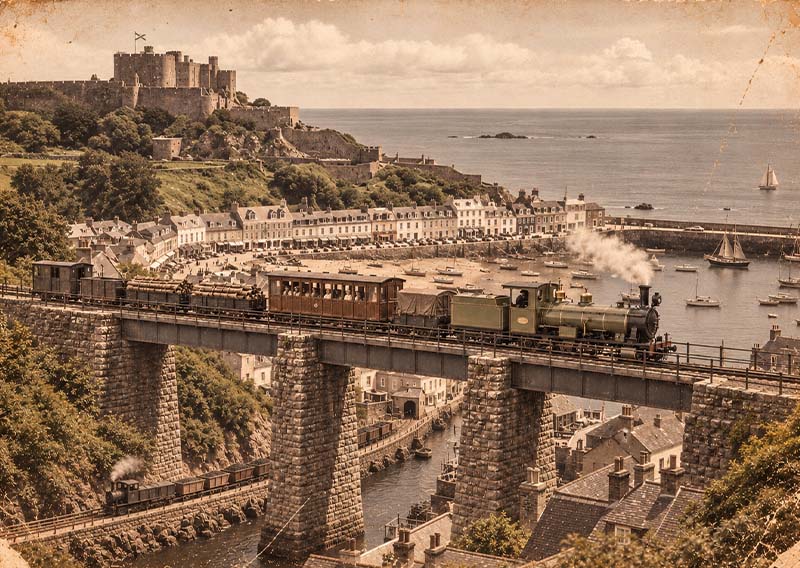
What had originally appeared to be an engineering disadvantage gradually became one of the Llyngor Valley Railway's greatest attractions. The line's winding alignment followed the contours of the valley, providing passengers with changing views of wooded hillsides, rivers, bridges and small settlements. Trains moved at comparatively modest speeds, particularly where the railway negotiated the more difficult sections of the route. For ordinary freight traffic, this could be a disadvantage. For holidaymakers and excursion passengers, however, the leisurely journey became part of the appeal. The railway was not simply a means of reaching Feorag. It offered an experience that visitors remembered and recommended to others. As tourism became increasingly important, the LVR developed a reputation for scenic travel, eventually adopting the promotional identity 'The Visitors' Choice'. The railway's passenger carriages, finished in chocolate and cream, presented an attractive contrast to its black locomotives. Together with the surrounding landscape, they helped establish the LVR as a distinctive presence among Rathmor's independent railway companies.
The Grouse Specials
Among the Llyngor Valley Railway's most celebrated services were its seasonal Grouse Specials. The hills and moorlands surrounding Feorag attracted shooting parties during the grouse season, bringing visitors who often travelled with considerable luggage and equipment. The railway responded by providing additional passenger accommodation and special trains to meet demand. For several weeks each year, traffic could increase substantially as shooting parties arrived and departed. These services became an important source of revenue and contributed to the railway's growing reputation among visitors. The Grouse Specials also presented an operational challenge. The LVR needed sufficient locomotives and carriages to accommodate the busiest weeks of the year, yet much of that additional capacity remained underused during quieter months. As the railway developed, this imbalance between seasonal demand and ordinary traffic would become increasingly significant.
The Glen Feorag Viaduct and Changing Railway Connections
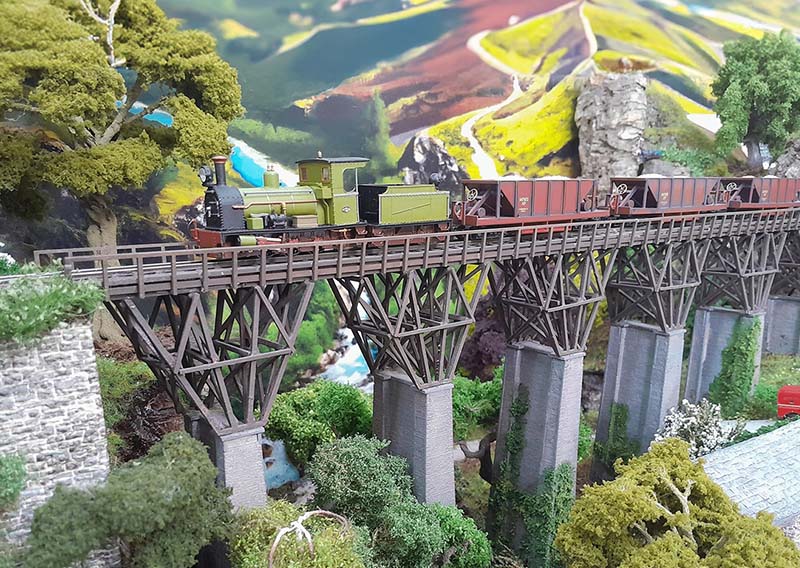
The opening of the Glen Feorag Viaduct in 1875 formed part of the development of a newer and faster railway route through the district. The viaduct became an important feature of the wider railway network, helping establish a more convenient route for longer-distance journeys. The Llyngor Valley Railway retained its original winding alignment between Llyngor and Feorag. Although the scenic line remained valuable for local traffic and tourism, its route was less suitable for the growing volume of longer-distance journeys across the islands. This distinction became increasingly important as the railway network expanded. Where passengers once had relatively limited choices, newer connections offered faster journeys to Feorag and beyond. The original LVR therefore developed a different role from the more direct routes. It continued to serve the valley's smaller communities and industries, while increasingly attracting passengers who valued the journey itself.
1880s: Timber for the Llyngor Bridge
One of the Llyngor Valley Railway's most significant contributions to the wider development of the Caerwyn Isles came during the construction of the Llyngor Bridge, which opened in 1885. The Feorag Forestry Company became the principal supplier of timber for the undertaking, drawing upon the extensive woodlands surrounding Feorag. The LVR played an important part in transporting the timber down the valley towards the bridge works. The arrangement provided valuable business for the forestry company and its railway, while contributing directly to one of the most important engineering projects in the islands' transport history. There was a certain irony in the undertaking. The railway established to defend Llyngor's timber trade was now helping to construct the very crossing that would transform the wider railway network and, in time, encourage traffic to use newer and faster routes. For the LVR, however, the bridge represented both an important commercial achievement and the beginning of a new era of railway connections.
A Changing Railway Network
The opening of Llyngor Bridge in 1885 transformed the possibilities for travel between the islands. The same year saw the emergence of the Glynoch & Rathmor Railway, which brought important parts of the existing network under a larger organisation. The Llyngor Valley Railway, however, remained independent. Although the LVR now operated within a much more extensive railway system, it continued to serve its own established markets. The growth of through traffic increasingly favoured the faster routes across Rathmor. Most longer-distance trains travelled by way of the Glen Feorag Viaduct and the newer route towards Llyngor and onward to Llanchala, rather than following the original LVR's slower and more circuitous alignment. For the valley railway, this changing pattern of traffic reinforced its distinctive character. Its services remained important to the communities along the route, while its scenic qualities continued to attract visitors. The LVR was no longer competing principally to provide the quickest connection across Rathmor. Instead, it offered something the faster lines could not easily reproduce: a leisurely journey through the heart of the Llyngor Valley.

Feorag Station c1890
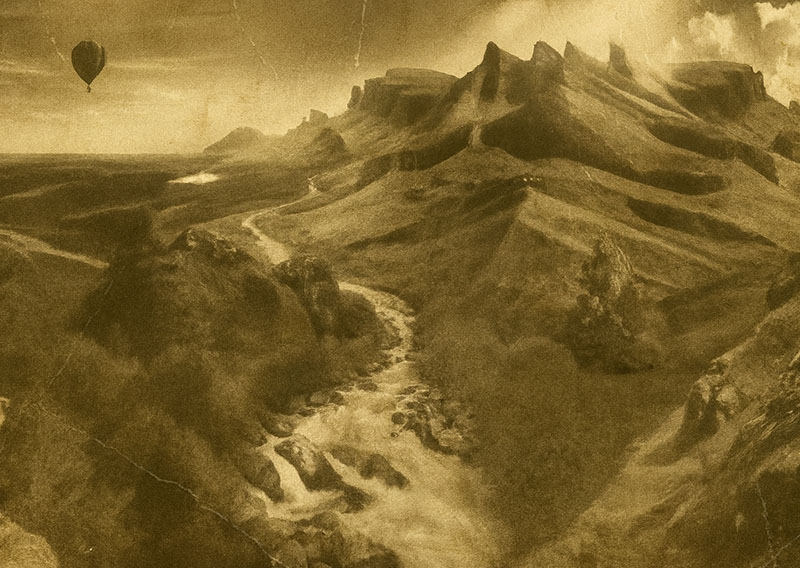
Glen Feorag c1850
The Challenges of Seasonal Success
By the early twentieth century, the Llyngor Valley Railway had become a well-established and respected undertaking. Its forestry and local goods traffic remained useful, while summer excursions and shooting parties continued to bring substantial passenger revenue. Nevertheless, the company's financial position presented difficulties. The problem was not a collapse in business or a lack of passengers. Rather, the railway's success was concentrated into particular periods of the year. During the busiest weeks, the LVR required enough locomotives and passenger carriages to accommodate large numbers of visitors. At other times, the same equipment might see relatively little use. Maintaining a fleet capable of handling these seasonal peaks placed an increasing burden upon a relatively small independent railway. By this period, the company had also begun contracting locomotive and rolling-stock maintenance to the workshops at Bryn Lar on Little Rathmor, taking advantage of the connections made possible by the expanded railway network. Although this arrangement provided access to facilities beyond the LVR's own resources, it also illustrated the growing advantages of belonging to a larger railway organisation. The directors recognised that the railway could remain commercially successful while still facing considerable difficulty financing its future requirements.
Among those responsible for addressing these difficulties was Edward Pritchard, who had risen to a senior management position within the Llyngor Valley Railway. Pritchard understood that the company's problem was not a shortage of business, but the uneven distribution of that business throughout the year. The railway required a substantial fleet during the summer excursion and grouse-shooting seasons, yet much of its rolling stock remained underused during quieter months. He became an advocate of closer cooperation with the Glynoch & Rathmor Railway, recognising that access to the larger company's locomotives, carriages and engineering facilities could provide a more economical solution than continued independent expansion. Pritchard would subsequently play an important role in the discussions that led to the G&R's acquisition of the Llyngor Valley Railway in 1912.
1912: Acquisition by the Glynoch & Rathmor Railway
In 1912, the Llyngor Valley Railway was acquired by the Glynoch & Rathmor Railway. The agreement represented a practical solution for both undertakings. For the LVR, incorporation into the larger company provided access to greater financial resources, extensive maintenance facilities and a much larger pool of locomotives and passenger carriages. The G&R could accommodate the railway's seasonal traffic without requiring a dedicated fleet large enough to meet the busiest weeks of the year. For the G&R, the acquisition brought a successful and attractive railway into its network. The Grouse Specials were particularly valuable, while the LVR's reputation among tourists offered considerable opportunities for further promotion. Importantly, the acquisition was not the result of the LVR's failure. The railway remained a viable undertaking, but its directors recognised that future prosperity would be more secure within a larger organisation. The arrangement therefore represented a strategic consolidation rather than a rescue.
The Visitors' Choice
Although the Llyngor Valley Railway ceased to exist as an independent company in 1912, its familiar identity did not disappear. The Glynoch & Rathmor Railway recognised the value of the LVR name and its established reputation among visitors. Rather than absorbing the line completely into its ordinary passenger operations, the G&R continued to promote the scenic route under the Llyngor Valley Railway identity. Advertising emphasised the beautiful countryside, the picturesque communities and the leisurely journey towards Feorag. The description, 'The Visitors' Choice' became particularly appropriate. Passengers seeking the quickest journey could use the newer and faster railway routes, which served Feorag and continued principally towards Talporth. Those wishing to enjoy the scenery could choose the original LVR route from Llyngor. The two alternatives complemented one another. One offered speed and convenience; the other offered an experience. The Grouse Specials remained an important part of the railway's identity, while ordinary excursion traffic continued to bring visitors into the valley. The survival of the LVR name demonstrated that a railway company could lose its independence without losing its character.
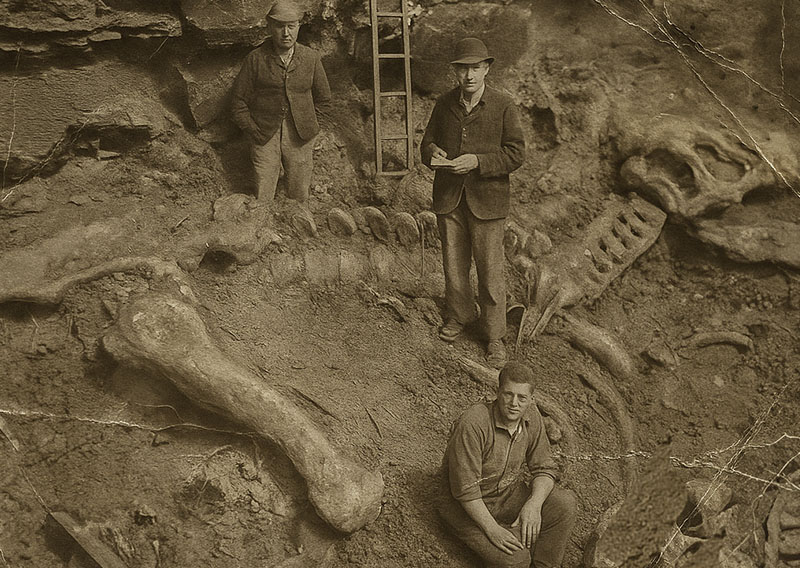
The Feorag Rex 1927

1930s Advert
1927: The Feorag Rex
A new chapter in Feorag's tourist history began in 1927 with the discovery of the remarkable 'Feorag Rex' dinosaur fossils. The discovery attracted considerable public interest and provided the district with an entirely new reason for visitors to make the journey. The Glynoch & Rathmor Railway was quick to recognise the opportunity. Advertisements promoted trains to see the Feorag Rex, including daily services from Llanchala. The fossils joined the scenery, countryside excursions and traditional shooting parties as another attraction drawing passengers towards Feorag. For the original Llyngor Valley Railway, the development was particularly fitting. A line built to transport timber had evolved into a celebrated scenic passenger railway. Now the wider district it served was attracting visitors interested in natural history as well as landscape and leisure. The discovery helped reinforce Feorag's reputation as a destination in its own right, long after the LVR had become part of the G&R.
A Lasting Legacy
The history of the Llyngor Valley Railway is one of changing circumstances and successful adaptation. Its origins lay in the commercial rivalry between Llyngor and Talporth, when the opening of the Talporth & Feorag Railway threatened an established timber trade. The Feorag Forestry Company responded by building its own railway in 1862. Within two years, the little industrial undertaking had developed into a passenger railway serving communities and visitors throughout the valley. Its winding route, initially a consequence of difficult geography, became one of its greatest attractions. The railway played an important part in the construction of Llyngor Bridge, adapted to the development of faster competing routes and eventually recognised the benefits of joining the larger Glynoch & Rathmor Railway. Yet through all these changes, the character of the original line survived. The Llyngor Valley Railway was never simply another route between two towns. It was a railway whose journey became as important as its destination: The Visitors' Choice.
History
Railways
About the LVR
LVR Maps
Llyngor Valley Railway
Opened in 1862 as the Feorag Forestry Company Railway before being renamed just two years later

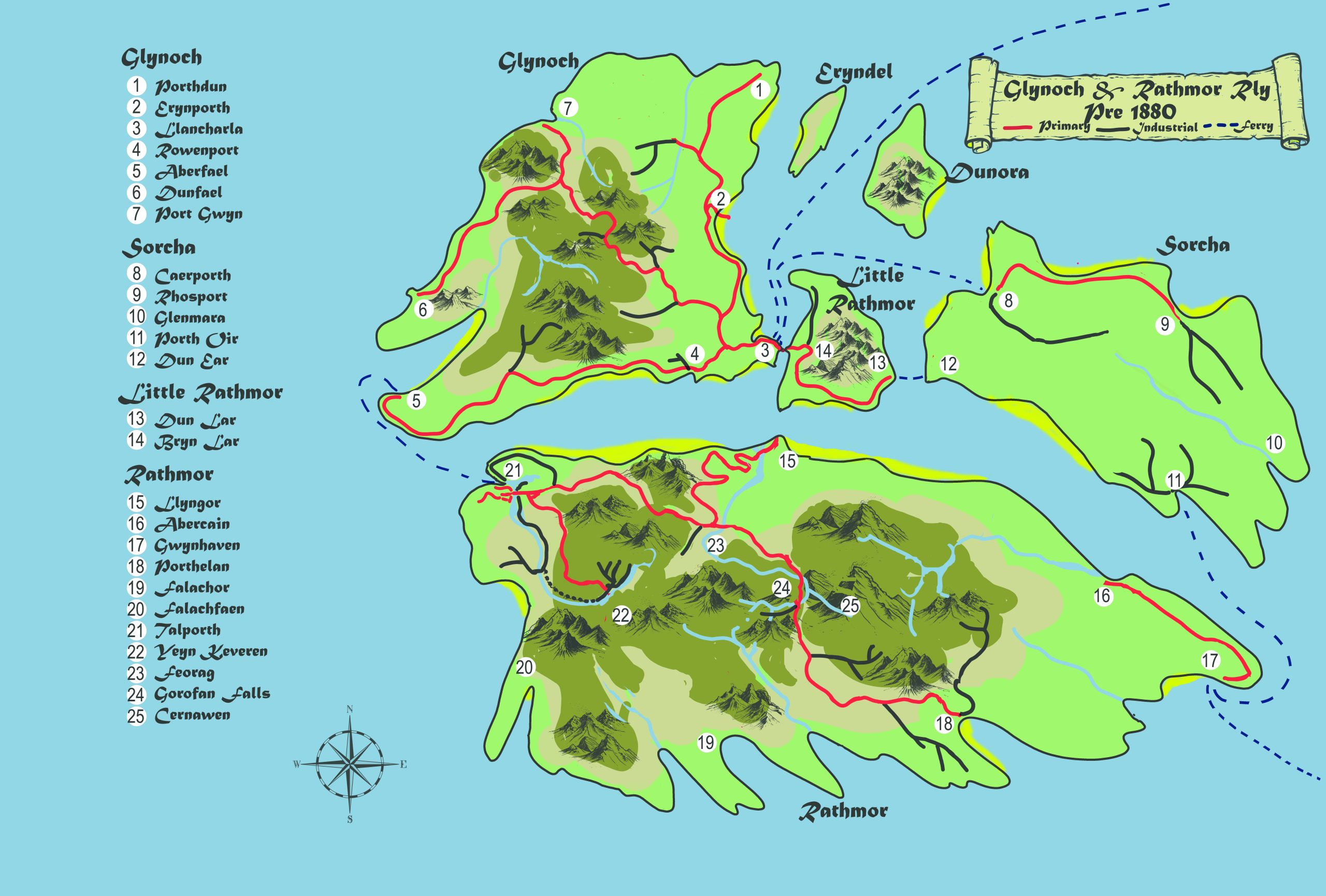
The railway network Pre-1880 showing just how important the LVR was at the time



0 Comments