

1860: Talporth & Feòrag Railway
From the busy quays of Talporth to the wooded valleys of Feorag, Rathmor's earliest passenger railway.
History

Railways

About the T&FR
T&FR Maps
Talporth & Feòrag Railway (T&FR)
At a glance:
Opened: 1860
Island: Rathmor
Route: Talporth–Feorag
Type: Public passenger and goods railway
Primary colour-scheme: Light/Lime green locomotives and dark red carriages
Gauge: 2ft Island narrow gauge
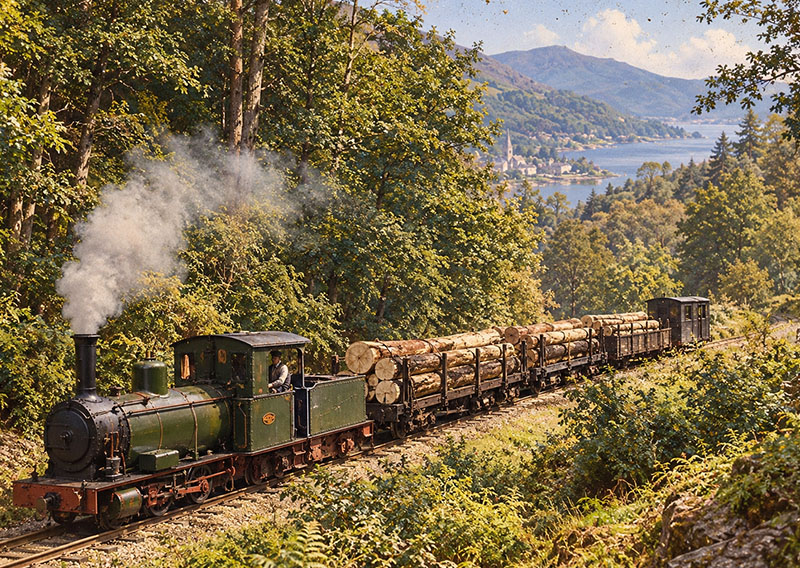
Traffic: Passengers, excursions, peat, timber, charcoal and general freight
Connections: Tal Valley Railway at Talporth; Feorag district interests
Fate: Incorporated into Rathmor Railway c.1879
A Railway for the People of Rathmor
By 1860, Talporth was no stranger to rails. The Tal Valley Tramway, established in 1845 and closely associated with the Keveren family, carried minerals along the corridor from Yeyn Keveren. Its origins were industrial, however, and the communities beyond Talporth still needed a railway capable of serving passengers as well as goods. The Talporth & Feorag Railway (T&FR), supported by Lord Rathmor and the Rathmor family, began operating in 1860. Connecting the harbour town with the inland district of Feorag, it offered a new means of travel while providing an outlet for the valley's produce and resources. The railway was an early example of a public passenger and freight line on Rathmor.
Talporth & Feòrag Timeline
Talporth & Feòrag Railway
Rathmor Railway
Glynoch & Rathmor Rly
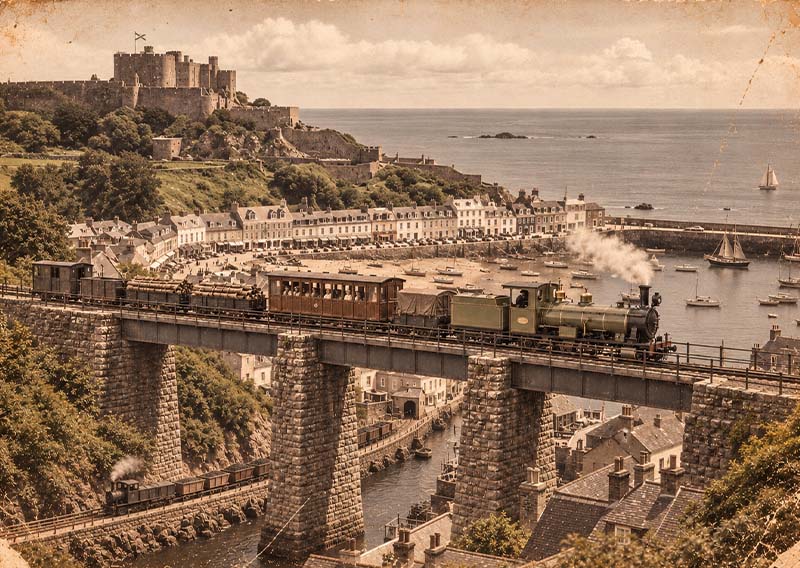
The Talporth Bridge with the Tal Valley Tramway visible below
The First Station — High Above the Town
The T&FR's original Talporth terminus occupied elevated ground on the EAST side of the Tal River. Although it provided a practical approach from the Feorag direction, the site was inconvenient for the commercial heart of Talporth and the quays below. Passengers and goods faced an awkward onward journey into town. For a railway intended to bring people and trade closer together, this was a serious disadvantage. The location would prove temporary, but the solution required cooperation with another railway interest. The railway's traffic reflected the country through which it ran. Passengers used the line for journeys between Feorag and Talporth, and the scenery of the wooded valleys encouraged excursion travel. Goods trains carried timber, charcoal, peat and general merchandise towards the harbour; provisions, equipment and manufactured supplies moved inland. The mixture of passenger and goods business distinguished the T&FR from the older mineral tramway and helped establish Feorag as a railway-connected community.

Talporth Quay c1880

Leaving Talporth heading to Feorag
Two Families, Two Railways
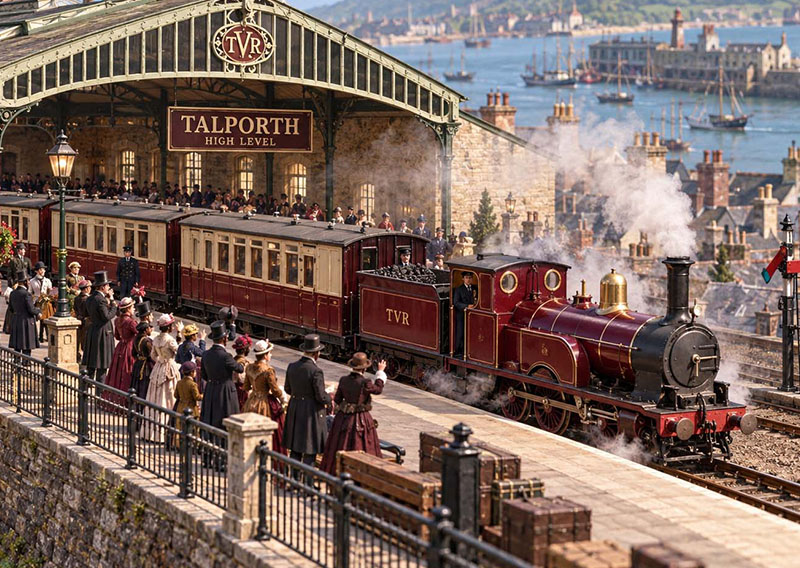
The Rathmor family's T&FR and the Keveren-associated Tal Valley Tramway had developed for different purposes. The former connected Talporth with Feorag as a public railway; the latter served the mineral route towards Yeyn Keveren. Neither company could fully solve Talporth's railway geography alone. The opportunity came in 1862, when the Tal Valley Tramway was rebuilt for locomotive operation and became the Tal Valley Railway (TVR). Rather than continuing to work around their separate limitations, the two railway undertakings agreed upon a joint programme of improvements. The centrepiece was a new railway bridge across the Tal River. Jointly promoted and built by the T&FR and TVR, it linked the systems and allowed the Feorag railway to cross from its inconvenient original east-bank station to a more useful position west of the river. A new Talporth High Level station was established on the west bank as part of the joint scheme in 1862. It was not simply a station belonging to one company and used by the other under running rights: the bridge and station were shared initiatives, reflecting a genuine partnership between the Rathmor and Keveren railway interests.
The Harbour Loop and Tunnel
The joint undertaking did more than build a bridge and station. A connecting loop line, including a short tunnel and a route around the rear of Talporth, gave BOTH the T&FR and the new TVR access down towards the docks. This overcame the earlier interruption and separation of harbour access associated with the original Tal Valley Tramway alignment. For freight customers, the improvement was especially valuable: goods from Feorag and the mineral district could now reach the quays through a more coherent railway arrangement. The dock connection also strengthened Talporth's position as a centre of trade and interchange.

Talporth High Level station c1870
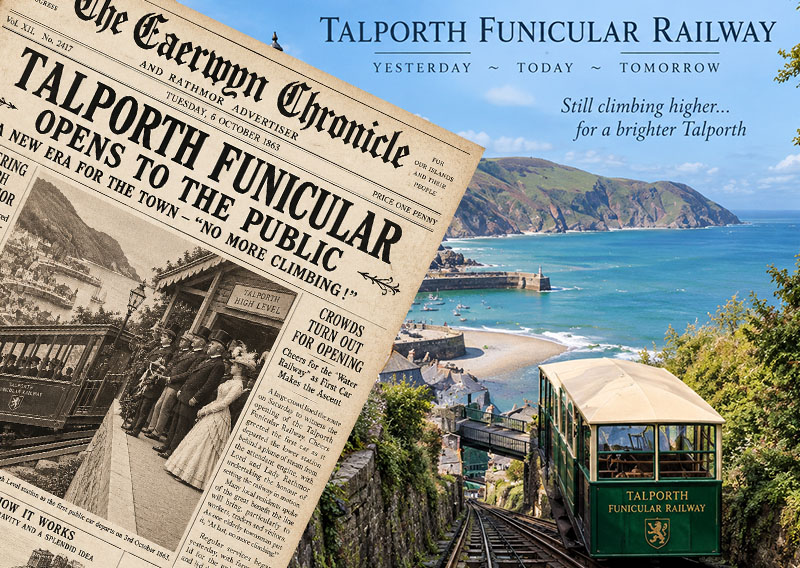
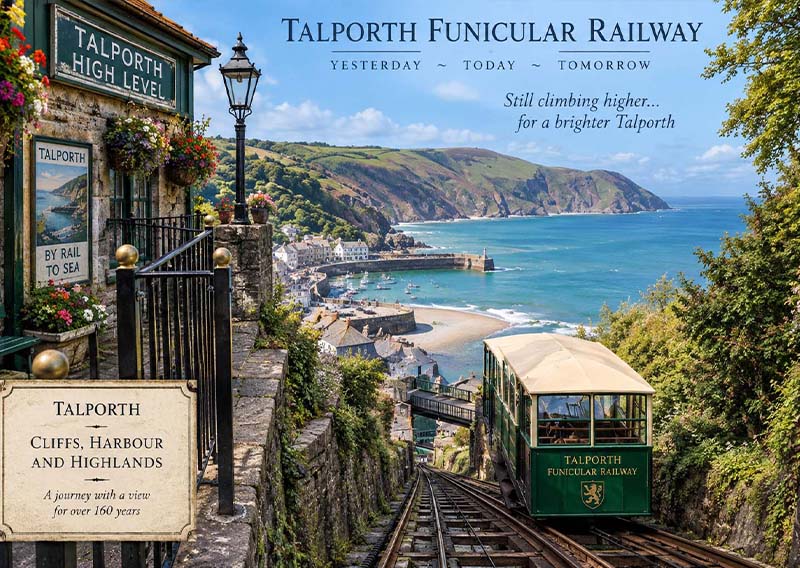
Talporth Funicular Railway
The Funicular Completes the Talporth Connection
The new west-bank High Level station was better situated, but it remained above the streets and quays. Passengers carrying luggage, traders with parcels and anyone travelling between the station and the lower town still faced a steep climb or descent. The separate Talporth Funicular Railway, opened on 3 October 1863, supplied the missing passenger connection between Talporth High Level and Talporth Quay. In only a few years, the town had acquired a bridge linking two railways, a new shared station, an improved dock route and a funicular connecting the upper railway to the harbour-side streets. The Feorag district's wooded valleys continued to generate timber and charcoal traffic, alongside peat, general goods and passengers. Other railway interests subsequently developed in the wider Feorag and Llyngor area, particularly those associated with forestry. These should not be confused with the T&FR itself. The later Llyngor Valley Railway followed an independent course and was not automatically absorbed when Talporth's principal railways were consolidated.
1875: Across the Glen Feorag Viaduct
The opening of the Glen Feorag Viaduct in 1875 marked another important milestone in the expansion of the Talporth & Feorag Railway. Pushing beyond Feorag and into Rathmor's mountainous interior, the railway established a new connection towards the industrial district around Gorofan. The mines and forests of this region were already served by a network of tramways extending northwards from Porthelan, some dating back to 1852, but the arrival of the T&FR provided a valuable new route for mineral and timber traffic to reach the larger harbour at Talporth. The viaduct helped transform the railway from a local passenger and goods line into an important part of Rathmor's developing industrial network, laying the foundations for the wider railway consolidation that followed in 1879.

Glen Feorag Viaduct under construction c1875

Lady Constance crossing Glen Feorag 1880
The Rathmor Railway of 1879
By the late 1870s, the advantages of a coordinated island railway network had become difficult to ignore. Lord Keveren and other interests promoted the consolidation that created the Rathmor Railway around 1879. The T&FR and TVR were incorporated, together with the Abercain & Gwynhaven Railway and other Rathmor interests. The Feorag route ceased to be a separate company, but continued to carry passengers and goods within the larger system. In 1885 the Rathmor Railway became a founding partner of the newly formed Glynoch & Rathmor Railway.
A Legacy of Cooperation
The Talporth & Feorag Railway deserves to be remembered not only for bringing passenger trains to Feorag in 1860, but also for its part in reshaping Talporth. Lord Rathmor's railway and the Keveren family's mineral railway began with different priorities, yet together they overcame the river, improved the station, and opened a better route to the docks. The bridge, High Level station and harbour loop were the physical expression of that cooperation. Long before the great railway consolidations, two independent companies had shown how much could be achieved by working together.

The Gorofan Gorge

The Gorofan Gorge heading south c1880
History
Railways
About the T&FR
T&FR Maps
Talporth and Feorag Railway
Opened to Feorag in 1860 and onwards to Gorofan after the Glen Feorag Viaduct opened in 1875

Related Articles....

Explore More Railways of Glynoch and Rathmor....


0 Comments