


1852: The Early Railways of Porthelan
From forest tramways and mineral workings to agricultural railways, the three pioneering companies that laid the foundations of the Porthelan Highland Railway
History

Railways

About Porthelan
Porthelan Maps
The Early Railways of Porthelan
At a glance:
Location: Porthelan and the southern highlands and peninsulas of Rathmor
Period: 1852–1866
Principal railways:
- Porthelan & Gorofan Timber Tramway (P>T)
- South Rathmor Mineral Tramway (SRMT)
- Southern Peninsular Railway (SPR)
Original motive power: Horses, with steam locomotives introduced by 1860
Principal traffic: Timber, molasses, minerals, quarried stone, agricultural produce, livestock and general supplies
Principal destinations: Porthelan Harbour, Gorofan, the southern highland mineral workings and the agricultural peninsulas
Successor: Porthelan Highland Railway, formed 1 January 1867
Origins
Long before the formation of the Porthelan Highland Railway, the harbour town of Porthelan had become the centre of a remarkable collection of small industrial railways. Built to serve the forests, mines, quarries and agricultural estates of southern Rathmor, these early lines were established independently, each answering the particular needs of its owners and customers. Their origins were modest. Horse-drawn wagons, lightly laid track and simple loading platforms were sufficient for the earliest operations. Yet as industry expanded and traffic increased, the advantages of railway transport became impossible to ignore. Between 1852 and 1866, three principal railway undertakings emerged around Porthelan: the Porthelan & Gorofan Timber Tramway, the South Rathmor Mineral Tramway and the Southern Peninsular Railway. Although initially independent, the three companies gradually developed a network of shared connections and commercial arrangements. Their eventual amalgamation on 1 January 1867 would establish the Porthelan Highland Railway, transforming a collection of industrial tramways into one of Rathmor's most important regional railway undertakings.
Porthelan Timeline
Porthelan & Gorofan Timber Tramway
South Rathmor Mineral Tramway
Southern Peninsular Railway
Porthelan Highland Railway
Rathmor Railway
Glynoch & Rathmor Rly

Porth Elan Harbour c1860
The Porthelan & Gorofan Timber Tramway — c.1852
The earliest of Porthelan's railways owed its existence to the extensive forests stretching inland towards Gorofan. Timber had long been an important commodity for the harbour town. Building materials, pit props, fencing, fuel and timber for coastal shipping were all in steady demand, but transporting felled trees over the rough and frequently waterlogged roads of southern Rathmor was slow, expensive and often impractical. The solution was a horse-worked tramway, promoted by local forestry and timber interests, intended from the outset to connect Porthelan with the forests around Gorofan. The name Porthelan & Gorofan Timber Tramway reflected this ambition. Its promoters were not simply constructing a short line to the nearest woodland, but envisaged a railway reaching deep into the interior.
By 1852, the tramway had reached the Gorofan district. The original line was a relatively primitive undertaking, with lightly laid track, simple passing places and basic timber-loading facilities. Horses hauled short trains of wagons towards Porthelan, where their loads could be transferred to coastal vessels or delivered directly to local merchants and workshops. The return journey was equally useful. Tools, provisions, equipment and supplies could be transported inland to the forestry settlements, reducing their dependence upon difficult road journeys. As the timber workings expanded, temporary branches were laid into newly exploited areas of forest. Some remained in use for years, while others were lifted and relaid as the timber was exhausted. The main route, however, became an increasingly permanent feature of the landscape. What began as a means of transporting timber had established a valuable railway corridor between Porthelan Harbour and the mountainous interior of Rathmor.
The South Rathmor Mineral Tramway — c.1855
The success of the timber tramway attracted the attention of the mining and quarrying interests of southern Rathmor. During the mid-1850s, the growing exploitation of the highland molasses deposits encouraged a number of independent mine owners and quarry operators to seek a more efficient means of transporting their products to the coast. Rather than each concern constructing an expensive independent railway to Porthelan, a collective undertaking emerged: the South Rathmor Mineral Tramway. Its principal route extended inland from the Porthelan district towards the southern highland workings, with a succession of short branches, private sidings and loading platforms serving individual businesses. Some mines possessed substantial loading facilities and their own small fleets of wagons. Others required little more than a short siding where material could be transferred from carts or narrow mine tracks. This arrangement allowed even relatively small operators to benefit from railway transport without having to finance an entire route to the harbour. The tramway's principal traffic consisted of molasses minerals, but it also carried stone from local quarries and other industrial materials. Loaded wagons travelled towards Porthelan, while empty vehicles, mining timber, tools, machinery and provisions moved in the opposite direction. The railway was therefore more than a private line serving one mine. It became a shared industrial transport system upon which a growing collection of independent businesses depended. The numerous branches and sidings also gave the mineral railway a very different character from the timber tramway. Its traffic was gathered from many small locations before being assembled into trains for the journey to the harbour. As mineral production increased, so too did the demands placed upon the railway.
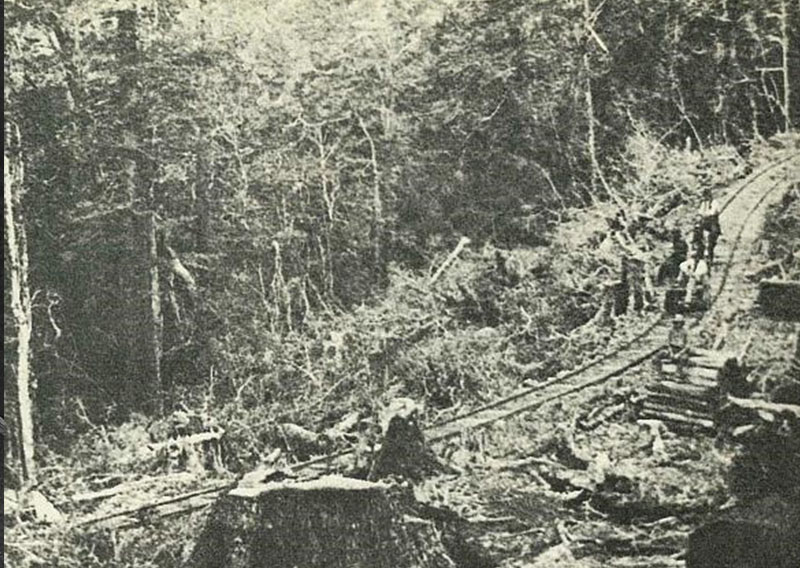
Logging tramway from Porthelan to Gorofan c1855
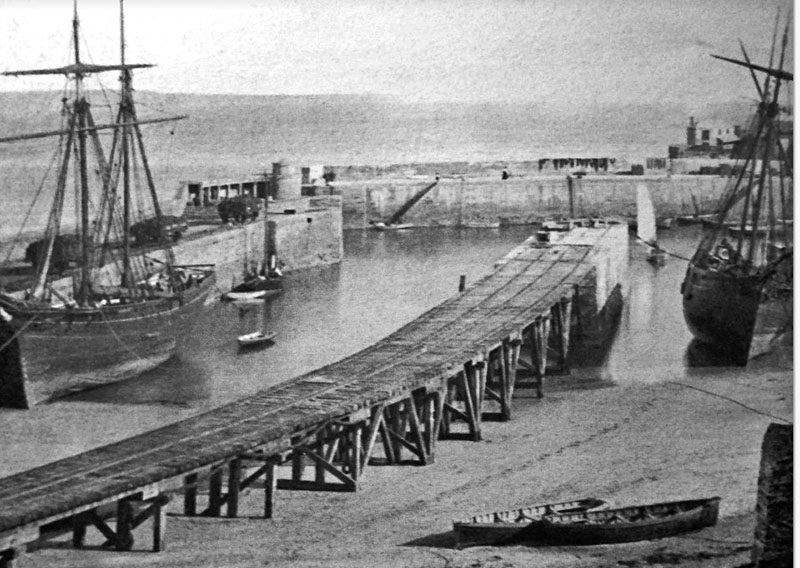
The railway jetty at Porthelan Harbour c1880
The Southern Peninsular Railway - 1859
While the timber and mineral tramways were developing inland, a third railway interest was emerging across the agricultural peninsulas to the south of Porthelan. This was the Southern Peninsular Railway, established to improve the movement of agricultural produce between the fertile coastal districts and the harbour. The southern peninsulas were predominantly agricultural, with farms and estates producing crops, livestock and other goods for local consumption and coastal export. Although the distances involved were often modest, the movement of bulky produce by road could be laborious, particularly during the harvest season or in poor weather. The SPR developed a network of rural branches extending through the agricultural districts, with loading points serving farms, estates, mills and small coastal communities. Unlike the timber and mineral undertakings, whose routes were largely determined by forests and mineral deposits, the agricultural railway was designed to collect traffic from a wider area. One of its most important arrangements was an agreement with the Porthelan & Gorofan Timber Tramway. Rather than constructing an entirely separate approach to Porthelan Harbour, the SPR used part of the timber railway's existing track to reach the docks. This cooperation reduced construction costs and avoided the unnecessary duplication of railway infrastructure. It also established an early example of railway interworking in southern Rathmor. Agricultural wagons carrying produce and livestock travelled towards Porthelan, while supplies, equipment, animal feed and other goods were conveyed inland. The railway's traffic was often seasonal, with harvest periods producing considerable demands upon the available wagons, horses and shared harbour facilities. Although the SPR retained its own identity and served a distinct geographical area, its operations became increasingly dependent upon the established timber railway. The two undertakings were separate companies, but their railways were already beginning to function as parts of a larger network.
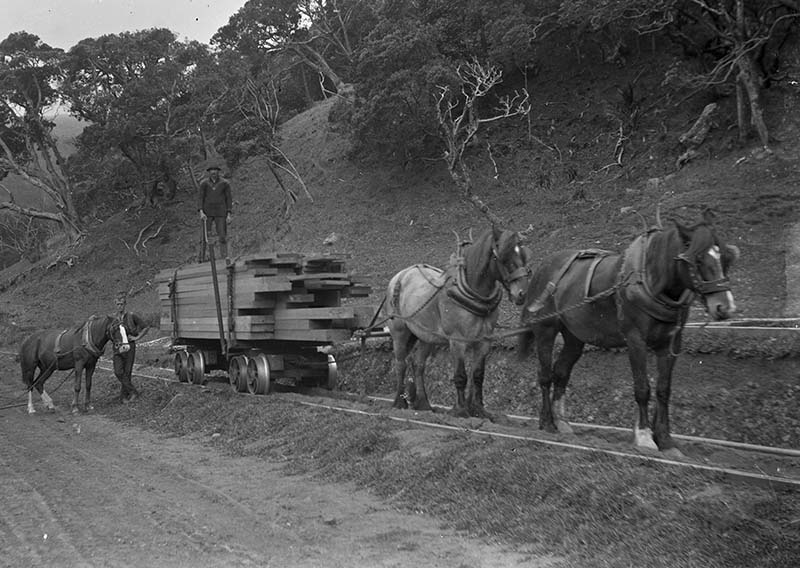
Logging tramway near Porthelan
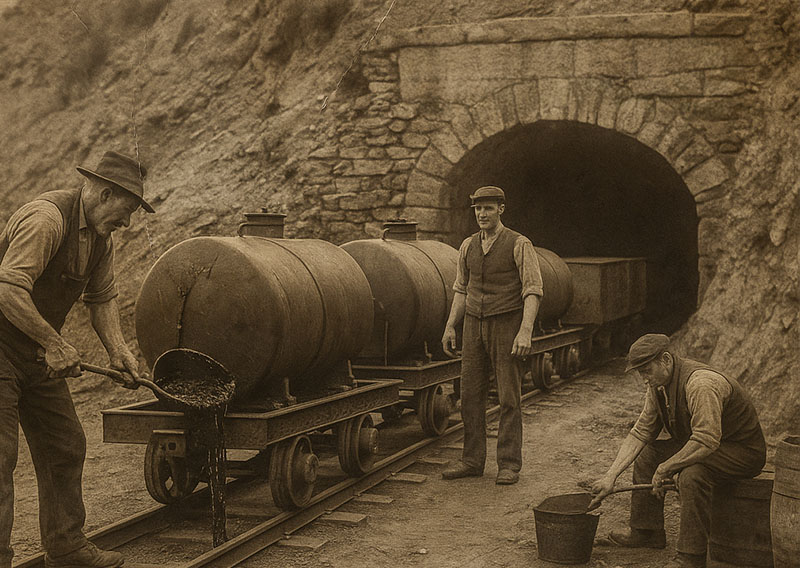
Rathmor Molasses Mine c1880
The Arrival of Steam
In their earliest years, the Porthelan railways relied principally upon horses. Horse traction was economical and practical for short industrial journeys, particularly where trains consisted of only a few wagons and frequent stops were required at small sidings. The rolling stock was equally straightforward. Timber bolsters, open mineral wagons, agricultural trucks and simple covered vehicles formed the basis of the early fleets. As traffic increased, however, the limitations of horse haulage became increasingly apparent. The gradients of the southern highlands, the weight of mineral trains and the growing volume of traffic approaching Porthelan Harbour all encouraged improvements to the railway infrastructure. By 1860, steam locomotives had begun operating on the Porthelan railway system.
Their introduction marked an important turning point. Steam locomotives could haul heavier loads and longer trains, allowing the railways to handle increasing quantities of timber, minerals and agricultural produce. Their arrival also encouraged improvements to track, bridges, sidings and operating arrangements. Steam did not immediately replace horse traction throughout the network. Some lightly laid branches, private sidings and short industrial connections continued to employ horses, particularly where traffic remained limited. Nevertheless, the introduction of steam demonstrated that Porthelan's railways were developing beyond their original role as primitive industrial tramways. They were becoming substantial transport undertakings.
Three Railways, One Harbour
By the early 1860s, the three companies had become increasingly interconnected. Timber, minerals and agricultural produce all converged upon Porthelan Harbour, where goods were transferred to coastal vessels, warehouses or local merchants. The Southern Peninsular Railway already relied upon the timber tramway for part of its harbour access, while the mineral railway brought growing volumes of heavy freight into the same district. As traffic increased, so did the need for improved coordination. Questions of track maintenance, access rights, wagon charges, harbour facilities and the allocation of railway capacity became matters of common concern. Improvements undertaken by one company could benefit its neighbours, while delays or congestion on shared sections of railway could affect more than one undertaking. There were practical advantages to closer cooperation. Locomotives and wagons could be used more efficiently, maintenance facilities could be shared, and the movement of traffic between different branches could be simplified. By the middle of the decade, the advantages of operating the three networks under common management were becoming increasingly apparent. What had begun as three independent solutions to three different transport problems was gradually becoming a single railway system in all but name.
The Porthelan Highland Railway - 1867
The solution came with the formal amalgamation of the three undertakings. On 1 January 1867, the Porthelan & Gorofan Timber Tramway, South Rathmor Mineral Tramway and Southern Peninsular Railway were united to form the Porthelan Highland Railway. The merger brought together the principal railway routes from Porthelan into the forests, highlands and agricultural peninsulas, along with their associated branches, sidings, workshops and harbour connections. For the first time, the network could be managed as a single undertaking. The new company inherited a varied collection of locomotives, wagons and permanent way, together with the challenge of transforming a group of independently developed industrial lines into a reliable regional railway. Over the following twelve years, the Porthelan Highland Railway would establish an identity of its own, improve its infrastructure and expand its operations.
In 1879, it would become one of the constituent undertakings of the newly formed Rathmor Railway, joining the wider movement towards railway consolidation across the island. But that was a story still to come. For the railway pioneers of Porthelan, the events of 1 January 1867 represented the culmination of fifteen years of industrial development. Three small railways, each created for a different purpose, had become one.
History
Railways
About Porthelan
Porthelan Maps
Porthelan Railways
Related Articles....

Railways of Rathmor
Rathmor’s railways are feats of daring engineering, snaking up cliff-sides, […] ...
The Molasses Mine of South Rathmor
Treacle was an unusual resource found on the islands. The […] ...
The Cement Works of Porthelan
Porthelan stands as one of Rathmor’s great industrial success stories, […] ...
Explore More Railways of Glynoch and Rathmor....

Island Railways PRE 1880
The railways began their transformation from scattered industrial tramways into […] ...


0 Comments