


18. Porthelan History
Sitting at the heart of Rathmor’s fertile southern farmlands, it is also the gateway to the molasses mines of the central highlands.
History
Towns
Porthelan
Porthelan Maps
Porthelan
Porthelan (PORT-hel-an) – From Cornish porth “harbor” and elan “beauty” or “fawn.” “Harbor of beauty.” Once a place where deer roamed down to the shoreline.
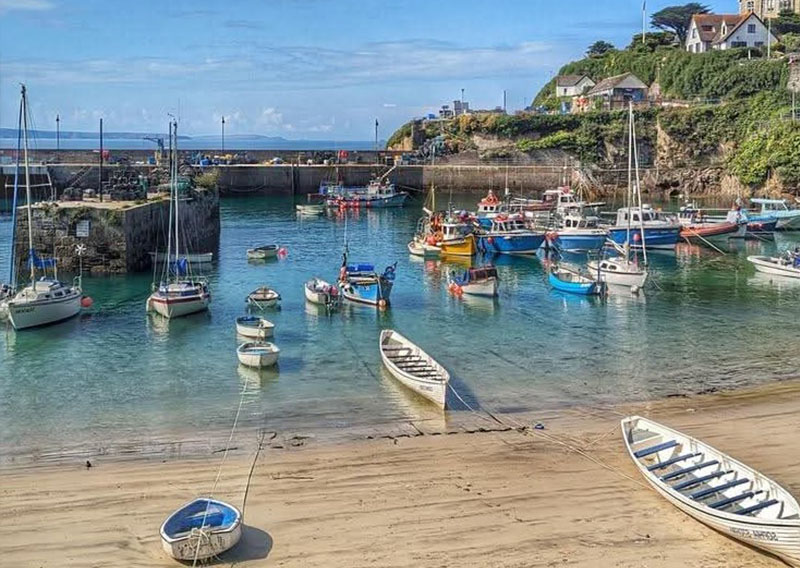
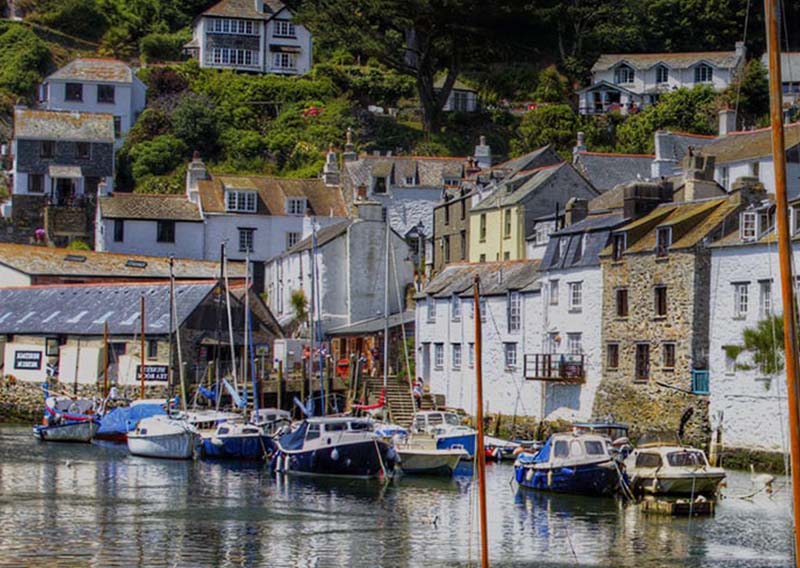
Porthelan Harbour
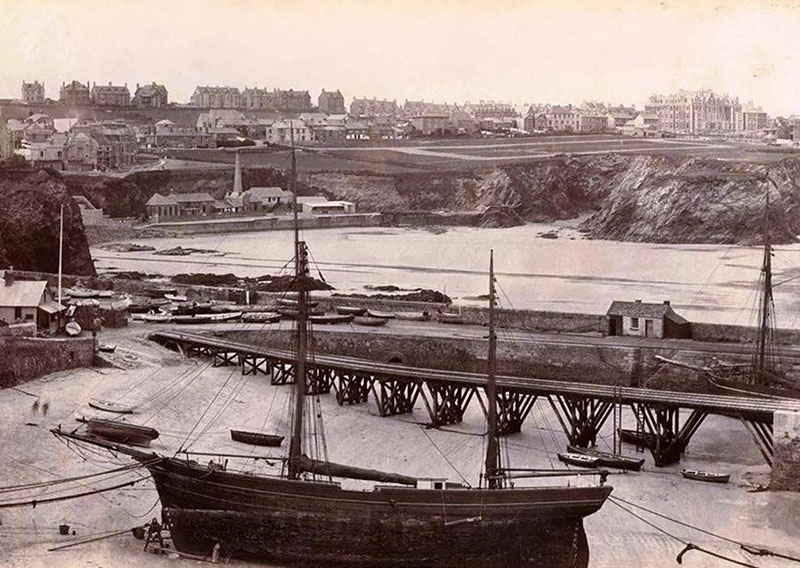
Porthelan Harbour c1860
Porthelan lies at the centre of Rathmor’s southern breadbasket, a harbour town where the produce of fertile farmland meets the riches of the highland molasses mines
The town of Porthelan sits at the meeting point of field and sea. Surrounded by Rathmor’s fertile southern farmlands, it has long been known as the heart of the island’s agricultural wealth. Golden wheat, sugar beet, and barley are carried in from the fields to its harbour, where warehouses brim with produce destined for both local use and export. Farmers’ markets have been held in Porthelan for centuries, and to this day the town celebrates an annual Harvest Fair, with processions, music, and competitions for the finest crops.
Yet Porthelan is not just a farming town. To the north and east lie the central highlands, where the unusual molasses mines were worked from the mid-19th century. This sticky, energy-rich resource, extracted from shale-like seams, was once considered a marvel, and Porthelan was its primary export point until sugar cane from Caerporth on Sorcha undercut the trade. For several decades, however, Porthelan thrived as the “sweet harbour,” sending casks of molasses to Britain and beyond.
The town itself retains a charm born of both industry and tradition. The harbour is lined with sturdy stone quays, and the church spire overlooks streets of slate-roofed houses. Today, Porthelan is a thriving community proud of its dual heritage: the breadbasket of Rathmor and the once-bustling port of the molasses mines.
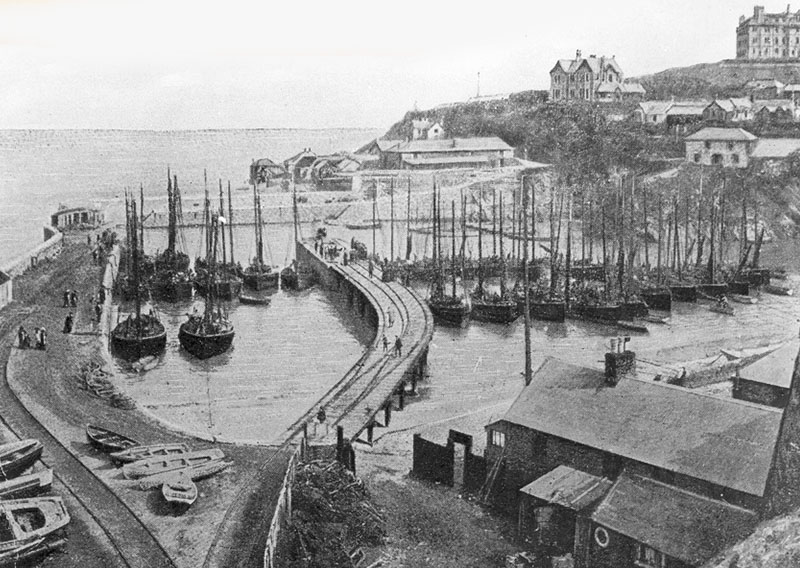
Porthelan Harbour c1890
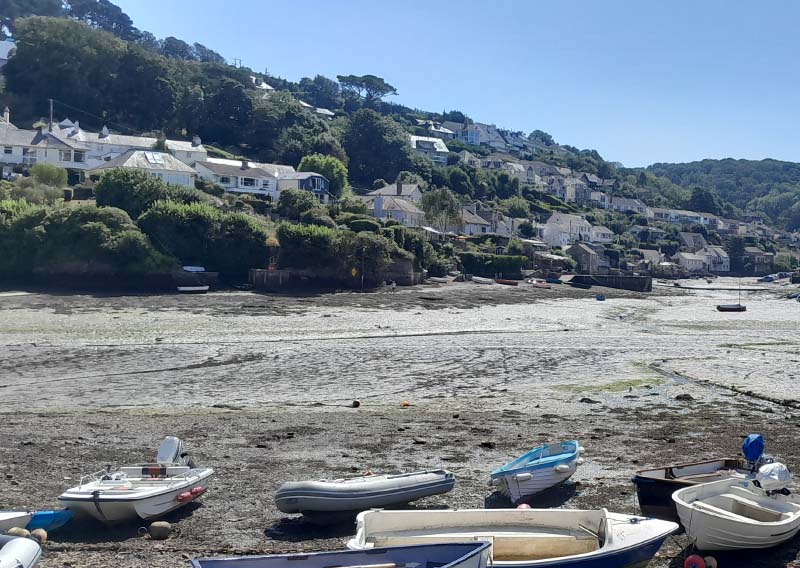
Low tide at Porthelan
Rathmor Molasses
The Molasses Mine of South Rathmor
Set in the rugged southern slopes of Rathmor, the Molasses Mine was established in the mid 19th century after geologists discovered thick seams of molasses shale. Unlike sugar cane molasses (a byproduct of sugar production), “molasses shale” in this case refers to an organic-rich sedimentary rock which, when processed, yielded thick, sweet-smelling oils and compounds. Early investors borrowed heavily to build extraction pits, tramways, and processing works, along with a narrow-gauge rail spur to link the mines to Porthelan
At its height, the mine supplied raw molasses shale to local refineries, where it was distilled for use in industrial lubricants, animal feed supplements, and as a precursor in certain fermentations. The mine employed miners, chemical engineers, and a host of ancillary workers — in transport, workshops, and refining. For a time the Molasses Mine was a source of prestige and profit for Rathmor, its products exported to other islands as well as overseas.
Decline and Closure
Several factors led to the mine’s decline and eventual closure:
-
Competition from Sorcha’s Sugar Cane Industry
As sugar cane plantations on Sorcha near Caerporth expanded heavily in the early to mid-20th century, the supply of true sugar-derived molasses grew dramatically. True molasses was cheaper, more widely available, and more familiar to users. Many of the same markets served by the Rathmor mine began to favor the genuine sugar molasses over shale-derived molasses products. Because sugar molasses could be produced in larger quantity, with simpler processing, it undercut the mine’s shale-derived produce on price. -
Rising Production Costs & Lower Yield
Molasses shale extraction proved energy-intensive, and processing required considerable chemical treatment. Over time, operating costs rose, especially as easier seams were exhausted. Transport of bulky shale also added costs, even with the spur line, especially compared with transporting refined sugar molasses from Sorcha to demand centers. -
Technological & Market Shifts
As chemical industries evolved, synthetic substitutes for some of the shale-derived compounds became possible, reducing demand. Also, changes in animal feed and lubricant formulations reduced reliance on the specific materials the mine produced. -
Regulatory, Environmental, & Health Pressures
Concerns about emissions, water runoff, and health impacts of shale dust grew, especially near residential areas. Regulations tightened, and the cost of meeting safety and environmental standards added burden.
By the mid-20th century, these pressures combined. A sharp drop in demand, coupled with slim profit margins, made the mine unsustainable. It ceased major operations in the 1960s. Today the mine is abandoned; old shafts, workshops, and the tramway remain visible in ruin, and local stories speak of the “sweet mine of Rathmor” and ghosts said to linger in the empty adits.
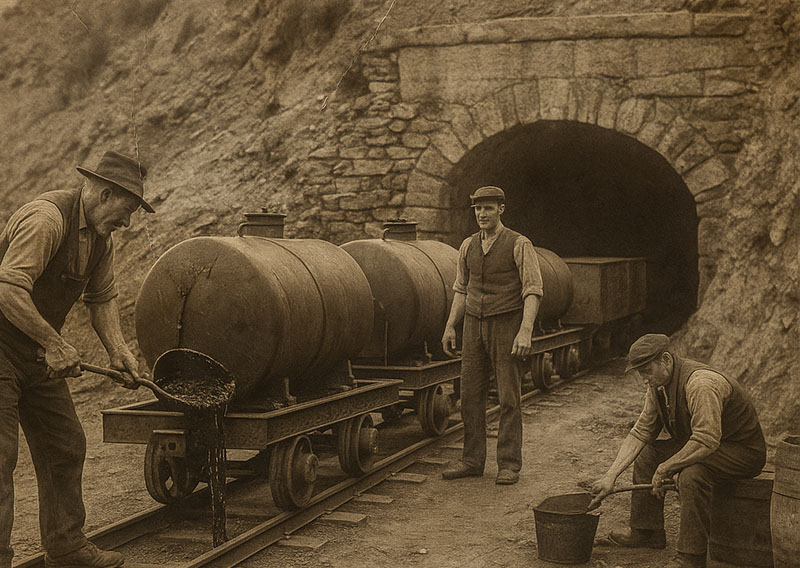
Rathmor Molasses Mine c1880
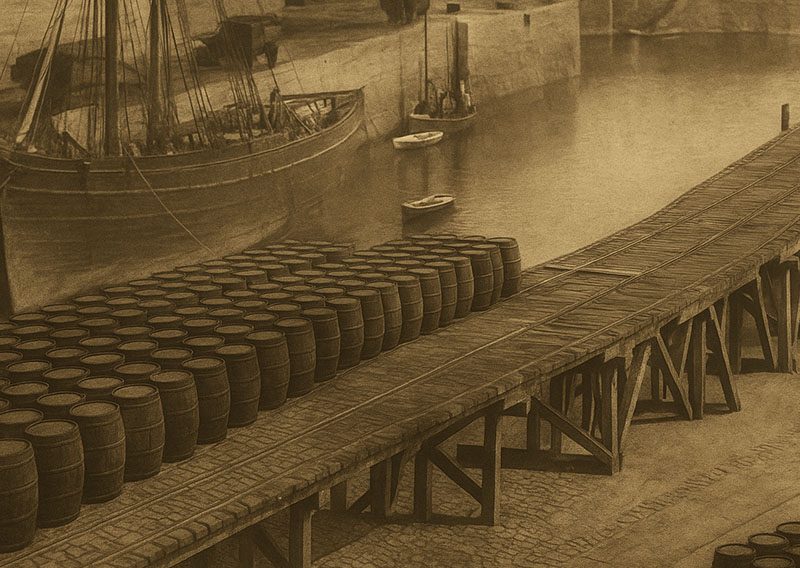
Molasses barrels at Porthelan Harbour c1870
Rathmor Cement
The Cement Works of Porthelan
Porthelan stands as one of Rathmor’s great industrial success stories, a town whose name has become synonymous with innovation in cement production. The origins of this prominence trace back to 1886, when the company unveiled the islands’—and indeed one of Europe’s—very first rotary kiln. This remarkable invention revolutionised cement manufacturing, offering far greater efficiency and consistency than the traditional static kilns that had dominated the industry for decades.
The success of the kiln transformed Porthelan from a modest coastal settlement into a thriving industrial hub almost overnight.
The raw materials required for the process were abundant across the islands. Limestone, quarried from the hills inland, provided the essential base for the cement mixture. Meanwhile, the island’s longstanding kelp-processing industry contributed another vital ingredient: potash, extracted from burned seaweed harvested at nearby Falachfaen. When combined, heated, and finely ground, these elements produced Rathmor’s own highly regarded interpretation of Portland cement. Known for its strength and reliability, this cement quickly gained a reputation for superior quality and became a cornerstone of the islands’ growing infrastructure.
Its first major tests came with the ambitious hydroelectric schemes constructed in the rugged interior during the early 20th century. Dams, spillways, and turbine halls all depended on the dependable material produced at Porthelan. Decades later, when construction began on the Falachor nuclear power station, it was once again Porthelan cement that formed the backbone of the vast concrete structures. This long-standing connection to major engineering projects cemented—quite literally—the town’s place at the heart of Rathmor’s industrial progress.
Today, the Porthelan works remain one of the largest employers on Rathmor, with hundreds of jobs tied directly to the cement trade, from quarrying and processing to transport and export logistics. Modernisation has expanded both capacity and reach, and the town now ships its cement to every corner of northern Europe, supplying everything from large construction firms to specialist engineering projects abroad.
Visitors to Porthelan will find a community proud of its industrial heritage—one built on ingenuity, natural resources, and more than a century of skilled craftsmanship. The roar of the kilns and the constant movement of freight speak to a town still very much in motion, as vital today as it was when the first rotary kiln began to turn.
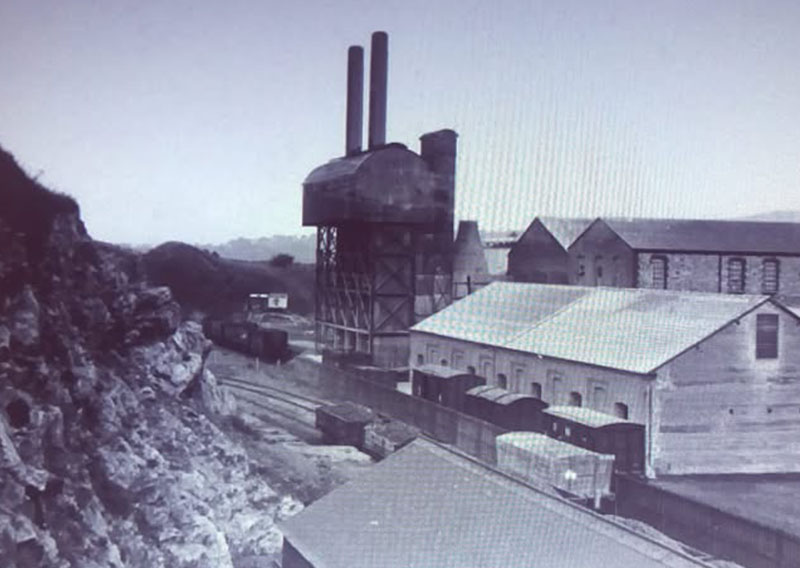
Rathmor cement works c1930
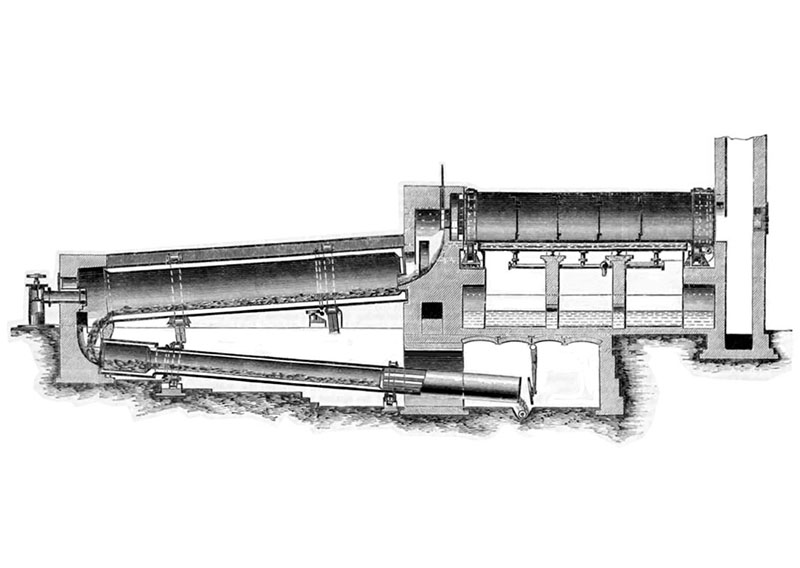
Rotary kiln design, Porthelan 1886
The Railways to Porthelan
The story of Porthelan’s railways reflects the town’s shifting role in the island’s economy. The earliest tracks were simple horse-drawn tramways, laid in the early 19th century to push into the forested interior in search of new logging sites. By 1852, one such tramway had reached Gorofan, linking the timber trade with Porthelan’s harbour.
The discovery of the molasses mines in the central highlands soon added urgency. By the mid-1850s, their own web of tramways carried barrels of the sticky product down towards the coast. At first horses sufficed, but by 1860 steam locomotives had arrived, transforming the trade. Timber and molasses rolled down the hills, and the ice trade—cut from the mountain glaciers near Gorofan—was also booming. Porthelan’s harbour bustled with exports, from food to fuel.
The next great leap came in 1875, when a link was forged from Talporth through the Gorofan Gorge, connecting Porthelan for the first time to Rathmor’s wider railway network. Just five years later, by 1880, a line eastward connected Porthelan to Abercain and Gwynhaven, creating the first continuous railway route from the western harbours of Rathmor to its eastern ports.
For Porthelan, the railway meant prosperity. Farmers could move crops swiftly, timber and ice reached wider markets, and even the molasses trade, though short-lived, was given a final flourishing chapter. The railways carried supplies into the town and produce away for export. Porthelan was a beautiful secluded and protected bay, but the harbour was prone to silting up. Only small boats and larger flat bottomed ships could get access, and even then it was tide dependent. The railways created links to deeper water at Talporth and eventually all the way to Llanchala.
Today, Porthelan remains a key stop on the east–west line, a reminder of how the iron road bound Rathmor’s coasts together for the first time.
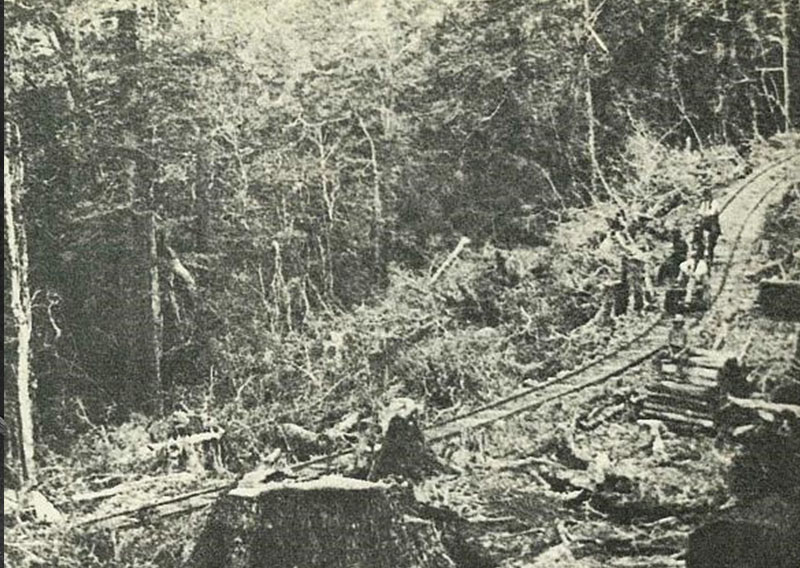
Logging tramway from Porthelan to Gorofan c1855
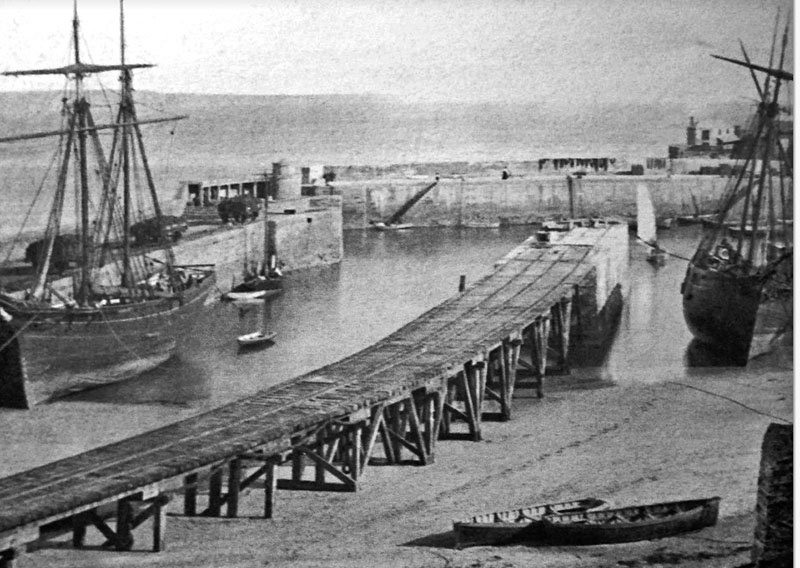
The new railway jetty at Porthelan Harbour c1860
History
Towns
Porthelan
Porthelan Maps
Porthelan
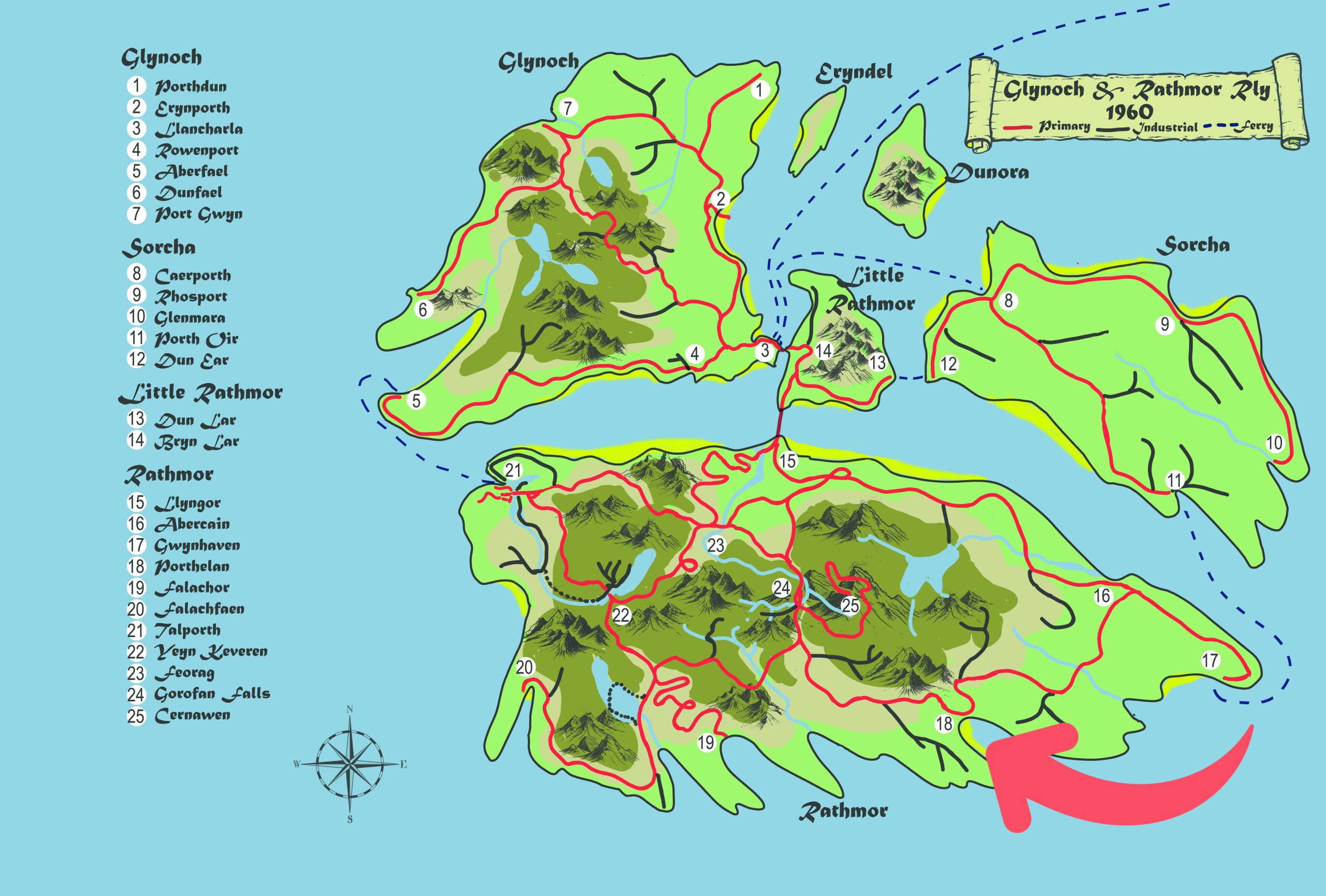
Located on the south coast of Rathmor
Explore More Towns...
...View All Towns