


1870: Llanchala & Eastern Coast Railway
Transformed a once isolated coastline into one of the island's most prosperous districts.
History

Railways

About the L&ECR
L&ECR Maps
Llanchala & Eastern Coast Railway (L&ECR)
At a glance:
Opened: 26 June 1870
Original route: Llanchala – Erynporth – Porthdun
Additional route: Erynporth Pier Branch, 1875
Principal promoter: Edward Penhallick, MP for Glynoch & Little Rathmor
Principal traffic: Fish, salt, agricultural produce, passengers and seaside excursions
Locomotive livery: Deep Blue
Passenger carriage livery: Grass Green and Ivory White
Associated railway: North Glynoch Railway
Independence ended: 1919
Successor: Glynoch & Rathmor Railway 1919
Transforming the East Coast
From the busy quays of Llanchala to the fishing harbours, sandy beaches and reclaimed marshlands of Glynoch's eastern coast, the Llanchala & Eastern Coast Railway helped transform a once-isolated coastline into one of the island's most prosperous districts. The railway owed much of its existence to the determination of Edward Penhallick, an Erynporth-born merchant, landowner and Member of Parliament who believed that the eastern coastal communities were being left behind as railways brought prosperity to other parts of the Caerwyn Isles. Authorised in 1868 and opened in 1870, the railway carried everything from freshly caught herring and sea salt to holidaymakers bound for Erynporth's fashionable seafront. In later years, its directors looked beyond their own coastal route, becoming influential supporters of the ambitious North Glynoch Railway. For almost half a century, the L&ECR remained an independent railway company, surviving the great railway consolidations of the late Victorian period before finally becoming part of the Glynoch & Rathmor Railway in 1919.
L&ECR Timeline
Llanchala & Eastern Coast Railway
Glynoch & Rathmor Rly
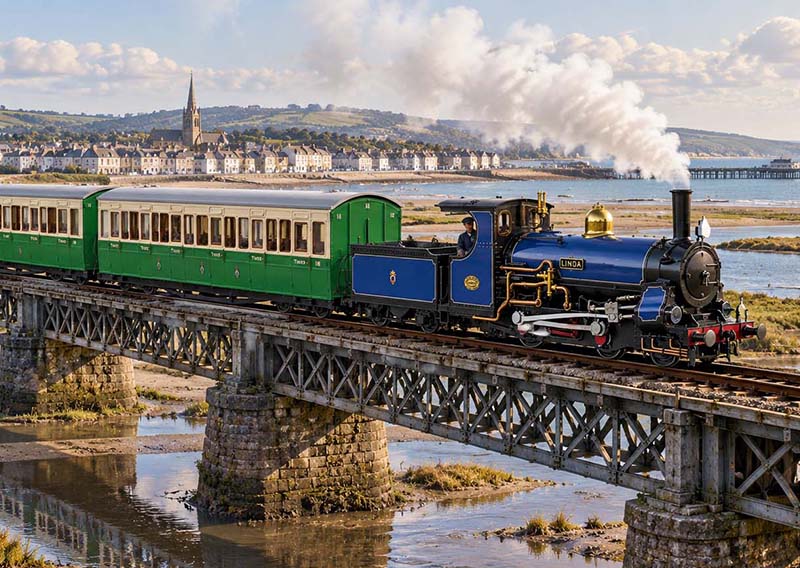
Departing Erynporth en-route for Llanchala
Origins: A Railway for the Eastern Coast
During the middle decades of the nineteenth century, the eastern coastline of Glynoch was undergoing considerable change. Llanchala had developed into one of the principal commercial and industrial centres of the Caerwyn Isles, its harbour handling an ever-increasing volume of goods. Further along the coast, Erynporth's fishing industry was flourishing, while the reclamation of extensive tidal marshlands around Porthdun was opening new opportunities for agriculture and industry. Yet communication between these communities remained difficult. The coastline was interrupted by broad sandy beaches, shifting dunes, salt marshes and tidal inlets. Roads were frequently unreliable, particularly in winter, and the movement of goods depended heavily upon coastal shipping and horse-drawn transport. For the fishing communities, delays could mean the difference between selling a valuable fresh catch and sending it for preservation. For the developing salt works and agricultural districts, transport costs threatened to limit further expansion. One of the most outspoken advocates for change was Edward Penhallick, a prosperous merchant and landowner born in Erynporth who had subsequently entered Parliament as the Member for Glynoch & Little Rathmor. Through his parliamentary duties and business interests, Penhallick had witnessed the extraordinary expansion of railways across Britain and the Caerwyn Isles. He had seen previously isolated towns transformed into thriving commercial centres, while communities without railway connections increasingly struggled to compete. He became convinced that the eastern coast faced precisely this danger. Penhallick argued that the railway was no longer a luxury for prosperous towns, but a necessity for those wishing to become prosperous. His campaigning attracted support from Erynporth's fishing merchants, Porthdun's agricultural interests and landowners along the proposed route. Among his supporters was Thomas Trevellan, a Porthdun merchant whose interests in salt production and agricultural transport made him particularly aware of the district's commercial disadvantages. While Penhallick provided the political influence and wider vision, Trevellan helped bring together the local businesses whose traffic would be essential to the railway's success. Together with other eastern coastal interests, they promoted a railway linking Llanchala, Erynporth and Porthdun. Unlike many early railways in the Caerwyn Isles, which had begun as short industrial tramways before gradually developing into public railways, the proposed L&ECR was intended from the outset as a continuous public railway serving several communities.

Edward Penhallick, MP (c.1868) Member of Parliament for Glynoch & Little Rathmor and the driving force behind the Llanchala & Eastern Coast Railway. Following his retirement from Parliament in 1869, Penhallick became the company's first chairman.
From Parliament to the Permanent Way
The promoters secured parliamentary authorisation in 1868, formally establishing the Llanchala & Eastern Coast Railway and allowing construction to proceed. Penhallick's experience in Parliament proved particularly valuable in guiding the proposal through the necessary legislative process. However, securing an Act was only the beginning. The company faced the considerable task of raising capital, acquiring land and constructing a railway across some of Glynoch's most difficult coastal terrain. The project required two years to complete, with engineers contending with shifting sands, tidal inlets and unstable marshland. Embankments, drainage works and iron viaducts were constructed to carry the railway across the low-lying landscape. In 1869, Penhallick retired from Parliament and accepted the chairmanship of the railway company he had worked so hard to establish. His appointment was welcomed by the eastern coastal business community, which regarded him as both the railway's principal champion and a figure capable of representing its commercial interests. The former MP now devoted his attention to bringing the railway into operation. On 26 June 1870, the complete Llanchala–Erynporth–Porthdun line opened to traffic, just two years after parliamentary authorisation. The occasion represented the culmination of years of campaigning by the eastern coastal communities and a personal triumph for Penhallick, whose belief in the railway's importance had helped bring the project into existence. For Erynporth, the railway offered a faster means of transporting fresh fish to Llanchala. For Porthdun, it provided an outlet for salt, agricultural produce and other goods from the reclaimed northern plains. Passenger services brought equally important changes, connecting communities which had previously depended upon slow and unreliable road transport. The railway had achieved its founding purpose: Glynoch's eastern coast was no longer being left behind.

Erynporth Pier

Erynporth Poster c1920
Erynporth and the Rise of Seaside Tourism
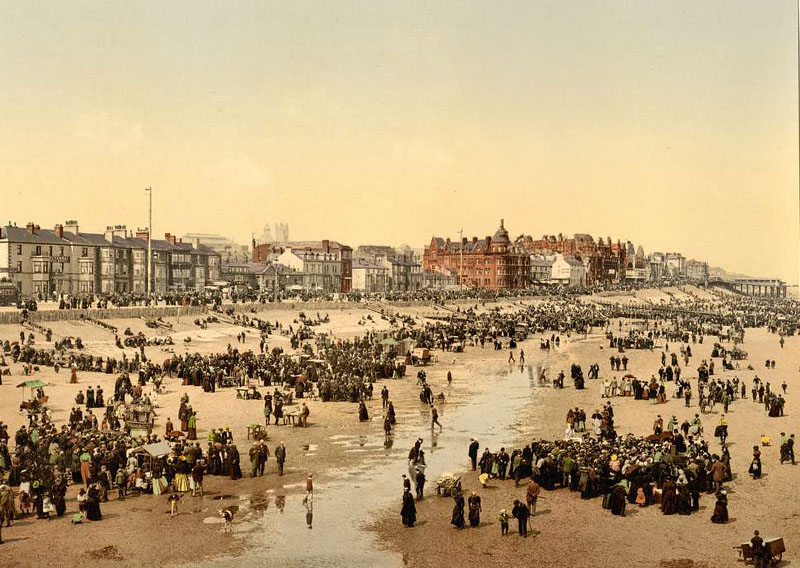
Erynporth's fishing industry had long been associated with the great seasonal herring catches known locally as the 'Silver Tide'. Its fishing boats, smokehouses and quays provided employment for generations of families, while its broad sandy beaches had remained largely the preserve of local residents. The opening of Erynporth's grand pier in 1860 had already begun to change the town's fortunes. Paddle steamers brought visitors from the mainland, establishing the foundations of a growing seaside holiday trade. The railway's arrival ten years later greatly accelerated this development. Visitors could now reach Erynporth conveniently from Llanchala and other parts of the island, while the connection between the railway and coastal steamers opened further opportunities for holiday travel. Recognising the growing importance of this traffic, the L&ECR opened a short branch to Erynporth Pier in 1875. The new connection allowed trains to serve the pier directly, providing convenient interchange with arriving and departing steamers. Holidaymakers could transfer between rail and sea transport with little difficulty, while the railway gained access to a growing and potentially lucrative source of passenger traffic. The branch also benefited the fishing industry, allowing catches landed near the pier to be transferred more efficiently into railway wagons. As Erynporth developed into a fashionable resort, hotels, guesthouses, tea rooms and entertainment venues appeared along its seafront. Seasonal excursions became an increasingly important part of the L&ECR's business. Yet the railway never lost sight of its original commercial purpose. Behind the holiday trains and seaside advertisements, fish wagons and goods services continued to provide an essential link between Erynporth's working harbour and the wider island economy.
The Industries of Porthdun
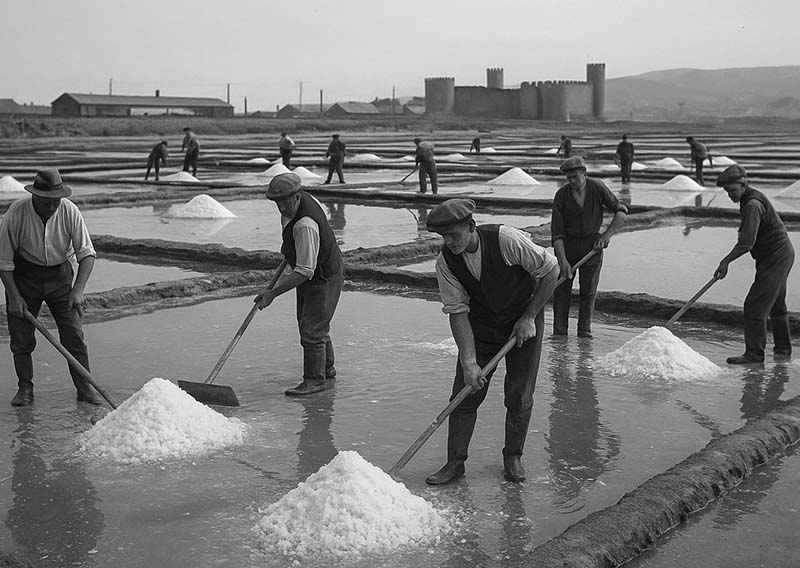
At the northern end of the original railway, Porthdun represented a very different opportunity. Extensive land reclamation had transformed former tidal marshes into productive farmland and industrial ground. The district became particularly associated with the production of sea salt, harvested from evaporation pans established across the reclaimed flats. Known commercially as the White Gold of Glynoch, the salt found markets throughout the islands, especially among the fishing, meat-preserving and food-processing industries. The L&ECR provided an important means of transporting this valuable commodity towards Llanchala and beyond. Agriculture also flourished on the reclaimed land. Cattle grazing and the movement of agricultural produce generated additional railway traffic, while the continuing development of the northern districts brought demand for building materials, machinery and general merchandise. Porthdun consequently became much more than a coastal terminus. It was an important commercial gateway to the reclaimed northern plains, and its growing traffic would eventually encourage the L&ECR's directors to consider opportunities extending far beyond the original railway.

Erynporth Pier 1876

Erynporth Pier Extension Map 1875
The Northern Ambition
By the closing decade of the nineteenth century, the Llanchala & Eastern Coast Railway had established itself as an important part of Glynoch's coastal transport network. Its directors, however, were increasingly aware of an opportunity developing far beyond Porthdun. The northern districts of Glynoch were undergoing considerable change. Extensive land reclamation had transformed former salt marshes into productive agricultural land, while the growing commercial interests of Port Gwyn were demanding better connections with the island's principal port at Llanchala. Although Port Gwyn was already connected to Llanchala by railway through the central highlands, the winding and difficult nature of that route made journeys comparatively slow. Local landowners, merchants and industrialists began promoting an alternative railway across the flatter northern districts, promising a faster and more direct connection between the two ports. The proposal attracted the attention of the L&ECR, whose directors recognised both its commercial potential and the opportunity to extend their company's influence without undertaking the entire venture themselves. The L&ECR became an important financial and engineering partner in the proposed North Glynoch Railway (NGR), contributing investment, technical expertise and practical assistance while allowing the new company to retain its independent identity. Crucially, the arrangement also provided the NGR with running rights over the L&ECR's existing network, allowing trains from the northern districts to reach Llanchala and make connections with the wider island railway system. The project also introduced an important new element of competition into Glynoch's railway network. The established central highland railway had already provided Port Gwyn with a connection to the rest of the island. The proposed northern crossing offered merchants and passengers another choice, with the prospect of shorter journeys and more competitive transport arrangements.
Port Gwyn at Last!
On 18 October 1901 the North Glynoch Railway completed its long-awaited northern crossing to Port Gwyn. The opening was celebrated as a major achievement, not only for the NGR and its promoters, but also for the communities and businesses which had supported the project. A ceremonial through train marked the completion of the new route, demonstrating the possibilities of railway travel across northern Glynoch and its connections with the wider island network. For the L&ECR, the occasion represented the successful culmination of years of financial and engineering cooperation. The new line provided an important source of additional traffic, with trains carrying agricultural produce, fish, commercial goods and passengers across the northern districts and onward towards Llanchala. Port Gwyn's expanding esparto grass industry was particularly well placed to benefit. The crop, used in papermaking and other industries, could now be transported more efficiently towards the paper mills of Llanchala. The L&ECR had played an important role in making the crossing possible, but the North Glynoch Railway remained an independent undertaking, governed by its own commercial interests. Together, the two companies had established a powerful new transport corridor across Glynoch, providing a serious alternative to the older central highland route.

Porth Dun Poster

Porth Dun Salt Co
Competition and Cooperation
The opening of the northern crossing marked a new chapter in the history of Glynoch's railways. The L&ECR, NGR and Great Central Railway each possessed their own routes, commercial interests and ambitions. Competition for goods and passenger traffic was inevitable, particularly where alternative routes offered access to the same markets. Yet the geography of the island also encouraged cooperation. The L&ECR's coastal railway provided an important connection to Llanchala, while the NGR opened the northern districts to faster through traffic. The Great Central Railway continued to serve the established central highland corridor, including communities which depended upon its more difficult but strategically important route. Rather than one company immediately swallowing its competitors, Glynoch developed a network of independent railways whose services increasingly depended upon practical working arrangements and connections. For passengers, this offered a growing choice of routes. For merchants and industrialists, it encouraged competition while making it possible to move goods across an ever-wider railway system. The L&ECR benefited from both developments. Its original coastal railway remained essential to local communities, while its involvement with the NGR strengthened its position in the wider island economy.
War and Consolidation
The outbreak of the First World War in 1914 brought new demands upon the railways of the Caerwyn Isles. As transport priorities changed, cooperation between the independent railway companies became increasingly important. The efficient movement of essential goods, industrial materials and passengers required coordination across routes which had previously been managed by separate undertakings. The L&ECR, North Glynoch Railway and Great Central Railway worked more closely with the Glynoch & Rathmor Railway during the war years, demonstrating the practical advantages of a more unified railway network. Although each company retained its independence throughout the conflict, the experience strengthened the case for consolidation. In 1919, the Llanchala & Eastern Coast Railway, North Glynoch Railway and Great Central Railway were absorbed into the Glynoch & Rathmor Railway. The amalgamation brought the principal northern and central Glynoch routes under the control of the G&R, ending almost half a century of independent operation for the L&ECR. Its railway, however, remained an essential part of the island's transport system.
Legacy
The Llanchala & Eastern Coast Railway left a lasting mark upon the communities it served. Its original line transformed the movement of goods along Glynoch's eastern coast, providing fishing communities, farmers and manufacturers with reliable access to wider markets. At Erynporth, the railway helped turn an established fishing harbour into one of the Caerwyn Isles' best-known seaside resorts. The pier branch, excursion services and connections with coastal steamers contributed to a thriving holiday industry whose influence continued long after the company itself had disappeared. At Porthdun, the railway supported the development of reclaimed land, salt production and agriculture, helping create the prosperous northern districts which would eventually demand their own railway connections. Perhaps its greatest achievement, however, lay beyond the limits of its original route. By supporting the creation of the North Glynoch Railway, the L&ECR helped establish a faster alternative across the northern plains to Port Gwyn. Its financial investment, engineering experience and willingness to provide access over its own tracks contributed to one of the most important railway developments on Glynoch at the turn of the twentieth century. Although the L&ECR lost its independent identity in 1919, its coastal railway continued to carry passengers and goods as part of the Glynoch & Rathmor Railway. Its legacy was not simply a line of rails beside the sea, but a railway which helped shape the commercial geography of an entire island.
History
Railways
About the L&ECR
L&ECR Maps
Llanchala & Eastern Coast Railway

Erynporth Harbour Branch Extension 1875

Related Articles....
SeaSalt – The White Gold of Porthdun
What was once a bleak stretch of brackish wetland became […] ...

1855: Glynoch Mineral Railway Company
From Llanchala’s industrial districts to the mountains and western shores […] ...

1859: Llanchala & South West Railway
The railway that united Glynoch’s southern coast, linking coastal communities […] ...

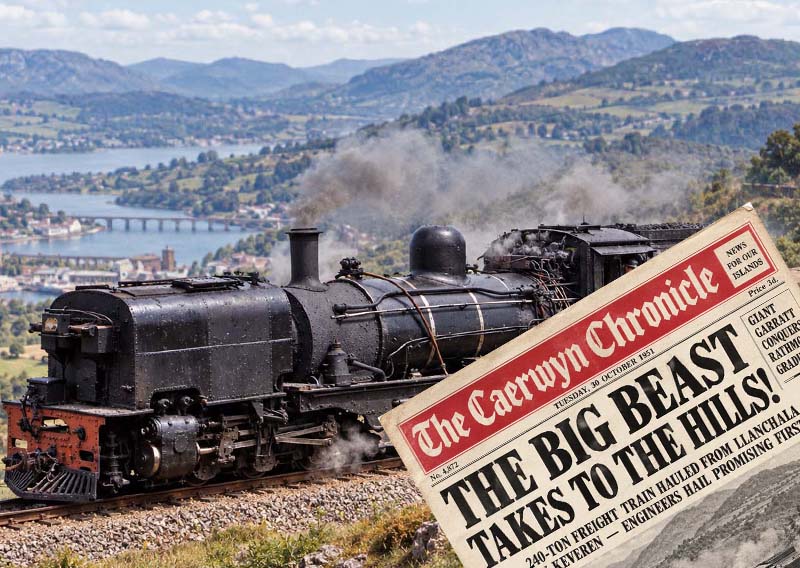
1951: The Big Beast Takes to the Hills
29th October: Just seven days after arriving the enormous new […] ...
Explore More Railways of Glynoch and Rathmor....


Island Railways PRE 1880
The railways began their transformation from scattered industrial tramways into […] ...
0 Comments