



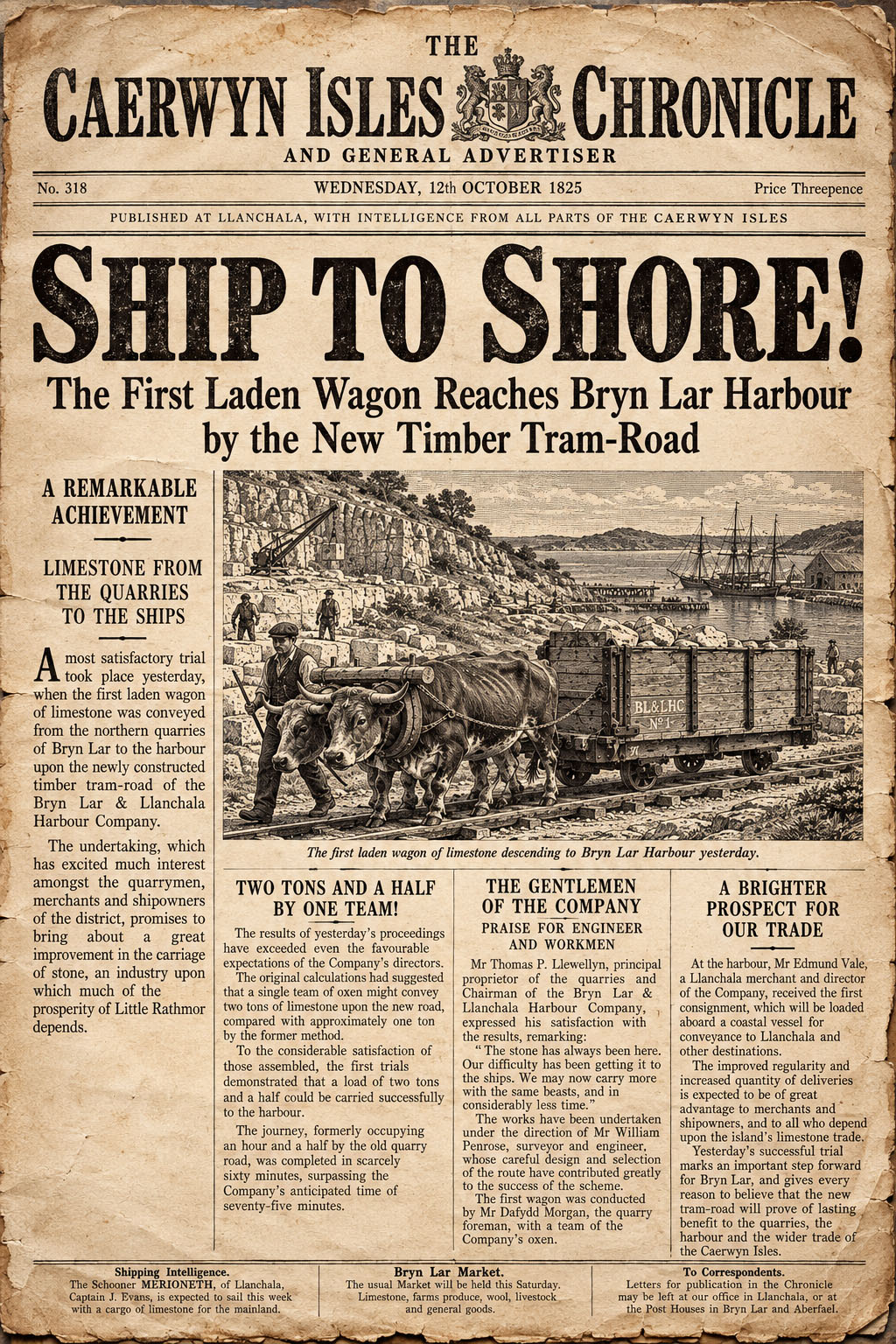
1825: Ship to Shore!
11th October: Remarkable Success of the New Bryn Lar Tram-Road — First Laden Wagon Reaches the Harbour
The first loaded limestone wagon reaches Bryn Lar Harbour
On this day in 1825, an ox team hauled two and a half tons of limestone along a newly constructed timber tram-road from the northern quarries of Little Rathmor to Bryn Lar Harbour. The undertaking was the work of the Bryn Lar & Llanchala Harbour Company, established to improve the movement of stone from the quarries to the waiting coastal vessels. The opening-day trials exceeded expectations. The new tram-road carried 25% more stone than the company had predicted, while reducing the journey from approximately 90 minutes on the old road to just one hour. The company's directors celebrated a promising commercial achievement. They could scarcely have imagined that their modest wooden tram-road would later be recognised as the earliest known railway in the Caerwyn Isles.
Our reconstructed newspaper report, dated 12 October 1825, tells the story as readers of the time might have encountered it....

Bryn Lar & Llanchala Harbour Company Tramway
Caerwyn Isles Chronical October 12th 1825
Ship to Shore! The Caerwyn Isles Chronical, 12th October 1825
A most satisfactory demonstration of mechanical ingenuity and commercial enterprise took place yesterday, when the first laden wagon of limestone was conveyed from the northern quarries to Bryn Lar Harbour upon the newly constructed timber tram-road of the Bryn Lar & Llanchala Harbour Company. The undertaking, which has attracted considerable interest amongst the quarry proprietors and merchants of the district, promises to bring about a substantial improvement in the carriage of stone, an industry upon which much of the prosperity of Little Rathmor depends. Until now, the conveyance of limestone from the quarry workings to the shore has been attended by considerable difficulty. The old roads, frequently rendered troublesome by ruts, loose stones and inclement weather, have obliged the employment of heavy teams and repeated journeys to deliver sufficient stone for loading aboard the coastal vessels.
The new tram-road offers a most ingenious remedy. Constructed with rails of timber obtained from the island's forests, the road permits specially adapted carts, fitted with flanged wheels, to follow a fixed course between the quarries and the harbour. Teams of oxen provide the motive power, drawing their heavy burdens along the wooden rails with considerably less resistance than upon the ordinary road.
A most Satisfactory Trial
The results of yesterday's proceedings have exceeded even the favourable expectations of the company's directors. The original calculations had suggested that a single team of oxen might convey two tons of limestone upon the new road, compared with approximately one ton by the former method. To the considerable satisfaction of those assembled, the first trials demonstrated that a load of two and a half tons could be carried successfully to the harbour.
Equally gratifying was the time occupied upon the journey. Where the old road had demanded approximately an hour and a half, the new tram-road completed the passage in scarcely sixty minutes, comfortably surpassing the company's anticipated journey time of seventy-five minutes. The improvement promises not merely to ease the labour of the animals, but to permit a substantially greater quantity of stone to be delivered to the harbour during the working day.
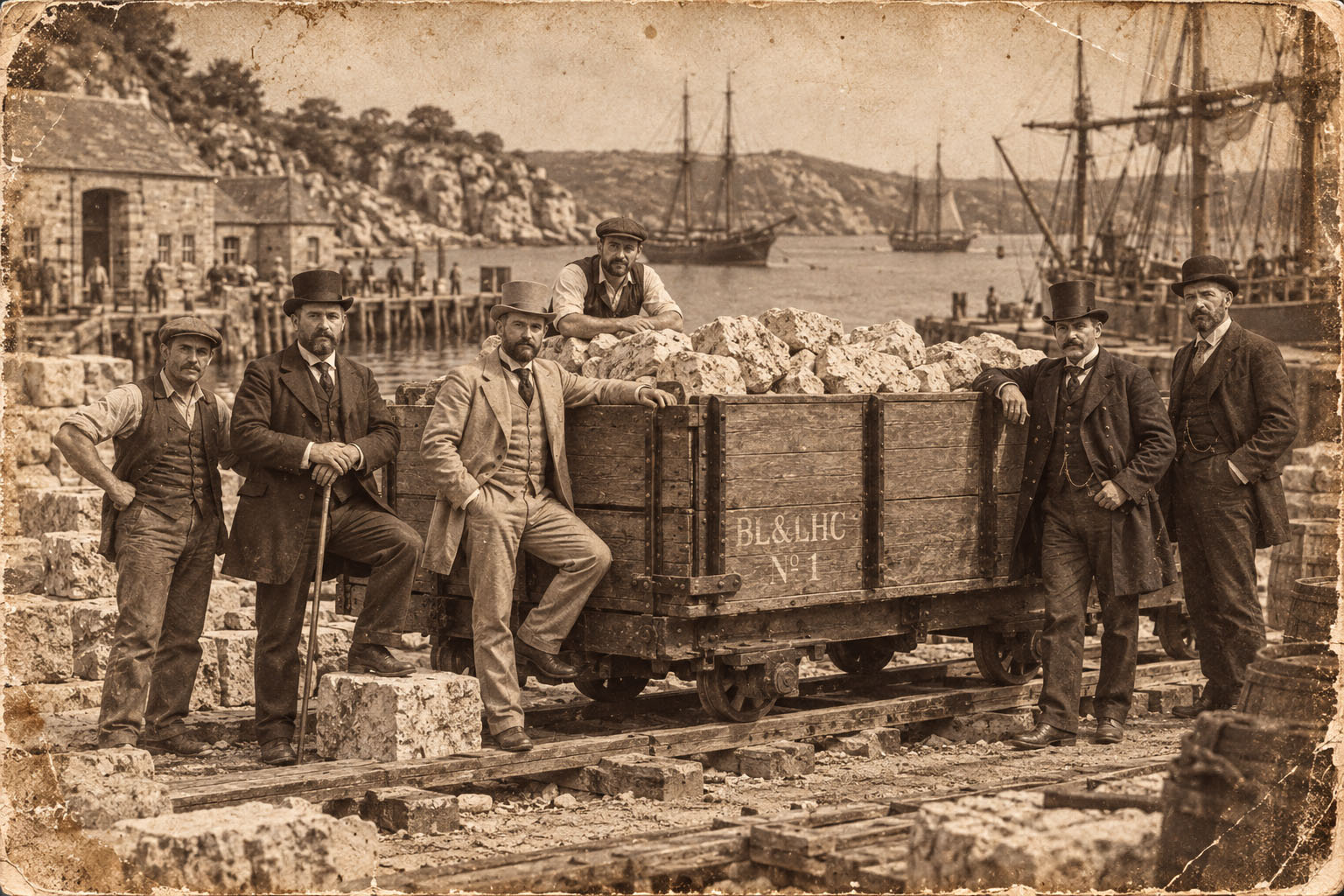
The Men Behind the Bryn Lar Tram-Road
The Men Behind the Bryn Lar Tram-Road
Company officials and quarry workers gather beside the first limestone wagon at Bryn Lar Harbour following the successful opening-day trials. Pictured in suits from left to right are Dafydd Morgan, quarry foreman; Thomas P. Llewellyn, quarry proprietor and company chairman; William Penrose, surveyor and engineer; and Edmund Vale, Llanchala merchant and company director, accompanied by two unidentified company employees. The wagon, marked BL&LHC No. 1, carried two and a half tons of limestone to the harbour, exceeding the company's original expectations.
Mr Thomas P. Llewellyn, principal proprietor of the quarries and chairman of the Bryn Lar & Llanchala Harbour Company, whose enterprise and investment have been instrumental in bringing the undertaking to completion. Mr Llewellyn expressed considerable satisfaction with the results, remarking:
"The stone has always been here. Our difficulty has been getting it to the ships. We may now carry more with the same beasts, and in considerably less time."
The construction of the tram-road has been undertaken under the direction of Mr William Penrose, surveyor and engineer, whose careful selection of the route and arrangement of the timber rails have contributed greatly to the success of the scheme. The first laden wagon was conducted from the quarry workings under the supervision of Mr Dafydd Morgan, the quarry foreman, who has been closely concerned with the practical arrangements for working the new road.
At Bryn Lar Harbour, Mr Edmund Vale, a Llanchala merchant and director of the company, joined representatives of the local shipping interests in receiving the first consignment.
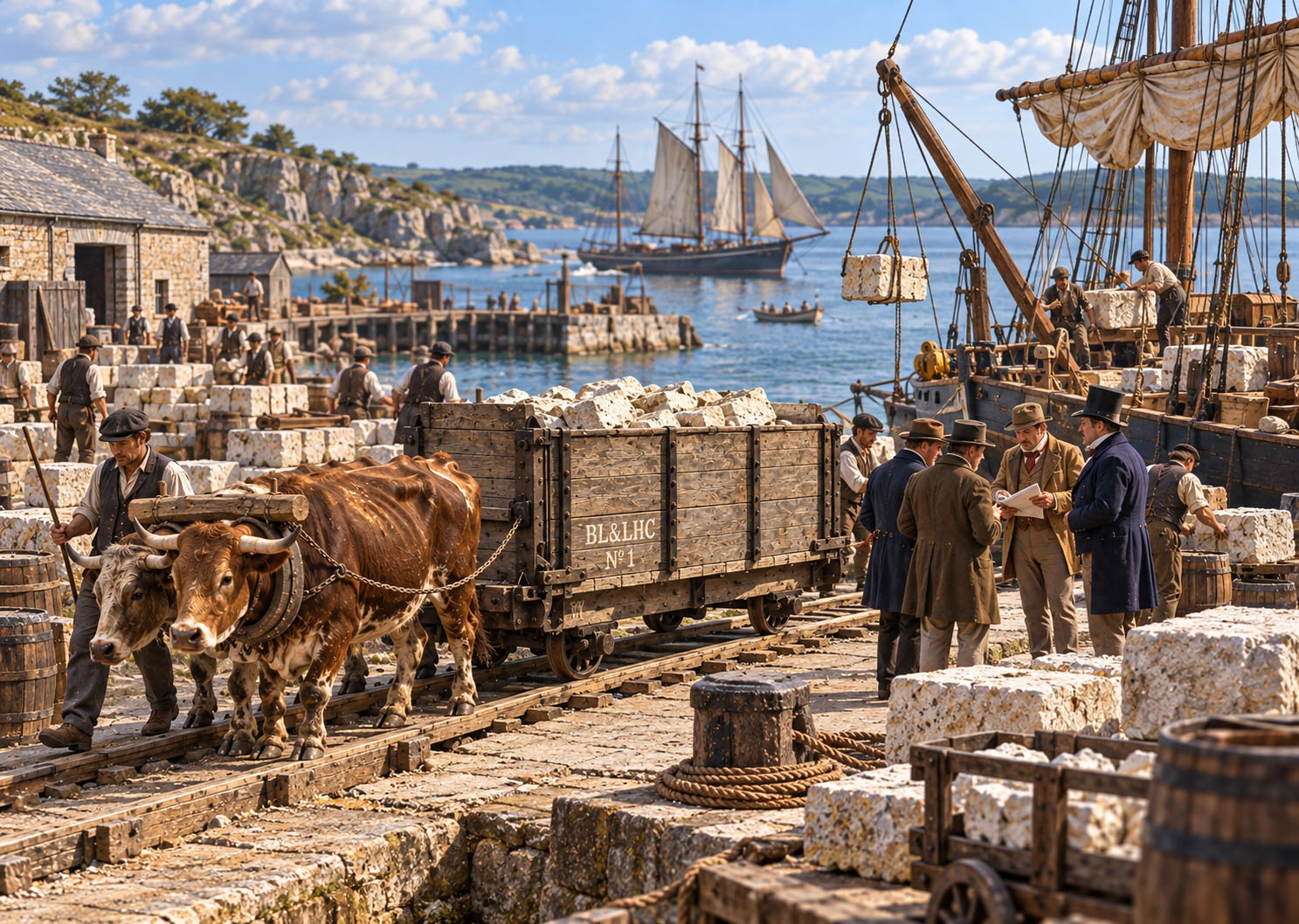
Bryn Lar c1840
Exciting Prospects for the Limestone Trade
The commercial importance of the undertaking is considerable. Limestone from the northern quarries is increasingly required for building, roads, wharves and harbour improvements throughout the islands. The growing port of Llanchala, lying across the channel from Bryn Lar, provides a particularly valuable market. Under the company's arrangements, stone will be brought by tram-road to the Bryn Lar wharves, where it may be stored or transferred directly aboard coastal vessels for conveyance to Llanchala and other destinations. Mr Vale is understood to regard the improved regularity of deliveries as being of particular advantage to merchants and shipowners, who have frequently experienced delays whilst awaiting sufficient quantities of stone for loading.
Although yesterday's trials have been attended with conspicuous success, the undertaking remains a practical working enterprise, and its performance under the demands of regular trade will be watched with interest. Nevertheless, there can be little doubt that the gentlemen of the Bryn Lar & Llanchala Harbour Company have provided the island's limestone industry with a most promising improvement. For the quarrymen, the merchants and the mariners who depend upon the stone trade, yesterday was indeed a day worthy of remembrance.
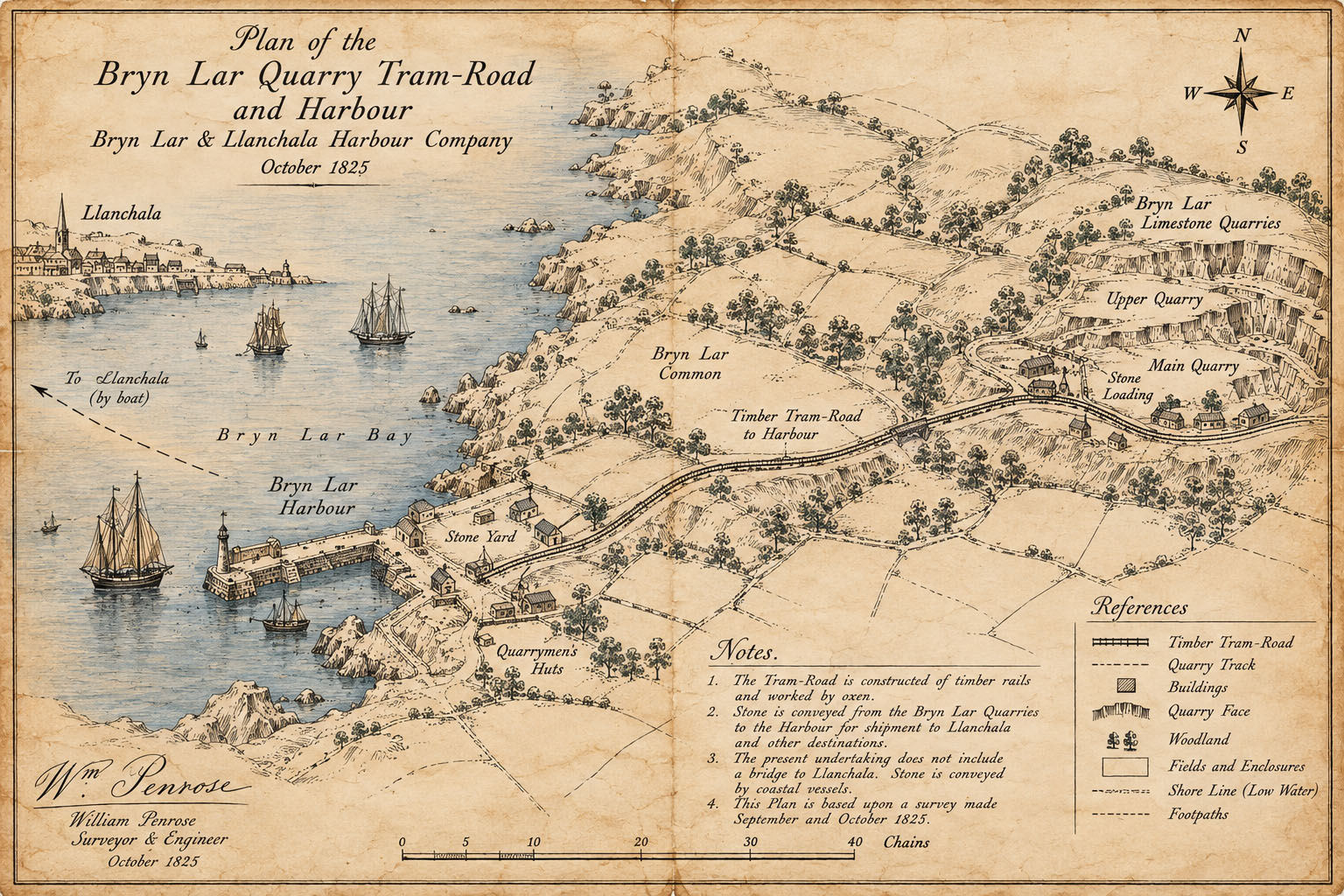
Bryn Lar Tramway Map 1825
Related Articles...


1825: Bryn Lar & Llanchala Harbour Company
The railway history of the Caerwyn Isles begins not with […] ...
1871: Little Rathmor Railway
From the limestone quarries to woollen mills and bustling harbours, […] ...

...View All
More Headlines...

0 Comments