

1863: Talporth Funicular Railway
The little railway that helped build a town
History

Railways

About the T&FR
T&FR Maps
Talporth Funicular Railway (TFR)
At a glance:
Opening date: 3 October 1863
Island: Rathmor
Location: Talporth
Route: Talporth Quay – Talporth High Level Station
Length: 528 feet
Vertical rise: 196 feet
Journey time: Approximately four minutes
System: Water-balanced cable funicular
Cars: Two counterbalanced passenger cars
Engineer: David Penhaligon
Water source: The Dragún, descending from Dragons Head
Original fares: Uphill 1d; downhill ½d
Initial controlling interest: Talporth & Feorag Railway
Popular nickname: The Drop
The little railway that helped build a town
Before the arrival of the railways, Talporth was a small fishing town and modest port situated at the estuary of the Tal River. Its inhabitants made their living principally from fishing, coastal trade and the activities associated with the harbour. The steep hillsides surrounding the town remained largely undeveloped, with little reason for anyone to venture regularly onto the higher ground. The arrival of the Talporth & Feorag Railway in 1860 began to change everything. New railway connections brought increasing commercial activity, passengers and opportunities for trade. Within just two years, further railway development had led to the construction of Talporth High Level station, perched on the hillside overlooking the original town. The new station represented an important advance in Talporth's railway connections, but its elevated position presented an immediate difficulty. Passengers travelling between the harbour and the station faced a steep climb, often with luggage, while those arriving by train had an equally awkward descent to reach the town below. An ingenious solution was found in the construction of a water-powered funicular railway, linking the quayside directly with the High Level station. Opened on 3 October 1863, the Talporth Funicular Railway transformed a difficult hillside journey into a comfortable four-minute ride. More importantly, it helped make the land surrounding the High Level station accessible for development. In the years that followed, shops, inns, accommodation and houses began appearing on the hillside, gradually forming the district that would become known as High Town. What had begun as a means of connecting a railway station to a fishing town would play a remarkable part in the transformation of Talporth into a thriving railway centre.
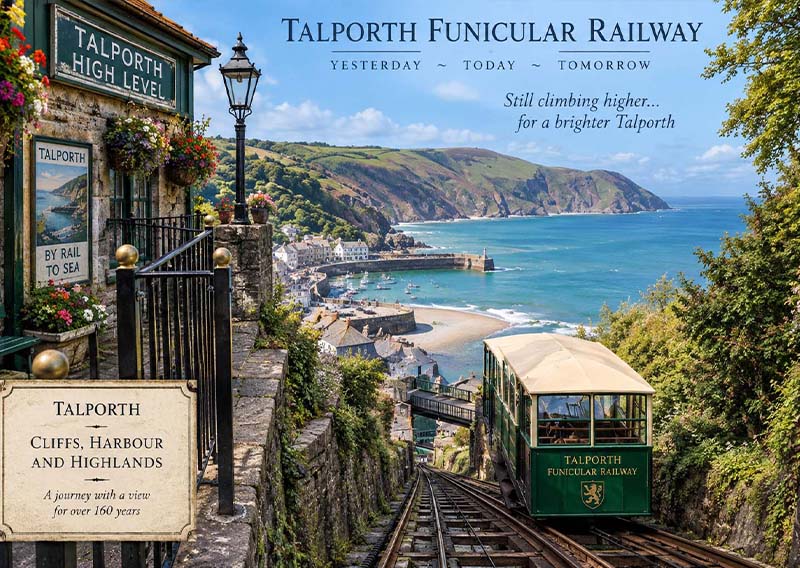
Talporth Funicular Railway
Origins: A Station Above the Town
The opening of the Talporth & Feorag Railway in 1860 marked the beginning of a remarkable period of railway expansion around Talporth. The town had already possessed a connection with the Tal Valley Tramway since 1845, but the development of passenger services and the reconstruction of the valley railway system brought new possibilities for travel and trade. In 1862, the Talporth & Feorag Railway and the Tal Valley Railway cooperated in the development of Talporth High Level station. Situated on the hillside above the harbour, the new station offered improved connections between railway services and helped establish Talporth as an increasingly important transport centre. However, its location presented a considerable inconvenience. The original fishing town occupied the lower ground around the harbour and river estuary. There was no established High Town, and the hillside above remained largely open land. The railway station had effectively created a new destination that was difficult to reach from the existing town. Passengers faced a steep ascent from the quayside, particularly troublesome for those carrying luggage. Horse-drawn vehicles were poorly suited to the gradient, while the climb was an unwelcome prospect for elderly travellers and visitors unfamiliar with the town. Old Hill Road provided a route up the hillside, but it was hardly an ideal connection for a growing railway station. It soon became apparent that the success of High Level station would depend upon providing a more convenient means of reaching it.
An Ingenious Proposal
The solution was a short inclined railway connecting the harbour directly with High Level station. The Talporth & Feorag Railway recognised the commercial advantages of such a scheme. An easier connection would encourage passengers to use its services, strengthen Talporth's position as a railway interchange and improve access to the developing railway facilities on the hillside. The promoters established the Talporth Funicular Railway Company as a separately managed undertaking under the initial control of the T&FR. This arrangement allowed the new railway to maintain its own staff, fares and operating accounts while remaining closely associated with the principal railway services. Responsibility for the engineering was entrusted to David Penhaligon, whose proposed solution made ingenious use of the natural water supply descending from Dragons Head. Rather than employ a steam engine to haul passengers up the incline, Penhaligon proposed a water-balanced system in which gravity would provide the motive power. It was an elegant answer to a difficult engineering problem.

Water Power from Dragons Head
The Talporth Funicular Railway was constructed as a water-balanced cable railway, with two passenger cars travelling in opposite directions on the steep hillside. The cars were connected by a cable passing around machinery at the upper station. By filling a tank beneath the upper car with water, the descending car could be made sufficiently heavy to draw the lower car uphill. At the bottom of the incline, the water was discharged and the process repeated for the next journey. The necessary water was supplied by the Dragún, descending from Dragons Head above Talporth. This reliable natural resource allowed the railway to operate without the need for a conventional locomotive or a stationary steam engine to provide its normal motive power. The braking machinery controlled the movement of the cars, allowing passengers to make the journey safely and at a comfortable speed. Although only 528 feet long, the railway climbed an impressive 196 feet between Talporth Quay and High Level station. The journey took approximately four minutes. It was a remarkably effective solution. A climb that had previously been an inconvenience could now be completed with little effort, while the railway's unusual method of operation quickly became a source of local pride.
1863: NO MORE CLIMBING! Opening Day
The Talporth Funicular Railway was officially opened on Saturday, 3 October 1863. The ceremony was performed by Lady Constance, accompanied by Lord Rathmor and representatives of the railway companies and local commercial interests. David Penhaligon attended the celebrations with his twelve-year-old son Samuel, who witnessed the inauguration of his father's engineering achievement. Samuel would later develop an interest in similar railway engineering, becoming associated with the cliff railway at Lynton in North Devon. The opening attracted considerable public attention. Crowds gathered to watch the two passenger cars moving in opposite directions on the steep hillside, an unfamiliar sight to many of Talporth's inhabitants. For a town whose railway development had accelerated so rapidly, the funicular was another extraordinary achievement. The original fares were set at one penny for the uphill journey and a halfpenny for the descent. The difference was entirely practical. While many residents were prepared to walk downhill, the ascent from the harbour was precisely the inconvenience the new railway had been built to overcome.
NO MORE CLIMBING!:
The opening was celebrated in the local press, with the following day's newspaper proclaiming 'No More Climbing'
It was a headline that neatly captured the significance of the new railway for the people of Talporth. Read the full article here
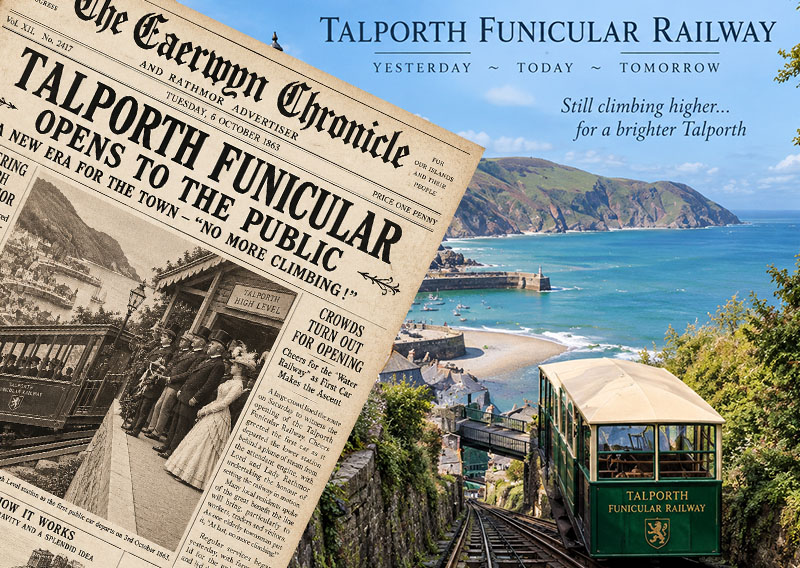
1863: Talporth Funicular Railway Opens
3rd October: NO MORE CLIMBING! Talporth’s Remarkable Water Railway Opens […] ...

Penhaligan inspecting works c1863

Opening day October 3rd 1863, including 12 year old Sam Penhaligon
The Drop Becomes Part of Everyday Life
Perhaps the funicular's most important contribution was not the passengers it carried, but the development it made possible. Before the arrival of the railways, the hillside above Talporth had remained largely undeveloped. The fishing town was concentrated around the harbour and the estuary of the Tal River, where its commercial activities had traditionally been based. The construction of High Level station in 1862 introduced a new centre of activity above the town, but the station alone was insufficient to encourage substantial development. The opening of the funicular changed that. With a convenient connection to the harbour below, the land around High Level station became increasingly attractive to businesses and residents. Inns and accommodation serving railway passengers were among the natural opportunities, followed by shops and other commercial establishments. Housing gradually appeared as the expanding railway economy brought new employment and encouraged people to settle in the area. Over time, the district became known as High Town, distinguishing it from the original settlement around the harbour. The two parts of Talporth developed different characters. The lower town retained its close relationship with fishing, shipping and the quayside trades, while High Town grew around the railway station and the businesses serving its passengers. The funicular provided the vital connection between them. In this respect, the little railway had achieved something considerably more important than saving passengers a difficult climb. It had helped create an entirely new part of Talporth.

Talporth Funicular Railway Ticket

Talporth Funicular Railway c1920
A Remarkable Independence
Perhaps the most remarkable aspect of the Talporth Funicular Railway is not simply its pioneering engineering, but its enduring independence. Although the Talporth & Feorag Railway played an important role in its establishment in 1863, the funicular was founded as a separate company and has remained independently operated ever since. While the great railway companies of the Caerwyn Isles gradually merged into the Glynoch & Rathmor Railway, the little funicular continued on its own path. Having survived more than a century and a half of railway amalgamations, reorganisations and changing fortunes, it holds the remarkable distinction of being the longest-surviving independent railway undertaking in the Caerwyn Isles. Its history is therefore one of continuity rather than changing ownership. A small but enduring exception to the great railway consolidations that shaped the islands.
Nine Years Without a Day Off
The Talporth Funicular Railway also holds one of the more unusual records in Caerwyn railway history. Between 17 August 1895 and 16 August 1904, the little railway carried passengers on an extraordinary 3,287 consecutive days, more than nine years without a single day's closure. The remarkable run finally ended on 17 August 1904, when the company announced a week's suspension of services to replace worn mechanical components and undertake a thorough overhaul of the winding machinery. Following seven days of intensive work, the funicular reopened on 24 August, returning to its familiar daily routine. The achievement became a source of considerable local pride, with generations of Talporth residents fondly recalling the railway that seemingly never took a day off.
A Railway of Its Own
The Talporth Funicular Railway occupied a distinctive position among the growing network of railways on Rathmor. Unlike the mineral tramways and passenger railways that connected towns, quarries and industries across the island, the funicular existed to overcome a single geographical obstacle. Its route was short, its operating methods unusual and its relationship with the larger railway companies particularly close. Nevertheless, its contribution to Talporth's development was substantial. As the railway companies of Rathmor moved towards greater cooperation and eventual consolidation, the funicular remained an important link between the harbour and the expanding railway facilities above. Its value lay not in the distance travelled, but in the accessibility it provided. It was a reminder that railway engineering did not always require ambitious routes across valleys and mountains to transform the fortunes of a community. Sometimes a few hundred feet of track could make all the difference.
A Lasting Legacy
The opening of the Talporth Funicular Railway in 1863 was far more than the introduction of a convenient way to climb a steep hillside. It helped transform a small fishing town into a growing railway centre, opening up the higher ground for development and laying the foundations of what would eventually become Talporth's High Town. And the funicular was by no means the last railway to arrive in Talporth. The Tal Valley Tramway had opened in 1845, followed by the Talporth & Feorag Railway in 1860, the Tal Valley Railway in 1862 and now the Talporth Funicular Railway in 1863. Four railways in less than twenty years was quite an achievement for a small fishing town. Yet Talporth had one more remarkable railway still to come. In 1885, the Dragons Head Electric Tramway would bring an entirely new form of railway transport to the hills above the town.
But that is a story for another day…
History
Railways
About the T&FR
T&FR Maps
Talporth Funicular Railway (TFR)


Related Articles....
The Slate Industry of Yeyn Keveren
Slate was first discovered here in the early 18th century, […] ...
1951: The Big Beast Takes to the Hills
29th October: Just seven days after arriving the enormous new […] ...

Railways of Rathmor
Rathmor’s railways are feats of daring engineering, snaking up cliff-sides, […] ...
Explore More Railways of Glynoch and Rathmor....


Island Railways PRE 1880
The railways began their transformation from scattered industrial tramways into […] ...
0 Comments