

1845: Tal Valley Tramway
An early mineral plateway connecting the workings at Yeyn Keveren with the port of Talporth, transporting minerals through the rugged Tal Valley.
History

Railways

Tal Valley Tramway
TVT Maps
Tal Valley Tramway (TVT)
At a glance:
Opened: 1845
Island: Rathmor
Route: Yeyn Keveren – Tal Valley – Talporth
Type: Mineral and industrial tramway
Track: Iron rails on wooden sleepers
Rolling stock: Small four-wheeled mineral wagons with metal-flanged wheels
Original operation: Gravity-worked loaded mineral wagons; horse-hauled return journeys; rope-worked inclines on the steepest sections.
Principal traffic: Slate and mineral products; supplies carried uphill
Passenger service: None during the tramway period
Rebuilt: 1862 as Tal Valley Railway, when passenger services began
Later successor: Rathmor Railway (formed 1879), then Glynoch & Rathmor Railway (1885)
Notable survival: Old plateway section reused for clay and sand traffic to Talporth Brickworks, later worked by small steam locomotives
Origins in the Tal Valley
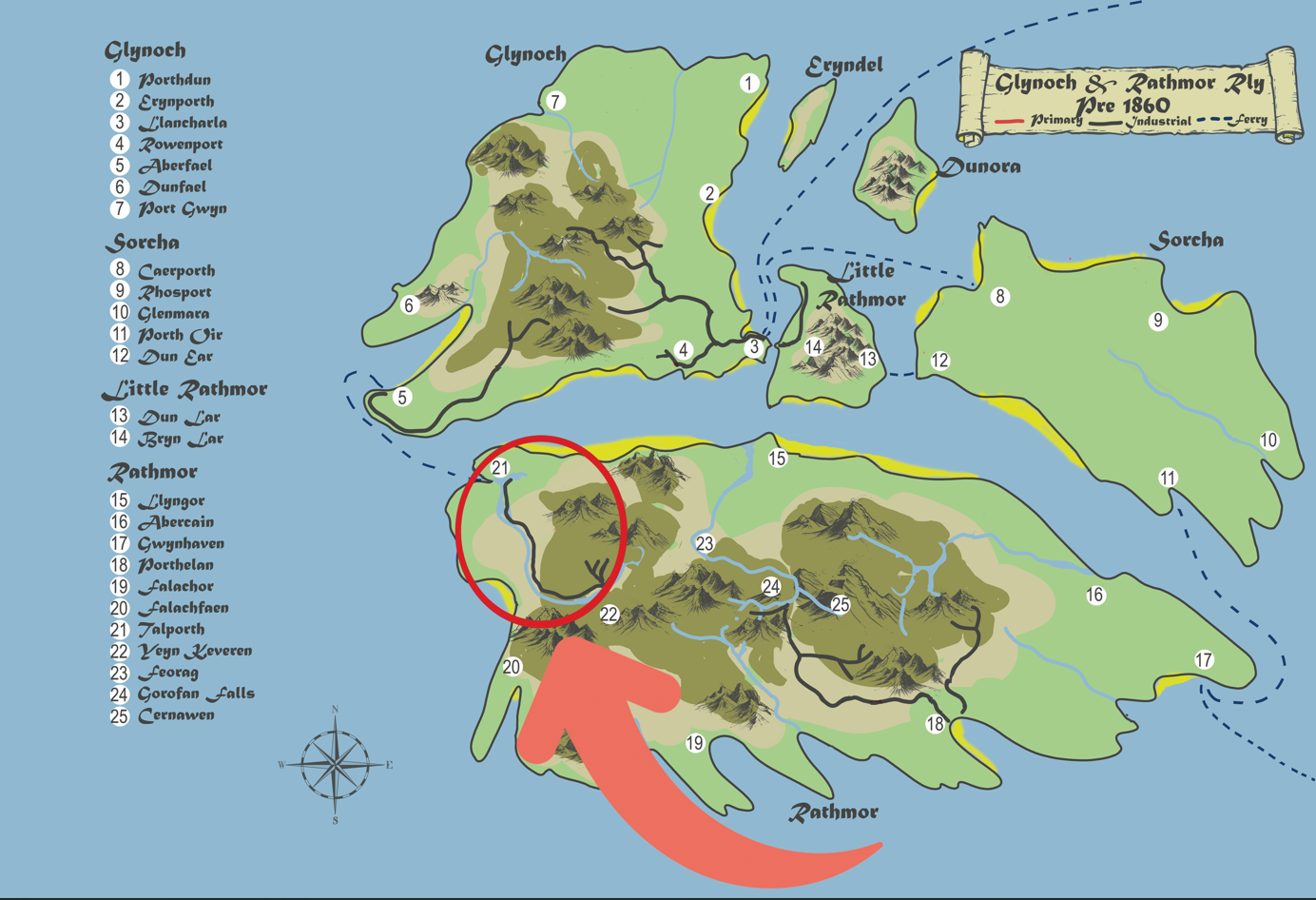
Long before steam locomotives reached Rathmor, the mineral wealth of the Tal Valley had attracted commercial interest. Around Yeyn Keveren, slate and other minerals were extracted from workings scattered across steep and rugged hillsides. The natural outlet for this traffic was Talporth, whose harbour and navigable river already supported coastal trade. Moving heavy loads between the workings and the port, however, was difficult. Roads were steep and rough, and ordinary carts could move only limited quantities at considerable expense. In 1845 the Tal Valley Tramway opened to provide a more dependable industrial connection between Yeyn Keveren and Talporth. Unlike a public passenger railway, it was built first and foremost to serve the mineral industry. Its significance lay in making the valley's resources easier to move to market and in establishing a rail corridor that later generations would enlarge and rebuild.
Tal Valley Tramway Timeline
Tal Valley Tramway
Tal Valley Railway
Rathmor Railway
Glynoch & Rathmor Rly

Gravity wagons descending towards Talporth
Building the Tramway
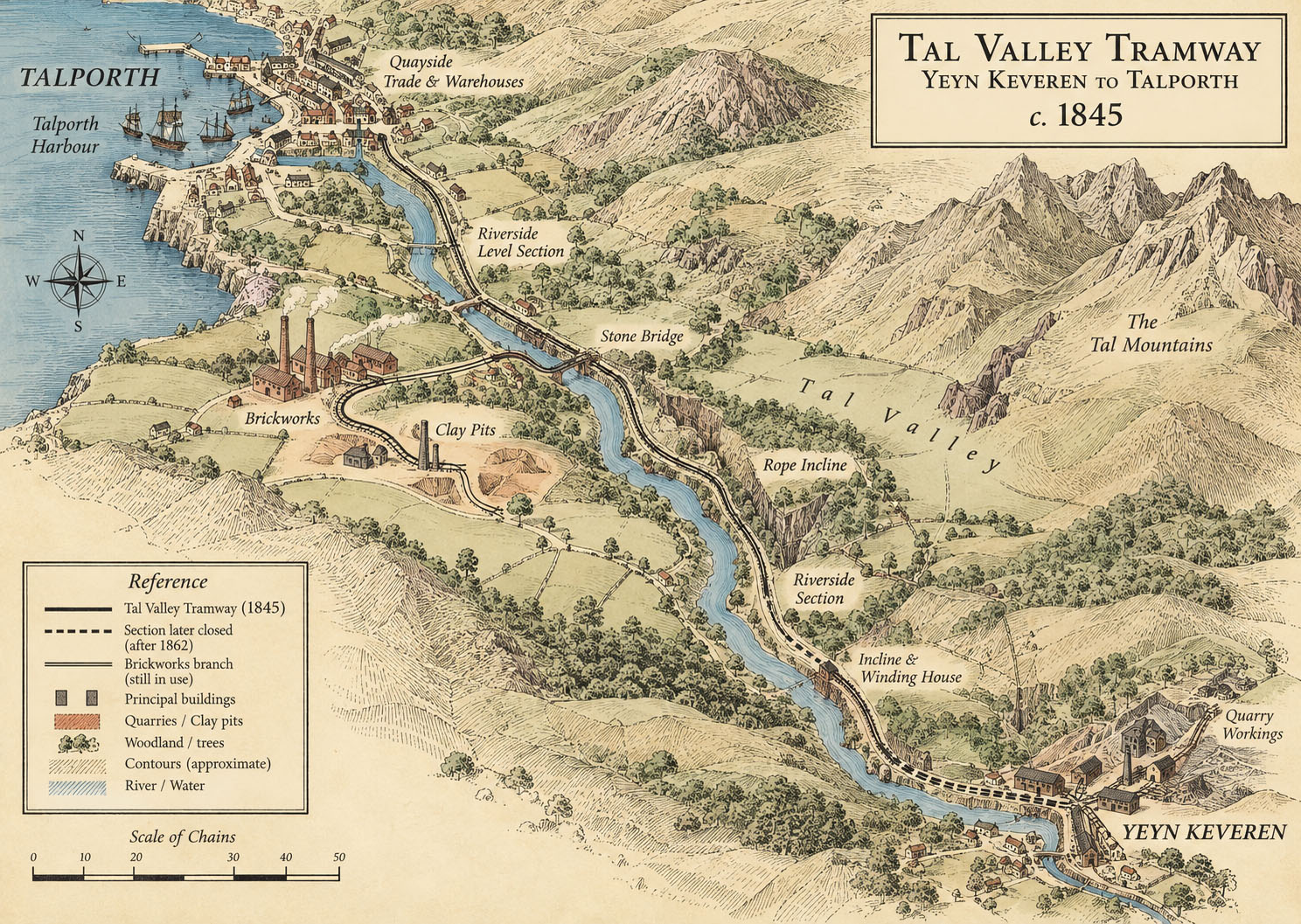
Constructing the Tal Valley Tramway presented its engineers with a considerable challenge. The railway needed to descend from the mineral workings around Yeyn Keveren to the harbour at Talporth, passing through a landscape of steep hillsides, rocky outcrops and narrow river valleys. Rather than relying upon horses to haul heavily laden wagons throughout the journey, the tramway was designed around a simple but effective principle: gravity would do much of the work. The route followed the Tal River closely, its engineers carefully selecting an alignment that provided a gentle but continuous downhill gradient towards the coast. Loaded mineral wagons could therefore descend under their own weight, controlled by wagon brakesmen who regulated their speed along the valley.
Where the natural terrain became too steep for ordinary gravity operation, rope-worked inclines were constructed. These allowed loaded wagons to be lowered safely over the more difficult sections, with winding machinery controlling their descent. The tramway was built using iron rails laid upon wooden sleepers, with small four-wheeled mineral wagons fitted with metal-flanged wheels. Although modest compared with later locomotive railways, it was a carefully planned industrial transport system. Horses provided the motive power for the return journey, hauling empty wagons uphill towards the mines. Their task was considerably easier than pulling loaded mineral wagons in the opposite direction, allowing relatively small teams of animals to maintain a regular flow of traffic. The result was an economical railway that made intelligent use of the valley's natural geography, requiring relatively little mechanical power to transport heavy mineral loads towards Talporth.
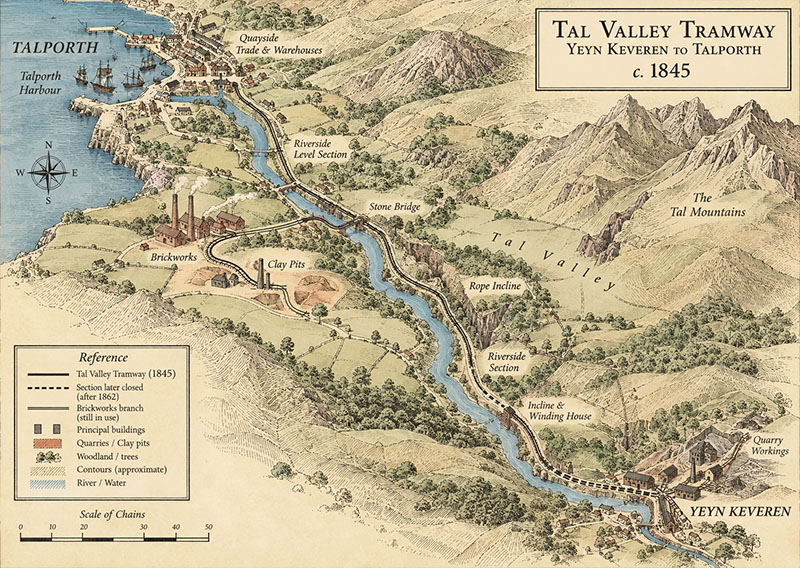
Tal Valley Tramway 1845
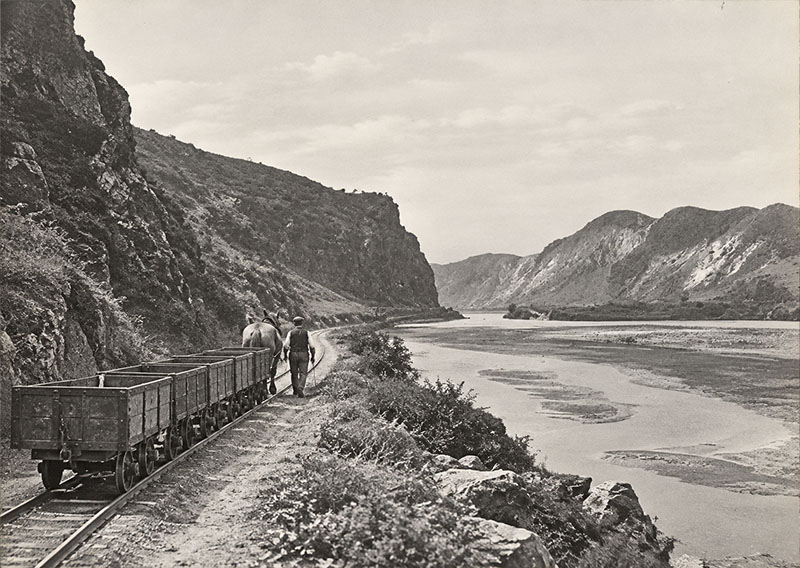
Tal Valley Tramway c1850
Minerals to the Harbour
The principal traffic of the Tal Valley Tramway was slate and other mineral products travelling downhill from the workings around Yeyn Keveren. Loaded wagons were assembled at the mines before beginning their descent towards Talporth. Along the gently graded sections, gravity provided the motive power, with brakesmen controlling the movement of the wagons. At the steeper inclines, the wagons were transferred to rope-worked sections for a controlled descent. On reaching Talporth, the minerals were unloaded at the harbour for shipment aboard coastal vessels.
The return journey was rather different. Horses hauled the empty wagons back towards Yeyn Keveren, often accompanied by supplies needed at the mines. Timber, tools, provisions and equipment could be carried uphill, although heavier incoming loads required additional horse power or separate arrangements. This created a distinctive pattern of operation, with gravity-worked mineral trains descending towards the coast and horse-hauled wagons returning inland. It was a practical and economical arrangement that allowed the tramway to move substantial quantities of minerals without the expense of steam locomotives.
The Tal Valley Tramway was remarkable not for the scale of its engineering works, but for the ingenuity with which it exploited the natural landscape. Its route remained close to the river, following the valley floor wherever possible. The carefully selected downhill gradient was fundamental to its operation, allowing loaded wagons to travel towards Talporth largely under gravity. The engineers faced a delicate balancing act. Too shallow a gradient and the wagons would fail to move reliably; too steep and controlling their descent would become dangerous. Brakesmen therefore played an essential role in the railway's operation, controlling wagon speed and ensuring that trains could negotiate the valley safely. Rope-worked inclines overcame the steepest sections, while horses provided the power needed to return wagons to the mines. The arrangement was effective, but it also imposed limitations. Traffic movements required careful coordination, and the line's sharp curves, steep inclines and relatively light construction made it unsuitable for the heavier locomotives that would eventually transform Rathmor's railways.
When the Tal Valley Railway was reconstructed for steam operation in 1862, its engineers adopted a different approach, building a more substantial route higher along the valley sides. The original tramway had been designed to work with gravity. Its successor was designed to work with steam.
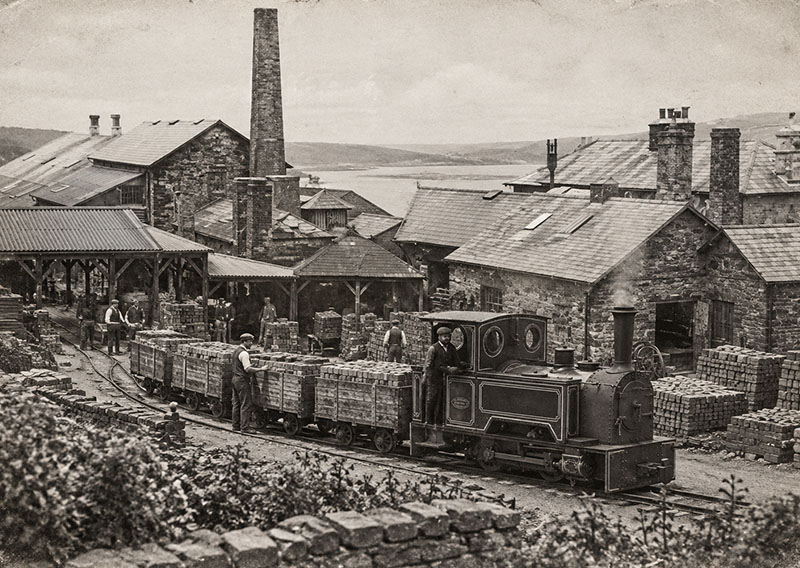
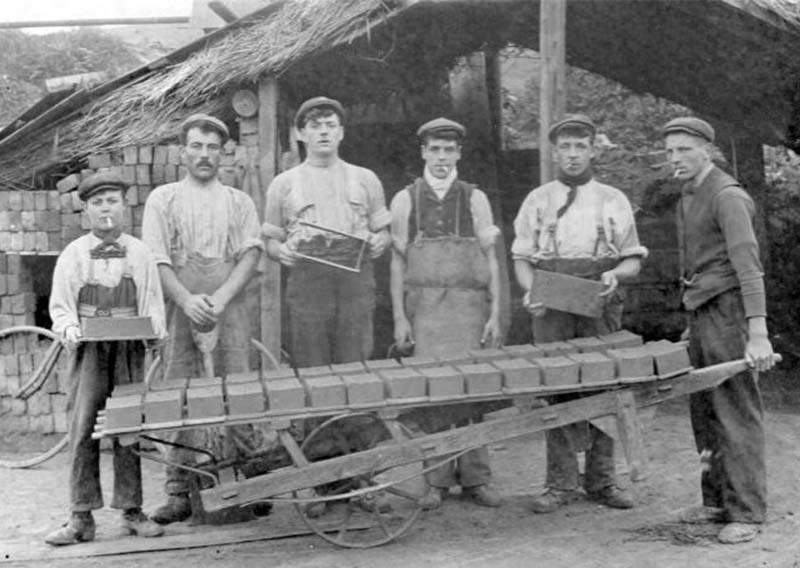
Keveren Brickworks c1910
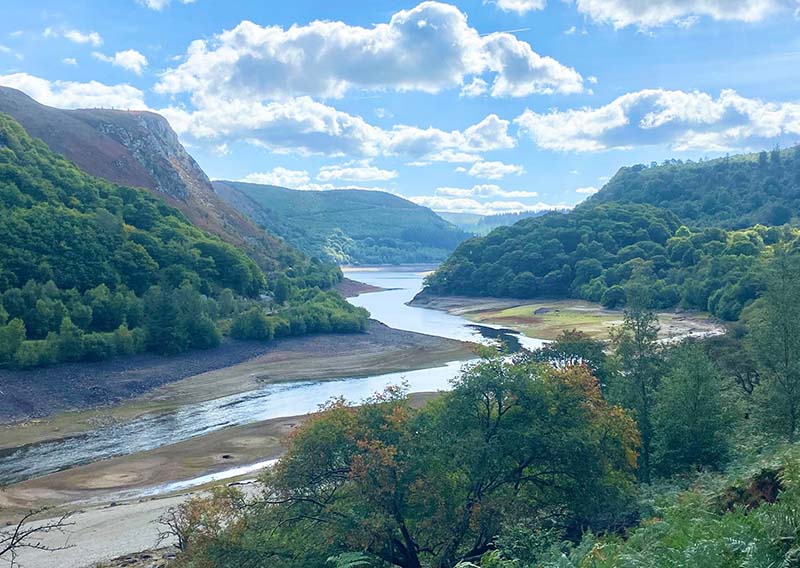
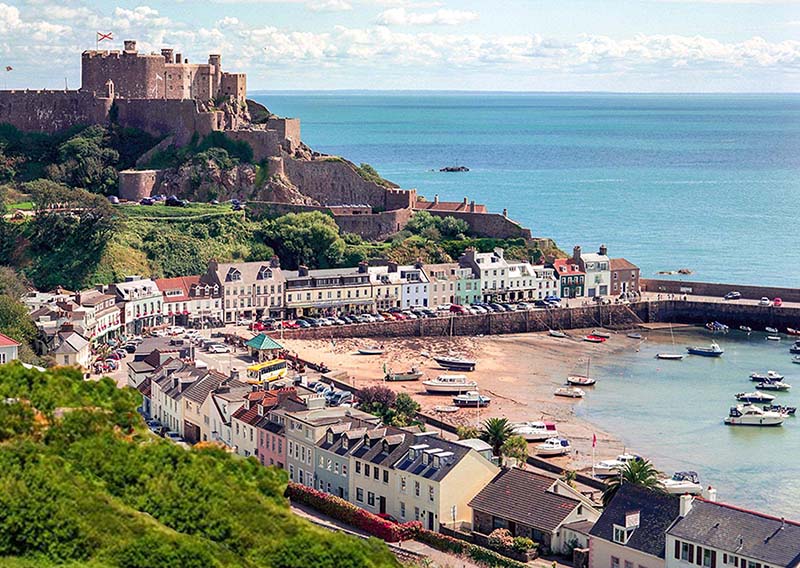
View inland from Talporth towards Yeyn Keveren
The Plateway That Survived
Near Talporth, a section of the original industrial route survived the 1862 reconstruction. It found a continuing purpose carrying clay and sand down from the surrounding hills to the Talporth Brickworks, an enduring local industry. This was not a preserved tourist railway. It remained a working industrial branch because the old alignment was useful for moving raw materials to the kilns and yards. Its later history developed separately from the main Tal Valley Railway. In a subsequent period the brickworks branch acquired small steam locomotives of its own. Two distinctive types became associated with its operations: a Kerr Stuart Sirdar, finished in lined red livery, and a small Peckett steam locomotive. Their precise acquisition dates and individual locomotive histories remain unknown, with just a couple of photographs to show their existence.
The Rathmor Railway
As the nineteenth century progressed, Rathmor's separate industrial and public railways began to be brought into larger undertakings. In 1879 the Rathmor Railway was formed through a consolidation led by Lord Keveren, with the Tal Valley Railway among its principal founding interests. The precise legal mechanisms and individual acquisition dates of the participating railways remain subjects for their own company histories. In 1885 the Rathmor Railway became part of the major reorganisation creating the Glynoch & Rathmor Railway. The corridor first opened as a mineral tramway in 1845 was now part of a far larger network. The surviving brickworks line, meanwhile, continued its own industrial story.
Legacy
The Tal Valley Tramway was one of Rathmor's earliest significant railways. Built in 1845 with iron rails, metal-wheeled mineral wagons, horses and rope-worked inclines, it made the transport of slate and other materials between Yeyn Keveren and Talporth more practical. Its reconstruction in 1862 created the steam-operated Tal Valley Railway and introduced passenger services to the route. The 1879 Rathmor Railway consolidation and 1885 formation of the Glynoch & Rathmor Railway carried its influence far beyond the original mineral corridor.
The survival of a section serving Talporth Brickworks gives the story an especially distinctive ending. Long after the principal route had been rebuilt, the early tramway continued to serve local industry, eventually with its own small steam locomotives. The railway had changed, but the purpose that inspired it in 1845, that of moving heavy materials through difficult country, has endured.
History
Railways
Tal Valley Tramway
TVT Maps
Tal Valley Tramway
Tal Valley Tramway
Related Articles....
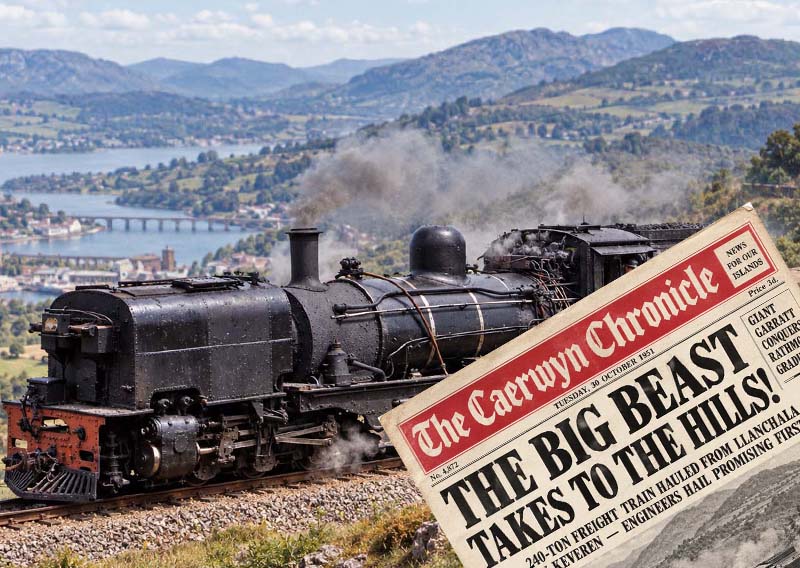
1951: The Big Beast Takes to the Hills
29th October: Just seven days after arriving the enormous new […] ...
Explore More Railways of Glynoch and Rathmor....


0 Comments