

1862: Tal Valley Railway
From Quarry Tramway to Steam Railway and the First Steps Towards a Greater Rathmor Network
History

Railways

About the T&FR
T&FR Maps
Tal Valley Railway (TVR)
At a glance:
Opened: 1862
Island: Rathmor
Route: Talporth–Yeyn Keveren with grand plans to head further south and south-west
Type: Public passenger and goods railway. Steam locomotive operated from day one.
Primary colour-scheme: Dark red locomotives with dark red and cream carriages
Gauge: 2ft Island narrow gauge
Traffic: Slate and other minerals, goods and passengers
Connections: Talporth & Feorag Railway at jointly owned Talporth High Level Station
Fate: Incorporated into Rathmor Railway 1879
From Quarry Tramway to Steam Railway
The opening of the Tal Valley Railway in 1862 marked a turning point in the industrial and social development of Rathmor. What had begun in 1845 as a modest horse-worked tramway serving the slate quarries around Yeyn Keveren was succeeded by a modern steam railway, capable of carrying heavier mineral loads, providing passenger services and supporting ambitions that extended far beyond the Tal Valley. The transformation owed much to the determination of one man: Edmund Trevelyan Keveren, son of the 7th Lord Keveren, whose family had been closely associated with the valley's railway development from the beginning. Inspired by the achievements of the steam-operated railways on neighbouring Glynoch, Edmund recognised that the future of the Tal Valley lay not in improving the existing tramway, but in constructing an entirely new railway capable of meeting the demands of a changing industrial age. His ambitions extended far beyond the slate industry. Edmund envisaged a railway that would carry passengers as well as minerals, connect previously isolated communities and, in time, reach the largely undeveloped south and south-western peninsula of Rathmor. The Tal Valley Railway would become the first practical step towards that much greater vision.
Tal Valley Railway Timeline
Tal Valley Tramway
Tal Valley Railway
Rathmor Railway
Glynoch & Rathmor Rly
The Talporth Bridge with the Tal Valley Tramway visible below
The Limitations of the Old Tramway
For almost two decades, the Tal Valley Tramway had provided an essential connection between the slate workings around Yeyn Keveren and the commercial facilities at Talporth. Established in 1845 under the patronage of the Keveren family, the tramway had transformed the movement of stone through the valley. Before its construction, slate had been transported over difficult roads by horse and cart, an expensive and often unreliable undertaking, particularly during the wetter months. The tramway offered considerable improvements, allowing loaded wagons to be moved more efficiently along a dedicated route. Yet its success also revealed its limitations. The line had been constructed economically, following the natural contours of the valley wherever possible and making use of steep rope-worked inclines, sharp curves and relatively light permanent way. These arrangements were appropriate for the small wagons and horse traction originally envisaged, but increasingly restrictive as quarry production expanded. Furthermore, the tramway had been conceived primarily as an industrial undertaking. Its purpose was to transport minerals, not to provide a comprehensive transport service for the people living and working throughout the valley. Those wishing to travel between Yeyn Keveren, the smaller settlements and Talporth remained largely dependent upon the roads. By the middle of the 1850s, the Keveren family faced a difficult question. Should they continue improving a tramway whose fundamental limitations remained unchanged, or invest in an altogether more ambitious undertaking? For Edmund Trevelyan Keveren, the answer would become clear following a visit to the neighbouring island of Glynoch.

Talporth Quay

Tal Vally Railway Route map
Inspiration from Glynoch
Railway development elsewhere in the Caerwyn Isles was beginning to demonstrate the considerable advantages of steam traction. Of particular interest was the Glynoch Mineral Railway Company (GMRC), which had commenced operations in 1855 and had employed steam locomotives from the outset. During a visit to Glynoch in the latter half of the 1850s, Edmund Keveren travelled over the GMRC's railway and observed its operations first-hand. He was deeply impressed. Here was a railway designed around the capabilities of steam locomotives, rather than the limitations of animal power. Its engines could haul substantial loads, maintain regular services and provide the dependable transport upon which expanding industries increasingly relied. The contrast with the Tal Valley Tramway was striking. Where the GMRC had been planned as a steam railway from the beginning, the Keveren family's undertaking remained dependent upon horses, gravity and the careful management of difficult inclines. Edmund returned to Rathmor convinced that steam traction offered the solution to the Tal Valley's growing transport difficulties. However, his visit had also taught him an important lesson. The introduction of locomotives could not be achieved simply by purchasing an engine and placing it upon the existing tramway. The Tal Valley would require an entirely new railway designed for steam operation. More importantly, Edmund began to appreciate that a railway need not exist solely to serve the industry that had brought it into being. The same tracks that carried slate to the coast could also carry passengers between communities, opening new opportunities for trade, employment and travel. The possibilities were considerable, and Edmund's ambitions began to extend well beyond the boundaries of the original tramway.
Building an Entirely New Railway
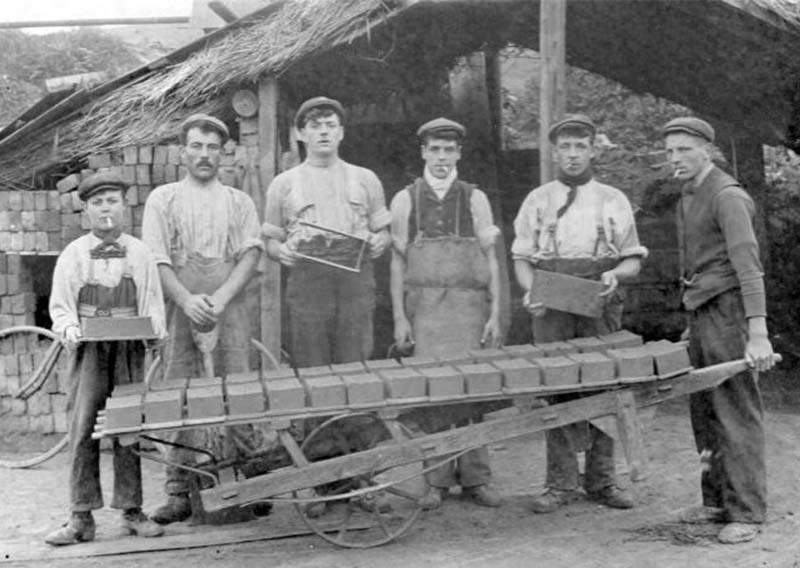
The introduction of steam traction to the Tal Valley presented a challenge far greater than simply replacing horses with locomotives. The original Tal Valley Tramway had been constructed in 1845 to meet the requirements of a relatively modest slate industry. Its winding alignment, steep inclines and lightly laid track were suitable for small horse-worked wagons, but entirely unsuited to the demands of regular steam operation. Edmund Trevelyan Keveren recognised that the solution lay not in attempting to improve the existing route, but in constructing an entirely new railway. The proposed Tal Valley Railway would follow a new alignment throughout its journey from the slate quarries at Yeyn Keveren to Talporth. The undertaking demanded extensive surveying and engineering work. New cuttings, embankments and bridges would be required to establish a route with gradients and curves suitable for steam locomotives, while the permanent way would be designed to accommodate heavier trains and increasing mineral traffic. The requirements of passenger operation added another dimension to the project. The new railway would need to provide suitable places for trains to stop, facilities for passengers to board and alight, and arrangements that allowed passenger traffic to operate alongside the heavy mineral trains upon which the undertaking's commercial success would continue to depend. The decision represented a considerable financial commitment, but Edmund believed that a purpose-built railway would offer far greater long-term advantages than a compromised conversion of the old tramway. The original line was not entirely lost, however. At Yeyn Keveren, sections of the earlier tramway continued to serve the quarry workings, preserving a direct connection with the industry's horse-worked origins. Elsewhere, a portion of the abandoned route found a new purpose serving the local brickworks, demonstrating how the infrastructure of the earlier railway could remain useful even after its principal traffic had transferred to the new line. Thus, rather than replacing the original tramway upon the same formation, the Tal Valley Railway established a completely new transport corridor through the valley. It was a railway designed not merely for the traffic of the present, but with the possibility of future expansion firmly in mind.

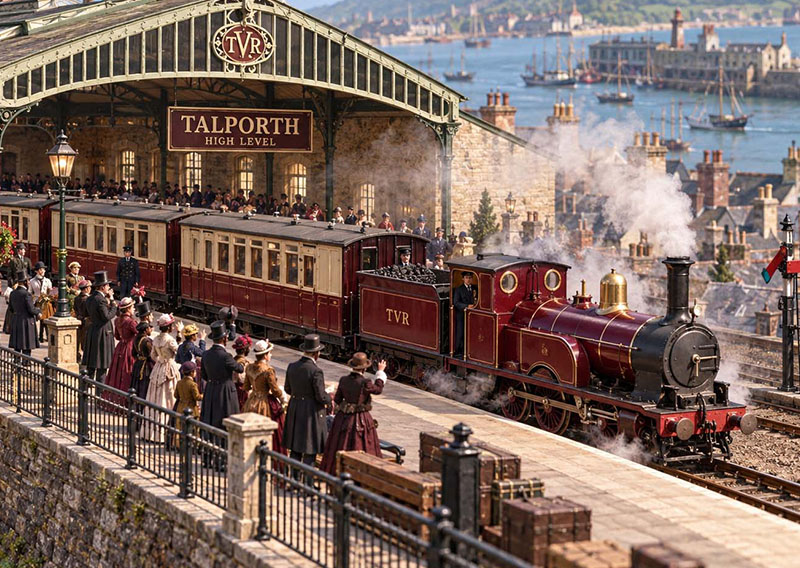
Talporth High Level station c1870
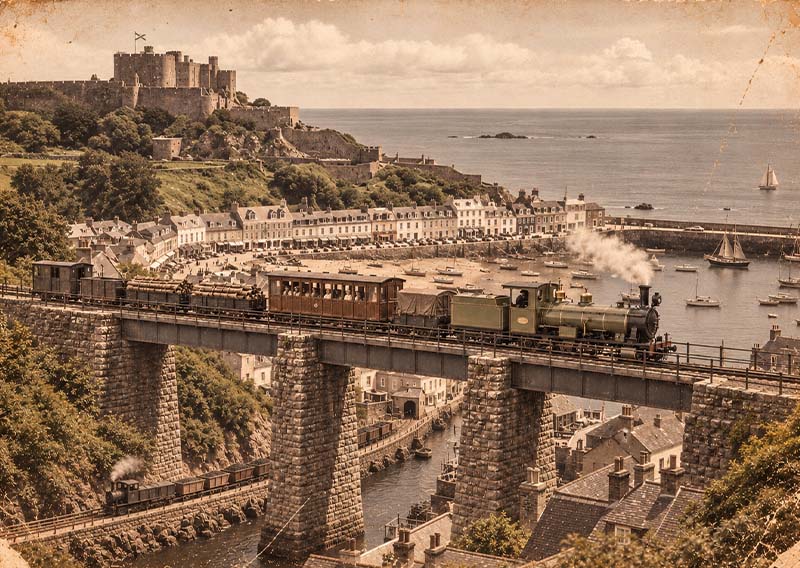
The new Talporth Bridge with the Tal Valley Tramway visible below
1862: The Arrival of Steam
In 1862, the Tal Valley Railway commenced steam operation. For the communities of the Tal Valley, the arrival of locomotives represented a remarkable change. The familiar sight of horses hauling small groups of wagons gradually gave way to steam engines working longer trains of slate towards Talporth. The sound of locomotive exhaust echoed through the valley, while the smoke rising above the railway became a visible symbol of industrial progress. For the quarry owners, the advantages were considerable. Larger consignments could be transported, journeys became more dependable and the railway was better equipped to respond to increasing demand from markets beyond Rathmor. The improvements also reduced some of the difficulties associated with moving traffic through the valley during poor weather, although the railway's mountainous surroundings continued to present operational challenges. The new undertaking was still heavily dependent upon the slate industry, but its improved infrastructure offered opportunities for carrying other goods and supplies associated with the growing settlements and industries along its route. For the Keveren family, the opening was an important achievement. The 7th Lord Keveren had helped establish the original tramway in 1845. His son had now overseen the construction of its steam-operated successor. Two generations of the family had shaped the development of transport through the Tal Valley, each responding to the industrial requirements of his own time. But the new railway was to introduce something that the original tramway had never been intended to provide. Passenger trains.
The First Passenger Services in the Tal Valley
The introduction of passenger traffic was one of the most important developments associated with the opening of the Tal Valley Railway. For the first time, the railway offered the inhabitants of the valley a practical means of travelling by train between Yeyn Keveren, communities along the route and Talporth. Until then, journeys had largely depended upon walking, horseback or road transport, with travel frequently made difficult by the rugged landscape and poor weather. The arrival of regular railway passenger services promised to change everyday life. Quarry workers and their families could travel more easily between settlements, merchants could conduct business in Talporth, and residents of the valley gained improved access to the town's shops, markets and services. The railway also created opportunities for visitors to explore a part of Rathmor that had previously been relatively difficult to reach. Although mineral traffic remained the principal commercial foundation of the undertaking, passenger operation gave the Tal Valley Railway a much broader purpose. It was no longer simply a means of moving slate from quarry to harbour. It was becoming a public railway, serving the people and communities through which it passed. This new responsibility would have a profound influence upon the railway's development, particularly at Talporth, where the need for suitable passenger facilities encouraged closer cooperation with another important railway undertaking.

Original Timetable of the TVR
Talporth Funicular Railway
A New Approach to Talporth
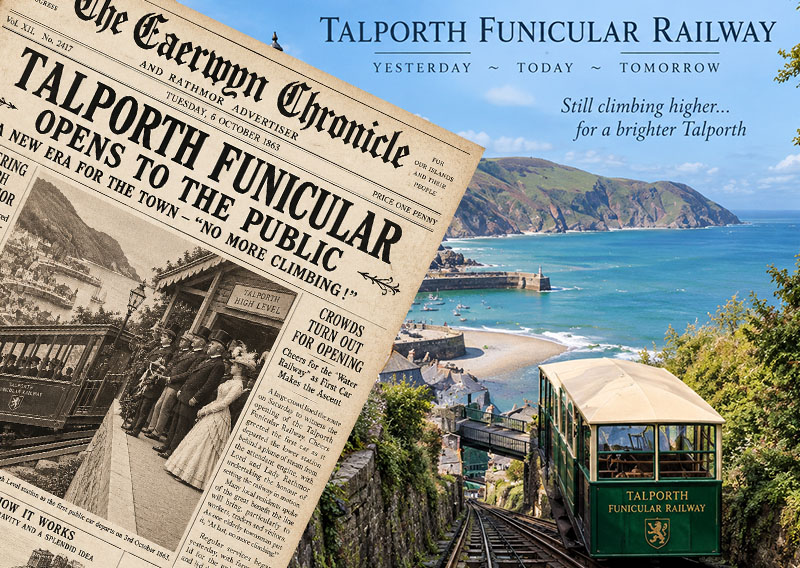
One of the most significant differences between the old tramway and the new railway was its approach to Talporth. Rather than following the original route into the town, the Tal Valley Railway arrived at a considerably higher elevation, running alongside the Talporth & Feorag Railway. This arrangement was an important part of the new railway's design. The Talporth & Feorag Railway, established in 1860 under the patronage of Lord Rathmor, was developing its own railway facilities above the town. Bringing the new Tal Valley Railway alongside it offered considerable opportunities for cooperation between the two independent undertakings. With the TVR now introducing passenger services, the advantages of a shared station became particularly apparent. Rather than establishing two separate passenger termini in close proximity, the companies could cooperate in providing a common High Level station, allowing travellers to arrive, depart and make connections between the two railway systems. For the people of the Tal Valley, this was especially important. Passengers travelling from Yeyn Keveren would no longer reach Talporth merely as the destination of an industrial tramway. They would arrive at a railway station that formed part of a growing transport network, with opportunities to continue their journeys over the neighbouring Talporth & Feorag Railway. The development of Talporth High Level station in 1862, together with the associated bridge and dock connections, helped establish a new focus for railway operations in the town. Although the companies retained their separate identities, their shared interests encouraged the coordination of passenger facilities, goods traffic and railway operations. The higher-level approach also created a new difficulty. While the railways could now operate more efficiently through the elevated station, passengers and goods still faced the inconvenient journey between the station and the commercial centre of Talporth below. Indeed, the arrival of regular passenger trains made this inconvenience considerably more apparent. A railway intended to improve travel throughout the valley could hardly fulfil its promise if passengers were then faced with a difficult descent into the town itself. The problem would soon lead to the construction of the Talporth Funicular Railway, which opened on 3 October 1863. The High Level station, initially developed to accommodate the expanding railway network, would therefore become the centre of a much wider transformation of transport within Talporth.
Beyond the Tal Valley: Ambitions for Southern Rathmor
Although the Tal Valley Railway was initially constructed to serve the slate-producing districts around Yeyn Keveren, Edmund Keveren's plans were never entirely confined to the valley. Even during the development of the new railway, he had begun considering the possibilities of extending railway transport into the southern and south-western districts of Rathmor. These regions had so far been largely overlooked by the railway revolution that was transforming other parts of the Caerwyn Isles. The rugged geography of the southern districts, together with the considerable expense of railway construction, had discouraged investment. Communities remained isolated, while the movement of minerals, agricultural produce and other goods continued to depend upon roads and coastal shipping. Yet the region possessed considerable economic potential. Mineral deposits near Falachfaen and the bountiful fishing off the south west coast offered opportunities for new industrial traffic, while the scattered settlements and coastal communities represented a largely untapped market for passenger transport. To Edmund, the two opportunities were closely connected. A railway built solely to serve mineral workings might struggle to justify the expense of penetrating difficult country. Equally, a passenger railway serving small and widely separated communities might offer insufficient revenue on its own. A railway carrying both minerals and passengers, however, could provide a much stronger commercial foundation. The Tal Valley Railway was therefore conceived not simply as a replacement for the old quarry tramway, but as the potential beginning of a more extensive system. From its established route between Yeyn Keveren and Talporth, future lines might one day reach towards the southern coast and the distant south-western peninsula, opening new mineral districts and bringing railway services to communities that had never previously enjoyed them. Such proposals remained ambitious ideas rather than immediate construction schemes. The financial and engineering challenges were substantial, and the immediate priority remained the successful establishment of the new Tal Valley route. Nevertheless, the possibility of southern expansion would become an enduring feature of Edmund Keveren's railway ambitions. The railway of 1862 was only the beginning.
Two Families, One Railway Future
The growing cooperation between the Tal Valley Railway and the Talporth & Feorag Railway was mirrored by an increasingly close relationship between the families associated with the two undertakings. Lord Rathmor had been an enthusiastic supporter of the Talporth & Feorag Railway, while the Keveren family remained the principal influence behind the development of the Tal Valley route. The relationship acquired a more personal dimension in the early 1860s when Edmund Trevelyan Keveren married Lady Eleanor Rathmor, the only daughter of Lord Rathmor and his wife, Lady Constance. The marriage united two prominent families whose railway interests were already closely connected. Although it did not immediately result in a merger of their respective companies, the alliance helped strengthen the personal relationships upon which much of Rathmor's subsequent railway development would depend. Edmund and his father-in-law shared a belief in the importance of improving the island's transport network, although their respective contributions were often quite different. Lord Rathmor brought considerable social standing, established influence and a deep personal interest in the prosperity of the island. Edmund Keveren supplied much of the commercial ambition and strategic determination that would eventually drive the consolidation of Rathmor's independent railways. The successful development of Talporth High Level station had already demonstrated the advantages of cooperation between the two undertakings. It also offered a glimpse of what might be achieved through a more extensive network, carrying both passengers and goods across a much greater part of the island. The partnership between the two families would prove particularly important during the following two decades.
Expansion and the Changing Railway Landscape
Throughout the 1860s and 1870s, railway development continued across Rathmor. Independent companies extended their routes, new industrial tramways appeared, and established undertakings increasingly found their interests overlapping. The Tal Valley Railway remained an important route for the slate industry, but its passenger services had also helped establish a new pattern of travel between the valley and Talporth. The wider railway network, however, was becoming increasingly complex. Different companies operated neighbouring lines, served competing commercial interests and faced the growing challenge of coordinating passenger and goods traffic across the island. Meanwhile, the southern and south-western districts remained a continuing reminder of how much of Rathmor had yet to benefit from railway development. Edmund Keveren increasingly believed that the island's railway future depended upon greater cooperation and, ultimately, consolidation. His experiences on Glynoch had demonstrated the advantages of well-planned steam railway operation. His work in the Tal Valley had shown what could be achieved through substantial investment in improved infrastructure. The introduction of passenger services had also demonstrated that a railway could serve a much wider purpose than the transport of minerals alone. He now began applying those lessons to the island's developing railway network. The growing relationship between the Keveren and Rathmor families placed him in a particularly influential position. The Tal Valley Railway and the Talporth & Feorag Railway had already demonstrated the practical benefits of cooperation at Talporth. Bringing such undertakings together under a larger organisation offered the prospect of more efficient operations, coordinated investment and a railway network capable of serving the island as a whole. By 1875 the Talporth & Feorag Railway had crossed the mighty Caileich River at Feorag and connected at Gorofan with lines that had developed up from the south coast at Porthelan. The railways of Glynoch were on track to become a unified railway network.
1879: The Formation of the Rathmor Railway
In 1879, these ambitions culminated in the formation of the Rathmor Railway. The new undertaking brought together the Tal Valley Railway, the Talporth & Feorag Railway and several other independent railway interests, creating a much larger organisation with the resources and influence to pursue major infrastructure projects. Lord Rathmor became a respected figurehead of the new enterprise, lending his standing and influence to the consolidation. Edmund Keveren, by then the 8th Lord Keveren, provided much of the commercial drive and strategic direction behind the undertaking. For the Tal Valley Railway, the formation of the Rathmor Railway marked the end of its independent existence. Yet the railway itself remained an essential part of the expanding network. The purpose-built steam railway of 1862, conceived to carry both minerals and passengers, had become one of the foundations upon which the island's railway consolidation was built. The larger organisation also offered new possibilities for the ambitious schemes Edmund had considered since the earliest days of the TVR, including the development of railway services into previously neglected districts. His ambitions, however, were far from satisfied. He increasingly looked towards the possibility of connecting Rathmor's railway network with the neighbouring island of Glynoch, opening access to new markets and, in particular, the important harbour facilities at Llanchala. The construction of the Llyngor Bridge, completed in 1885, would become one of the defining achievements of his railway career. It was a project of particular personal importance to Edmund, who was determined that his father-in-law, Lord Rathmor, should live to witness the completion of the long-awaited connection. Lord Rathmor did indeed see the bridge opened, an achievement that marked a new era in the transport history of the Caerwyn Isles. The same year also witnessed the formation of the Glynoch & Rathmor Railway, bringing together the Rathmor Railway and the Llanchala Railway interests in an undertaking that would transform the railway geography of the islands.
Legacy of the Tal Valley Railway
The Tal Valley Railway's independent existence lasted just seventeen years, from 1862 until its incorporation into the Rathmor Railway in 1879. Its influence, however, extended far beyond that relatively short period. The construction of an entirely new railway demonstrated the importance of modern railway engineering in overcoming the limitations of earlier industrial transport systems. It provided the slate industry around Yeyn Keveren with a more capable and dependable connection to Talporth, while opening the valley to passenger traffic for the first time. The development of the joint High Level station also established an important precedent for cooperation between independent railway companies, helping to create the relationships that would shape Rathmor's railway future. Perhaps most significantly, the Tal Valley Railway represented the beginning of a much greater ambition. Edmund Keveren had envisaged a railway network that would not merely serve established industries, but encourage the development of new ones, connect isolated communities and eventually reach the mineral-rich southern and south-western districts of Rathmor. Not all of these ambitions could be realised during the TVR's short independent existence, but they helped shape the thinking behind the later expansion and consolidation of the island's railways. Above all, the Tal Valley Railway marked the emergence of Edmund Trevelyan Keveren as one of the island's most influential railway promoters. Inspired by the steam locomotives he had witnessed on Glynoch, Edmund had returned home determined to transform his family's transport undertaking. What began as an ambitious plan to replace a horse-worked quarry tramway would ultimately contribute to the creation of a railway system spanning the Caerwyn Isles. The Tal Valley Tramway had opened the valley to railway transport in 1845. The Tal Valley Railway brought steam and passenger services in 1862. And the ambitions of the Keveren family would help carry that railway far beyond the valley from which it took its name.
History
Railways
About the T&FR
T&FR Maps
Tal Valley Railway (TVR)

TVR route showing the proposed ambitious extentions to the south and south west.

Related Articles....
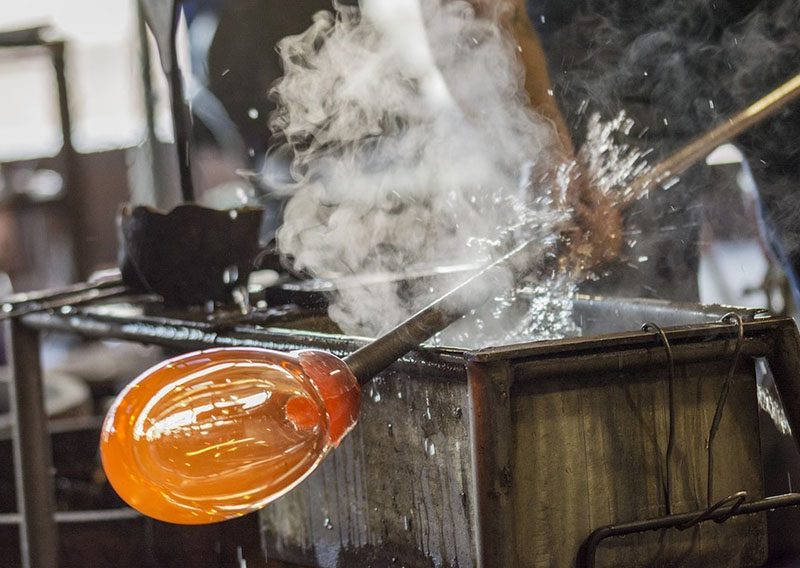
The Glassmaking Industry of Talporth
The industry owes its origins to the exceptionally pure silica […] ...

Explore More Railways of Glynoch and Rathmor....


0 Comments