

The Railways of the Caerwyn Isles
What began with simple horse-drawn plateways and industrial tramways gradually grew into an extraordinary collection of lines...
History

Railways
Timeline
Maps
The Railways of the Caerwyn Isles
The railways of the Caerwyn Isles are a wonderfully tangled story of ambition, rivalry, necessity and the occasional questionable engineering decision. What began with simple horse-drawn plateways and industrial tramways gradually grew into an extraordinary collection of independent lines — from the mountain-climbing Cernawen Mountain Railway and forestry-born Llyngor Valley Railway, to the competing routes of Glynoch and the sugar and agricultural railways of distant Sorcha. Companies were formed, renamed, merged and swallowed by their neighbours as tracks pushed across mountains, bridged seemingly impossible valleys and connected once-isolated communities. Together, these remarkable little railways tell the story of how the Caerwyn Isles were connected by rail.
Featured Posts: View All Posts
All Posts: View Featured Posts


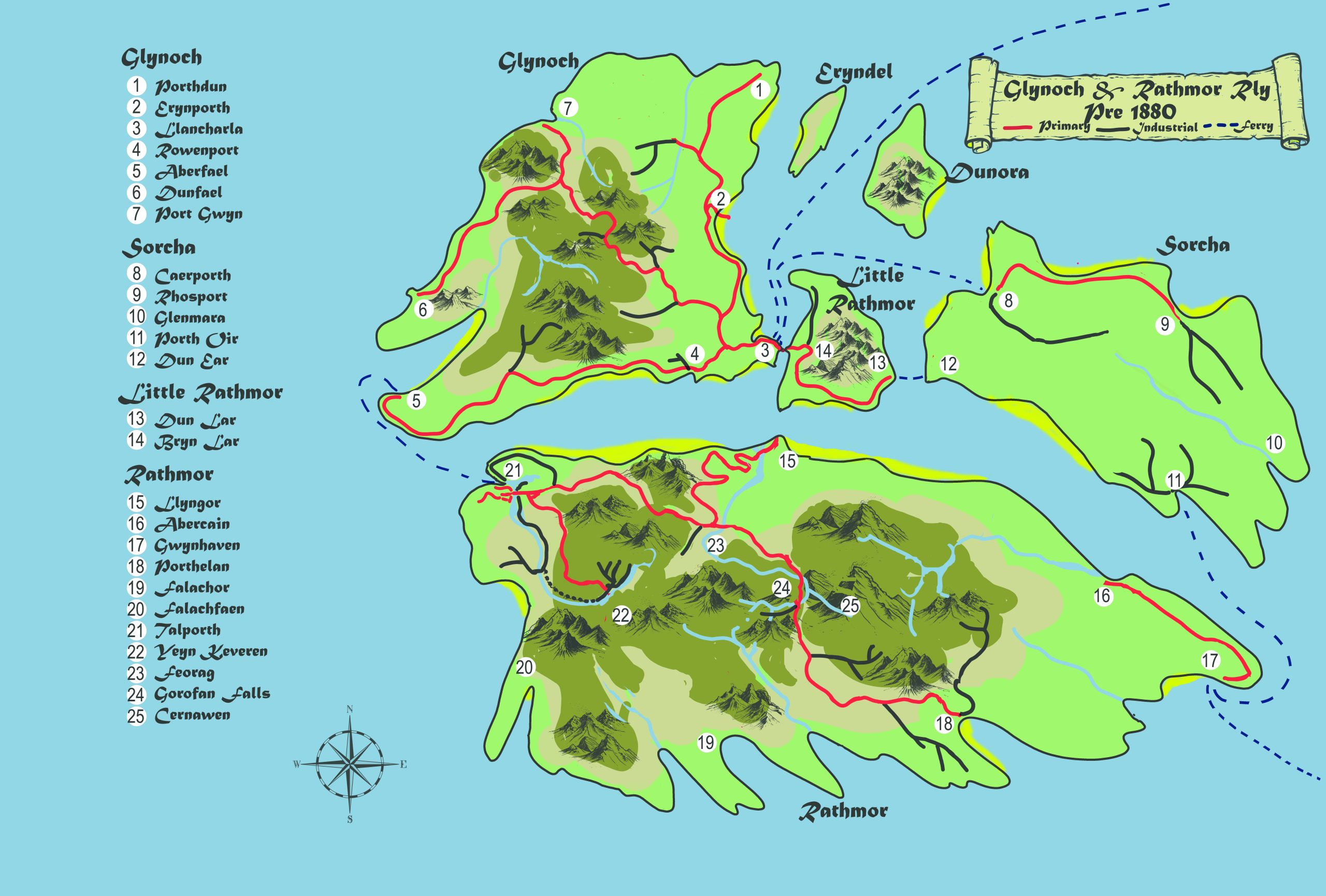
Island Railways PRE 1880
The railways began their transformation from scattered industrial tramways into […] ...


Railways of Glynoch
Glynoch’s railways criss-cross the landscape, conquering hills and marshes alike ...

Railways of Rathmor
Rathmor’s railways are feats of daring engineering, snaking up cliff-sides, […] ...


Featured Railways
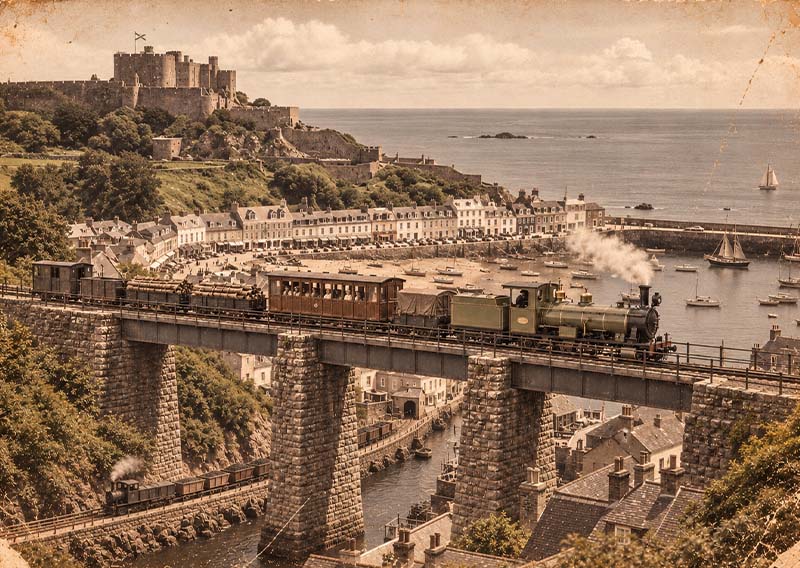
1876: Glynoch Central Railway
Born out of boardroom conflict, it became one of the […] ...
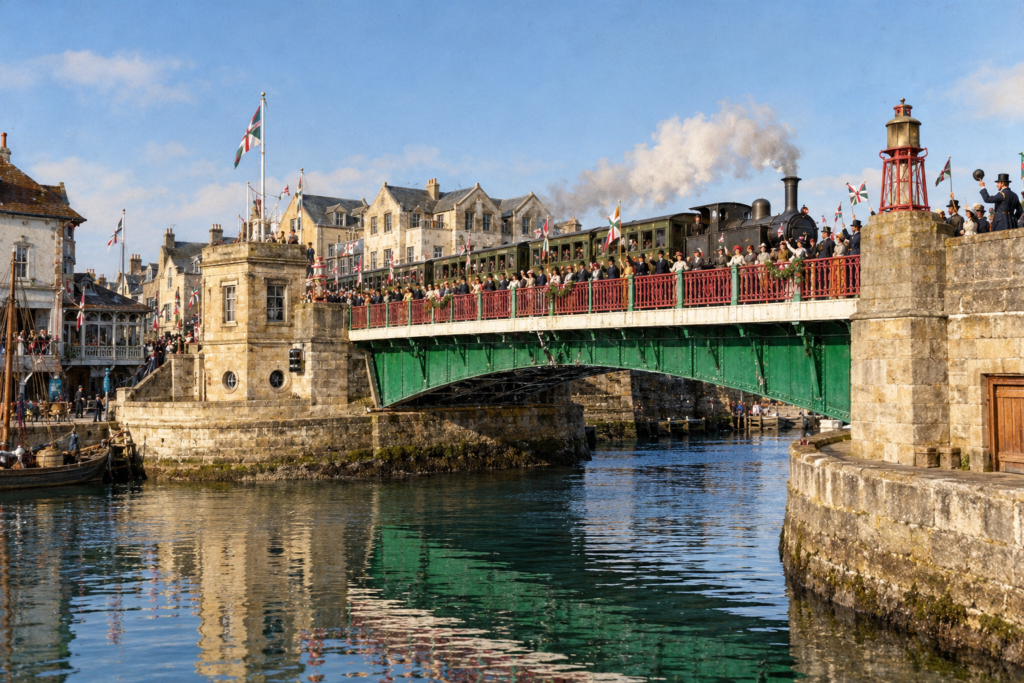
1871: Little Rathmor Railway
From the limestone quarries to woollen mills and bustling harbours, […] ...
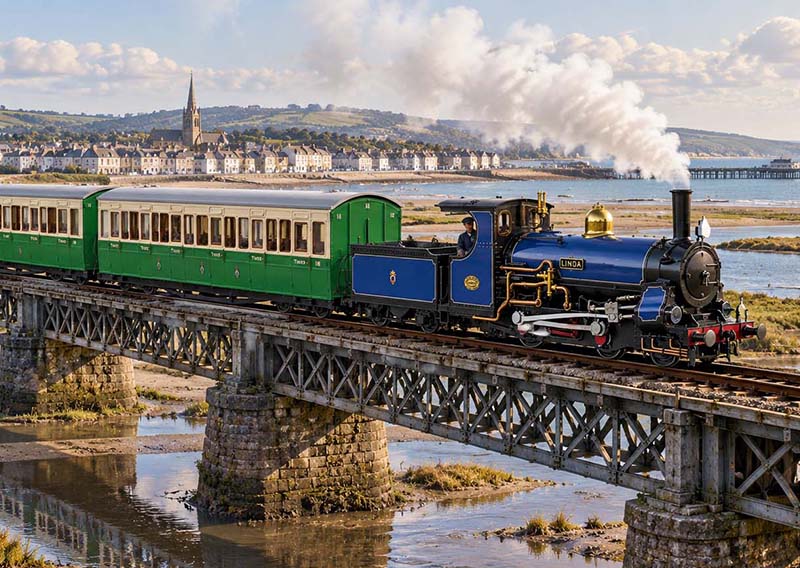
1870: Llanchala & Eastern Coast Railway
Transformed a once isolated coastline into one of the island’s […] ...
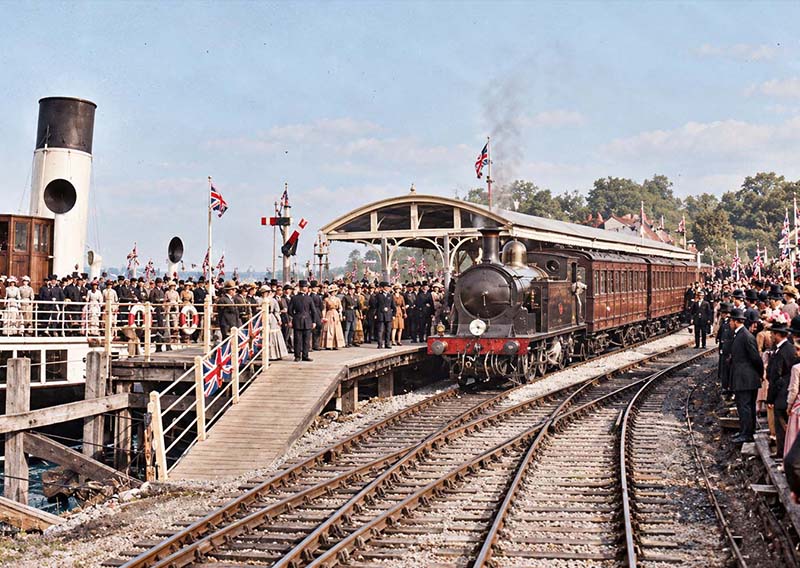
1860: Abercain & Gwynhaven Railway
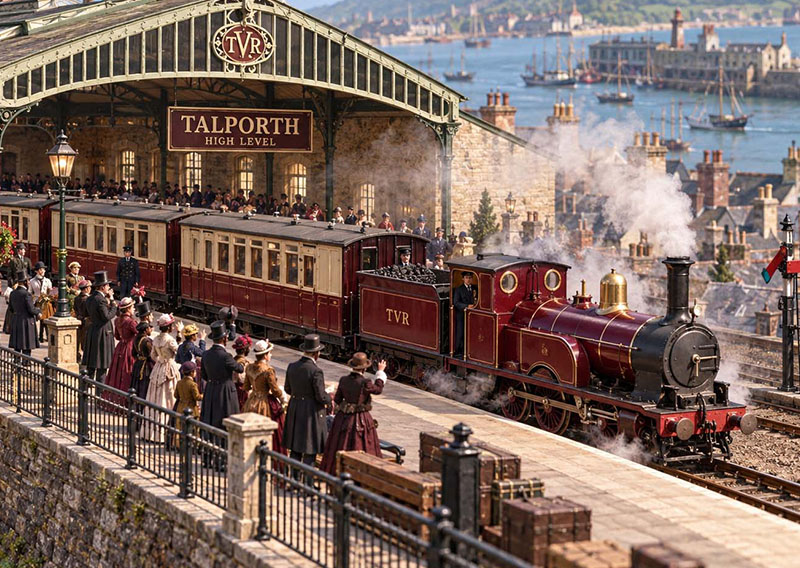
Rathmor’s standard-gauge experiment. A railway built to serve the shipping […] ...

1860: The Early Railways of Porth Oir
From orchard to harbour, cooperative and privately owned agricultural tramways […] ...

1859: Llanchala & South West Railway
The railway that united Glynoch’s southern coast, linking coastal communities […] ...


1855: Glynoch Mineral Railway Company
From Llanchala’s industrial districts to the mountains and western shores […] ...
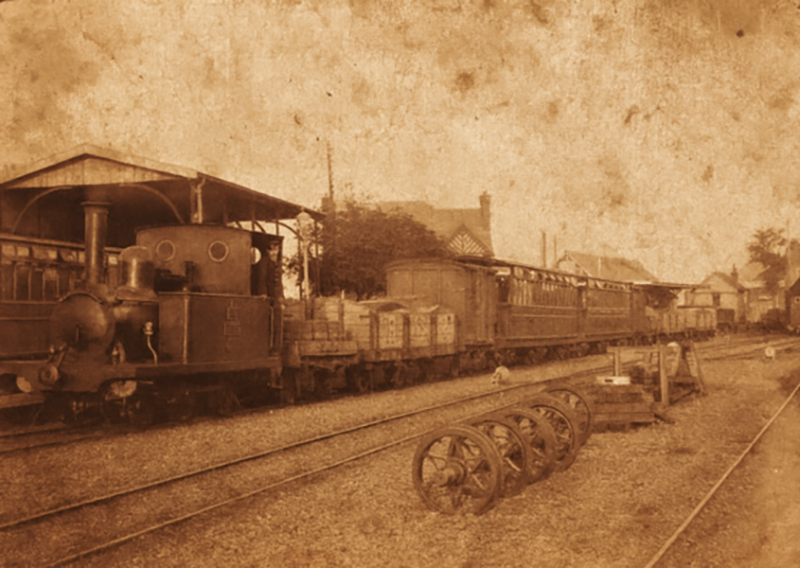
1852: Early Railways of Caerporth
Various independent industrial tramways primarily for moving goods from inland […] ...

1852: The Early Railways of Porthelan
From forest tramways and mineral workings to agricultural railways, the […] ...


1840s: Arwyn-Rowen Estate Plateway
Long before Rowenport appeared on the passenger timetables, the Arwyn-Rowen […] ...

1825: Bryn Lar & Llanchala Harbour Company
The railway history of the Caerwyn Isles begins not with […] ...
Railways of Rathmor
Rathmor’s railways are feats of daring engineering, snaking up cliff-sides, […] ...
Railways of Glynoch
Glynoch’s railways criss-cross the landscape, conquering hills and marshes alike ...
Island Railways PRE 1880
The railways began their transformation from scattered industrial tramways into […] ...
History

Railways
Timeline
Maps
The Railways of the Caerwyn Isles – A Timeline
From the first primitive plateways and ox-hauled tramways of the 1820s to the great engineering achievements and railway expansions of the twentieth century, the history of the Caerwyn Isles' railways is a fascinating tale of ambition, rivalry, innovation and occasionally questionable decisions! What began as a handful of isolated industrial lines gradually evolved into a remarkable network of competing railway companies, connecting remote communities, bustling ports and industries across the islands. Here we bring together the complete railway chronology of the Caerwyn Isles, charting the formation of companies, the opening of new routes, spectacular bridges, mergers, milestones and the occasional railway disaster. Follow the story through the years and click on the individual railway links to discover the people, places and events behind each chapter of this ever-growing railway history.
NOTE: Work in progress. As each railway company has a dedicated page it will be linked to from here. Keep up to date with our progress documenting the railways of Glynoch and Rathmor by joining our newsletter.
Filter: By Island
Show All
Glynoch
Rathmor
Little Rathmor
Sorcha
All Island Railways:
Bryn Lar & Llanchala Harbour Company (Little Rathmor)
Where it all started. Ox-hauled tramway on wooden rails, transporting limestone from quarry to the sea. Evolved into the Little Rathmor Railway in 1871 after the opening of the Llanchala bridge.
Arwyn-Rowen Estate Plateway (Glynoch)
Private estate and industrial plateway including a rope-worked incline from the harbour at Rowenport up to the estate. Parts incorporated into the Llanchala & South West Railway from 1859–60
Tal Valley Tramway (Rathmor)
An early mineral plateway connecting the workings at Yeyn Keveren with the port of Talporth, transporting minerals through the rugged Tal Valley. Rebuilt for steam locomotive operation in 1862, becoming the Tal Valley Railway and later forming part of the Rathmor Railway.
Rhosper Estate Tramways (Sorcha)
A network of agricultural tramways established to carry sugar cane and estate produce across central Sorcha towards Caerporth. These early lines became the foundations of the Grand Sorcha Central Railway in 1879–80.
Porthelan & Gorofan Timber Tramway (Rathmor)
The earliest of Porthelan's railways owed its existence to the extensive forests stretching inland towards Gorofan.
Glynoch Mineral Railway Company (Glynoch)
Established to develop the mineral trade westwards from Llanchala, connecting the island's growing industries with valuable inland resources. Reorganised in 1876, with its interests divided between the Llanchala Railway and Glynoch Central Railway.
Aberfael China Clay Railway (Glynoch)
Industrial railway connecting the inland china clay workings with the harbour at Aberfael. An important early mineral route on southern Glynoch, incorporated into Llanchala Railway Ltd in 1876.
South Rathmor Mineral Tramway (Rathmor)
The exploitation of the highland mineral deposits encouraged a number of independent mine owners to seek a more efficient means of transporting their products to the coast.
West Cane Estate Railway (Sorcha)
An agricultural railway serving the sugar plantations of western and central Sorcha, transporting harvested cane towards the processing and shipping facilities around Caerporth. Absorbed into the Grand Sorcha Central Railway in 1879–80.
Caer Valley Tramway (Sorcha)
A small agricultural tramway carrying produce from the fertile Caer Valley towards Caerporth. One of several independent estate lines eventually brought together under the Grand Sorcha Central Railway.
Southern Peninsular Railway (Rathmor)
Formed to connect the existing industrial railways of southern Glynoch, completing the route between Llanchala, Rowenport and Aberfael in 1860. Incorporated into Llanchala Railway Ltd during the railway reorganisation of 1876.
Llanchala & South West Railway (Glynoch)
Formed to connect the existing industrial railways of southern Glynoch, completing the route between Llanchala, Rowenport and Aberfael in 1860. Incorporated into Llanchala Railway Ltd during the railway reorganisation of 1876.
Talporth & Feorag Railway (Rathmor)
An early passenger and goods railway linking Talporth with Feorag, bringing railway transport into the spectacular Cailleach Valley. Later incorporated into the expanding Rathmor Railway network.
Abercain & Gwynhaven Railway (Rathmor)
An independent standard gauge railway connecting the eastern coastal communities of Abercain and Gwynhaven, providing passenger services and an important outlet for local goods. Incorporated into the Rathmor Railway in 1879.
Porth Oir Agricultural Tramway (Sorcha)
An agricultural tramway connecting the farms, barns and processing works around Porth Oir with the harbour. One of the early lines incorporated into the Grand Sorcha Central Railway during the consolidation of 1879–80.
Tal Valley Railway (Rathmor)
The steam-operated successor to the Tal Valley Tramway of 1845, rebuilt to carry minerals and passengers between Talporth and Yeyn Keveren. Later incorporated into the Rathmor Railway.
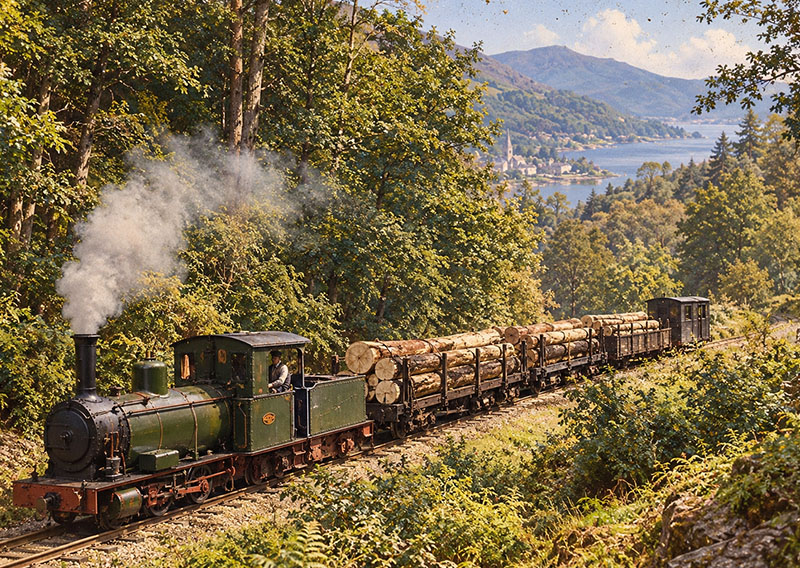
Feorag Forestry Company Railway/Llyngor Valley Railway (Rathmor)
Llyngor timber merchants response to losing trade to Talporth after the opening of the Talporth and Feorag Railway in 1860
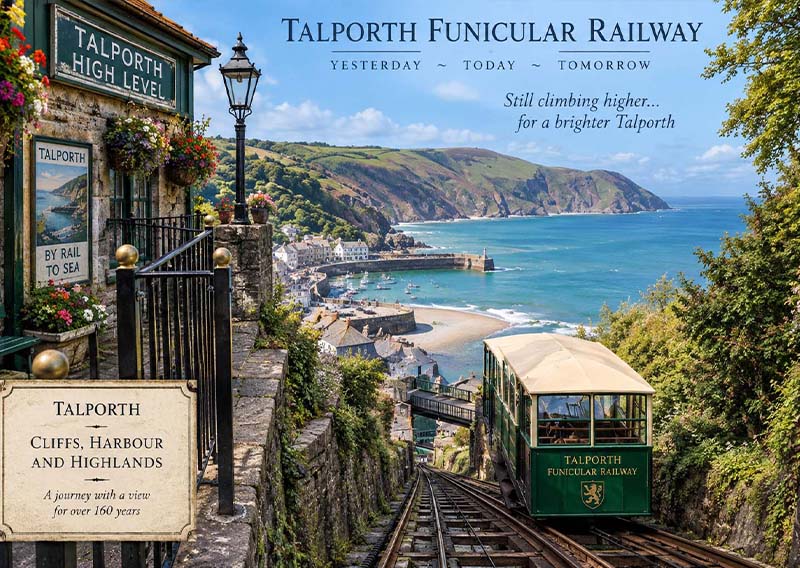
Talporth Funicular Railway (Rathmor)
A remarkable water-powered funicular connecting Talporth's busy harbour with the High Level railway station. Built to overcome the town's steep hillside, transforming access between the quayside and the growing railway network.
Northern Estates Railway (Sorcha)
An agricultural railway serving northern Sorcha's livestock, dairy and farming communities, providing improved transport towards Caerporth. Incorporated into the Caerporth & Rhosport Railway in 1877.
Golden Orchard Tramway (Sorcha)
A small agricultural tramway serving the orchards and cider presses around Porth Oir, transporting fruit and finished products towards the harbour. Incorporated into the Grand Sorcha Central Railway in 1879–80.
Caerporth Sugar Cane Ltd Railway (Sorcha)
An industrial railway developed to transport sugar cane from the plantations towards Caerporth, relieving congestion around the harbour. Its expanding interests helped establish the Caerporth & Rhosport Railway in 1877.
Caerporth Harbour Board Railway (Sorcha)
An independent harbour railway operating among the docks, warehouses and interchange sidings at Caerporth. Provided an essential neutral connection between the port's many industrial and railway interests.
Llanchala & Eastern Coast Railway (Glynoch)
A coastal railway linking Llanchala with Erynporth and Porthdun, opening new opportunities for passenger travel and the movement of goods along Glynoch's coastline.
Little Rathmor Railway (Little Rathmor)
Developed from the pioneering Bryn Lar & Llanchala Harbour Company following the opening of the Llanchala Bridge. Transformed the original limestone tramway into a more substantial railway serving the island's growing transport needs.
Penrath & Caerporth Railway (Sorcha)
Promoted by Penrath's fishing merchants to connect their isolated harbour with Caerporth and its wider markets. Only part of the intended route was completed before incorporation into the Caerporth & Rhosport Railway in 1877.
Llanchala Railway Ltd (Glynoch)
Created through the consolidation of the southern Glynoch railway companies, bringing the principal routes around Llanchala under unified management. Merged with the Rathmor Railway interests in 1885 to form the Glynoch & Rathmor Railway.
Glynoch Central Railway (Glynoch)
Formed from the central and highland interests of the Glynoch Mineral Railway Company. Developed an ambitious railway through the island's mountainous interior towards Dunfael and Port Gwyn, later becoming known as the Great Central Railway.
Caerporth & Rhosport Railway (Sorcha)
Created from a collection of industrial, agricultural and fishing railways to establish a public route north and east from Caerporth. Reached Rhosport in 1878 and merged into the Great Sorcha Railway in 1881.
Glenmara & Rhosport Railway (Sorcha)
An independent railway promoted by Glenmara's commercial interests, constructing westwards towards Rhosport to connect the town with the developing northern network. Joined the Great Sorcha Railway in 1881.
Grand Sorcha Central Railway (Sorcha)
Established under the influence of Lord Rhosper to consolidate the agricultural tramways of central Sorcha. Completed its cross-island route from Caerporth to Porth Oir in 1880 and remained fiercely independent until the 1923 Grouping.
Rathmor Railway (Rathmor)
Formed under Lord Keveren through the consolidation of Rathmor's independent railways. Developed an ambitious island-wide network, including the southern extension towards Falachor and Falachfaen, before merging into the G&R in 1885.
Great Sorcha Railway (Sorcha)
Formed by the merger of the Caerporth & Rhosport and Glenmara & Rhosport railways, creating a continuous northern route across Sorcha. Joined with the Dun Ear Railway in 1896 to form the Sorcha Grand Junction Railway.
Dun Ear Railway (Sorcha)
An independent railway serving the Dun Ear district of Sorcha, opening in 1882. Merged with the Great Sorcha Railway in 1896 to form the Sorcha Grand Junction Railway.
Dragons Head Electric Tramway (Rathmor)
An early electric tramway serving the Dragons Head district of Talporth, adding a remarkable new form of transport to the town's growing railway network. Opened in 1885, alongside the established High Level railway and funicular.
Caerwyn Junction Railway (Little Rathmor)
A jointly owned railway established to improve connections between Little Rathmor and the neighbouring islands. Operated under shared railway interests, including a later Great Western Railway shareholding, before coming fully under G&R control in 1939.
Glynoch & Rathmor Railway (Glynoch, Rathmor, Little Rathmor & Sorcha)
The opening of the Llyngor Bridge finally united the principal railway networks of Glynoch and Rathmor, making the merger of the Llanchala and Rathmor railways the obvious next step. The newly formed G&R would grow to become the dominant railway company of the Caerwyn Isles.
Cernawen Mountain Railway (Rathmor)
A spectacular mountain railway climbing from Gorofan towards the 2,940-foot summit of Cernawen. Built to attract tourists into Rathmor's dramatic highlands, offering breathtaking views across the Caerwyn Isles.
Sorcha Grand Junction Railway (Sorcha)
Formed by the merger of the Great Sorcha and Dun Ear railways, creating the largest railway company on Sorcha. A fierce rival to the Grand Sorcha Central Railway until both companies passed into Great Western Railway ownership in 1923.
North Glynoch Railway (Glynoch)
An ambitious cross-island railway developed to provide a more direct northern route towards Port Gwyn, avoiding the difficult gradients and winding routes of the central highlands. Opened in 1901, providing an important alternative connection across Glynoch.
Great Western Railway (Sorcha)
The GWR assumed control of Sorcha's two principal railway companies, the Sorcha Grand Junction Railway and Grand Sorcha Central Railway, under the 1923 Grouping. Running a narrow gauge railway network on a remote island far away from their main interests was clearly not in the main interests of the GWR and eventually offloaded the lines of Sorcha to the Glynoch & Rathmor Railway in 1939.
Rathmor Railways:
Tal Valley Tramway (Rathmor)
An early mineral plateway connecting the workings at Yeyn Keveren with the port of Talporth, transporting minerals through the rugged Tal Valley. Rebuilt for steam locomotive operation in 1862, becoming the Tal Valley Railway and later forming part of the Rathmor Railway.
Porthelan & Gorofan Timber Tramway (Rathmor)
The earliest of Porthelan's railways owed its existence to the extensive forests stretching inland towards Gorofan.
South Rathmor Mineral Tramway (Rathmor)
The exploitation of the highland mineral deposits encouraged a number of independent mine owners to seek a more efficient means of transporting their products to the coast.
Talporth & Feorag Railway (Rathmor)
An early passenger and goods railway linking Talporth with Feorag, bringing railway transport into the spectacular Cailleach Valley. Later incorporated into the expanding Rathmor Railway network.
Abercain & Gwynhaven Railway (Rathmor)
An independent standard gauge railway connecting the eastern coastal communities of Abercain and Gwynhaven, providing passenger services and an important outlet for local goods. Incorporated into the Rathmor Railway in 1879.
Tal Valley Railway (Rathmor)
The steam-operated successor to the Tal Valley Tramway of 1845, rebuilt to carry minerals and passengers between Talporth and Yeyn Keveren. Later incorporated into the Rathmor Railway.
Feorag Forestry Company Railway/Llyngor Valley Railway (Rathmor)
Llyngor timber merchants response to losing trade to Talporth after the opening of the Talporth and Feorag Railway in 1860
Talporth Funicular Railway (Rathmor)
A remarkable water-powered funicular connecting Talporth's busy harbour with the High Level railway station. Built to overcome the town's steep hillside, transforming access between the quayside and the growing railway network.
Rathmor Railway (Rathmor)
Formed under Lord Keveren through the consolidation of Rathmor's independent railways. Developed an ambitious island-wide network, including the southern extension towards Falachor and Falachfaen, before merging into the G&R in 1885.
Dragons Head Electric Tramway (Rathmor)
An early electric tramway serving the Dragons Head district of Talporth, adding a remarkable new form of transport to the town's growing railway network. Opened in 1885, alongside the established High Level railway and funicular.
Glynoch & Rathmor Railway (Glynoch, Rathmor, Little Rathmor & Sorcha)
The opening of the Llyngor Bridge finally united the principal railway networks of Glynoch and Rathmor, making the merger of the Llanchala and Rathmor railways the obvious next step. The newly formed G&R would grow to become the dominant railway company of the Caerwyn Isles.
Cernawen Mountain Railway (Rathmor)
A spectacular mountain railway climbing from Gorofan towards the 2,940-foot summit of Cernawen. Built to attract tourists into Rathmor's dramatic highlands, offering breathtaking views across the Caerwyn Isles.
Glynoch Railways:
Arwyn-Rowen Estate Plateway (Glynoch)
Private estate and industrial plateway including a rope-worked incline from the harbour at Rowenport up to the estate. Parts incorporated into the Llanchala & South West Railway from 1859–60
Glynoch Mineral Railway Company (Glynoch)
Established to develop the mineral trade westwards from Llanchala, connecting the island's growing industries with valuable inland resources. Reorganised in 1876, with its interests divided between the Llanchala Railway and Glynoch Central Railway.
Aberfael China Clay Railway (Glynoch)
Industrial railway connecting the inland china clay workings with the harbour at Aberfael. An important early mineral route on southern Glynoch, incorporated into Llanchala Railway Ltd in 1876.
Llanchala & South West Railway (Glynoch)
Formed to connect the existing industrial railways of southern Glynoch, completing the route between Llanchala, Rowenport and Aberfael in 1860. Incorporated into Llanchala Railway Ltd during the railway reorganisation of 1876.
Llanchala & Eastern Coast Railway (Glynoch)
A coastal railway linking Llanchala with Erynporth and Porthdun, opening new opportunities for passenger travel and the movement of goods along Glynoch's coastline.
Llanchala Railway Ltd (Glynoch)
Created through the consolidation of the southern Glynoch railway companies, bringing the principal routes around Llanchala under unified management. Merged with the Rathmor Railway interests in 1885 to form the Glynoch & Rathmor Railway.
Glynoch Central Railway (Glynoch)
Formed from the central and highland interests of the Glynoch Mineral Railway Company. Developed an ambitious railway through the island's mountainous interior towards Dunfael and Port Gwyn, later becoming known as the Great Central Railway.
Glynoch & Rathmor Railway (Glynoch, Rathmor, Little Rathmor & Sorcha)
The opening of the Llyngor Bridge finally united the principal railway networks of Glynoch and Rathmor, making the merger of the Llanchala and Rathmor railways the obvious next step. The newly formed G&R would grow to become the dominant railway company of the Caerwyn Isles.
North Glynoch Railway (Glynoch)
An ambitious cross-island railway developed to provide a more direct northern route towards Port Gwyn, avoiding the difficult gradients and winding routes of the central highlands. Opened in 1901, providing an important alternative connection across Glynoch.
Little Rathmor Railways:
Bryn Lar & Llanchala Harbour Company (Little Rathmor)
Where it all started. Ox-hauled tramway on wooden rails, transporting limestone from quarry to the sea. Evolved into the Little Rathmor Railway in 1871 after the opening of the Llanchala bridge.
Little Rathmor Railway (Little Rathmor)
Developed from the pioneering Bryn Lar & Llanchala Harbour Company following the opening of the Llanchala Bridge. Transformed the original limestone tramway into a more substantial railway serving the island's growing transport needs.
Caerwyn Junction Railway (Little Rathmor)
A jointly owned railway established to improve connections between Little Rathmor and the neighbouring islands. Operated under shared railway interests, including a later Great Western Railway shareholding, before coming fully under G&R control in 1939.
Glynoch & Rathmor Railway (Glynoch, Rathmor, Little Rathmor & Sorcha)
Although the G&R was formed in 1885 after the opening of the Llyngor Bridge, the island railways of Little Rathmor didn't join up with the railway until just before the outbreak of World War 2.
Sorcha Railways:
Rhosper Estate Tramways (Sorcha)
A network of agricultural tramways established to carry sugar cane and estate produce across central Sorcha towards Caerporth. These early lines became the foundations of the Grand Sorcha Central Railway in 1879–80.
West Cane Estate Railway (Sorcha)
An agricultural railway serving the sugar plantations of western and central Sorcha, transporting harvested cane towards the processing and shipping facilities around Caerporth. Absorbed into the Grand Sorcha Central Railway in 1879–80.
Caer Valley Tramway (Sorcha)
A small agricultural tramway carrying produce from the fertile Caer Valley towards Caerporth. One of several independent estate lines eventually brought together under the Grand Sorcha Central Railway.
Porth Oir Agricultural Tramway (Sorcha)
An agricultural tramway connecting the farms, barns and processing works around Porth Oir with the harbour. One of the early lines incorporated into the Grand Sorcha Central Railway during the consolidation of 1879–80.
Northern Estates Railway (Sorcha)
An agricultural railway serving northern Sorcha's livestock, dairy and farming communities, providing improved transport towards Caerporth. Incorporated into the Caerporth & Rhosport Railway in 1877.
Golden Orchard Tramway (Sorcha)
A small agricultural tramway serving the orchards and cider presses around Porth Oir, transporting fruit and finished products towards the harbour. Incorporated into the Grand Sorcha Central Railway in 1879–80.
Caerporth Sugar Cane Ltd Railway (Sorcha)
An industrial railway developed to transport sugar cane from the plantations towards Caerporth, relieving congestion around the harbour. Its expanding interests helped establish the Caerporth & Rhosport Railway in 1877.
Caerporth Harbour Board Railway (Sorcha)
An independent harbour railway operating among the docks, warehouses and interchange sidings at Caerporth. Provided an essential neutral connection between the port's many industrial and railway interests.
Penrath & Caerporth Railway (Sorcha)
Promoted by Penrath's fishing merchants to connect their isolated harbour with Caerporth and its wider markets. Only part of the intended route was completed before incorporation into the Caerporth & Rhosport Railway in 1877.
Caerporth & Rhosport Railway (Sorcha)
Created from a collection of industrial, agricultural and fishing railways to establish a public route north and east from Caerporth. Reached Rhosport in 1878 and merged into the Great Sorcha Railway in 1881.
Glenmara & Rhosport Railway (Sorcha)
An independent railway promoted by Glenmara's commercial interests, constructing westwards towards Rhosport to connect the town with the developing northern network. Joined the Great Sorcha Railway in 1881.
Grand Sorcha Central Railway (Sorcha)
Established under the influence of Lord Rhosper to consolidate the agricultural tramways of central Sorcha. Completed its cross-island route from Caerporth to Porth Oir in 1880 and remained fiercely independent until the 1923 Grouping.
Great Sorcha Railway (Sorcha)
Formed by the merger of the Caerporth & Rhosport and Glenmara & Rhosport railways, creating a continuous northern route across Sorcha. Joined with the Dun Ear Railway in 1896 to form the Sorcha Grand Junction Railway.
Dun Ear Railway (Sorcha)
An independent railway serving the Dun Ear district of Sorcha, opening in 1882. Merged with the Great Sorcha Railway in 1896 to form the Sorcha Grand Junction Railway.
Sorcha Grand Junction Railway (Sorcha)
Formed by the merger of the Great Sorcha and Dun Ear railways, creating the largest railway company on Sorcha. A fierce rival to the Grand Sorcha Central Railway until both companies passed into Great Western Railway ownership in 1923.
Great Western Railway (Sorcha)
The GWR assumed control of Sorcha's two principal railway companies, the Sorcha Grand Junction Railway and Grand Sorcha Central Railway, under the 1923 Grouping. Running a narrow gauge railway network on a remote island far away from their main interests was clearly not in the main interests of the GWR and eventually offloaded the lines of Sorcha to the Glynoch & Rathmor Railway in 1939.
Glynoch & Rathmor Railway (Glynoch, Rathmor, Little Rathmor & Sorcha)
Although the G&R was formed in 1885 after the opening of the Llyngor Bridge, the island railways of Sorcha didn't join up with the railway until the GWR offloaded the responsibility just before the outbreak of World War 2.
History
Railways
Timeline
Maps
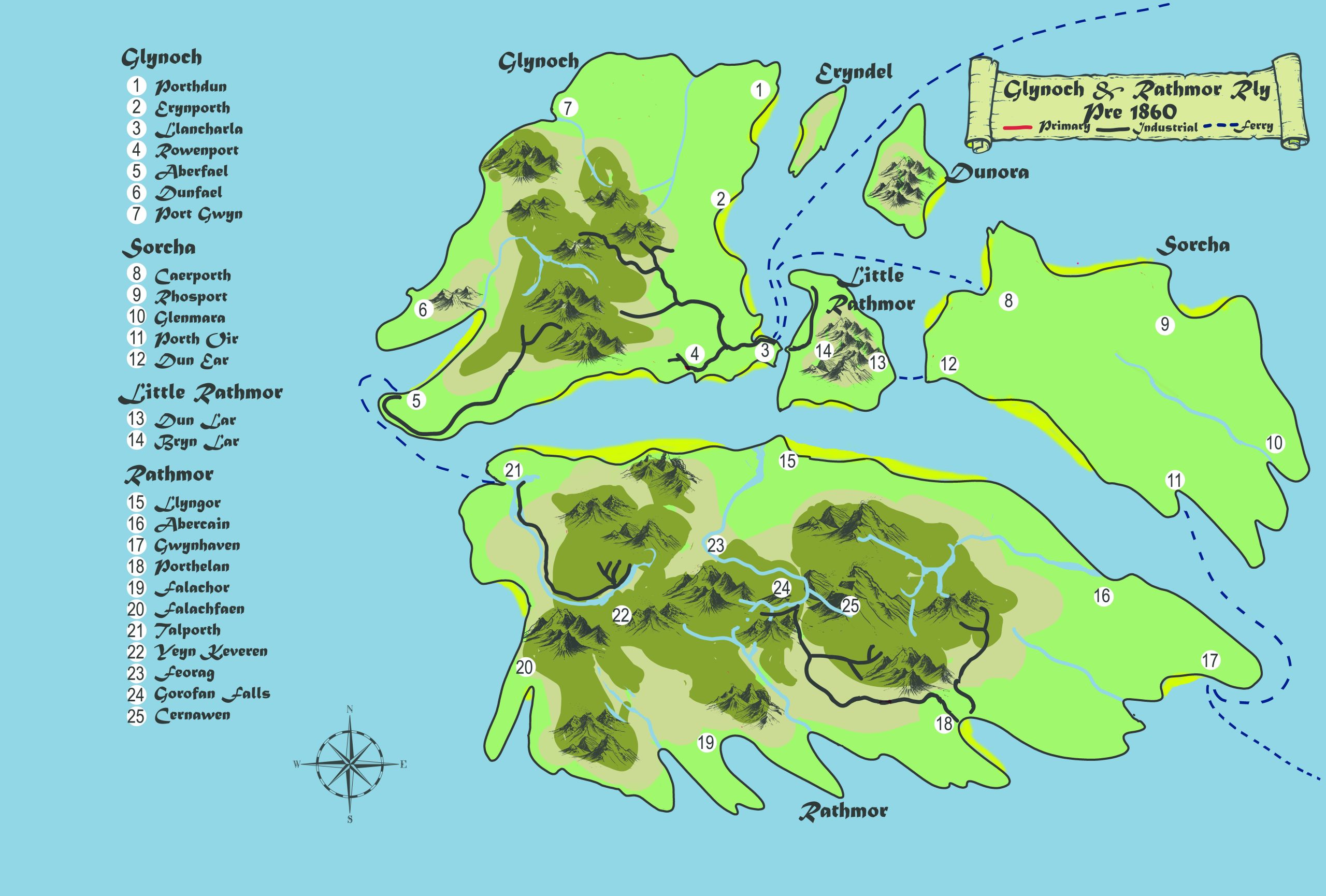
Island Railways PRE 1860
These were the days of crude plateways, horse-drawn tramways and small industrial lines
Island Railways PRE 1880
The railways began their transformation from scattered industrial tramways into a true transport network.
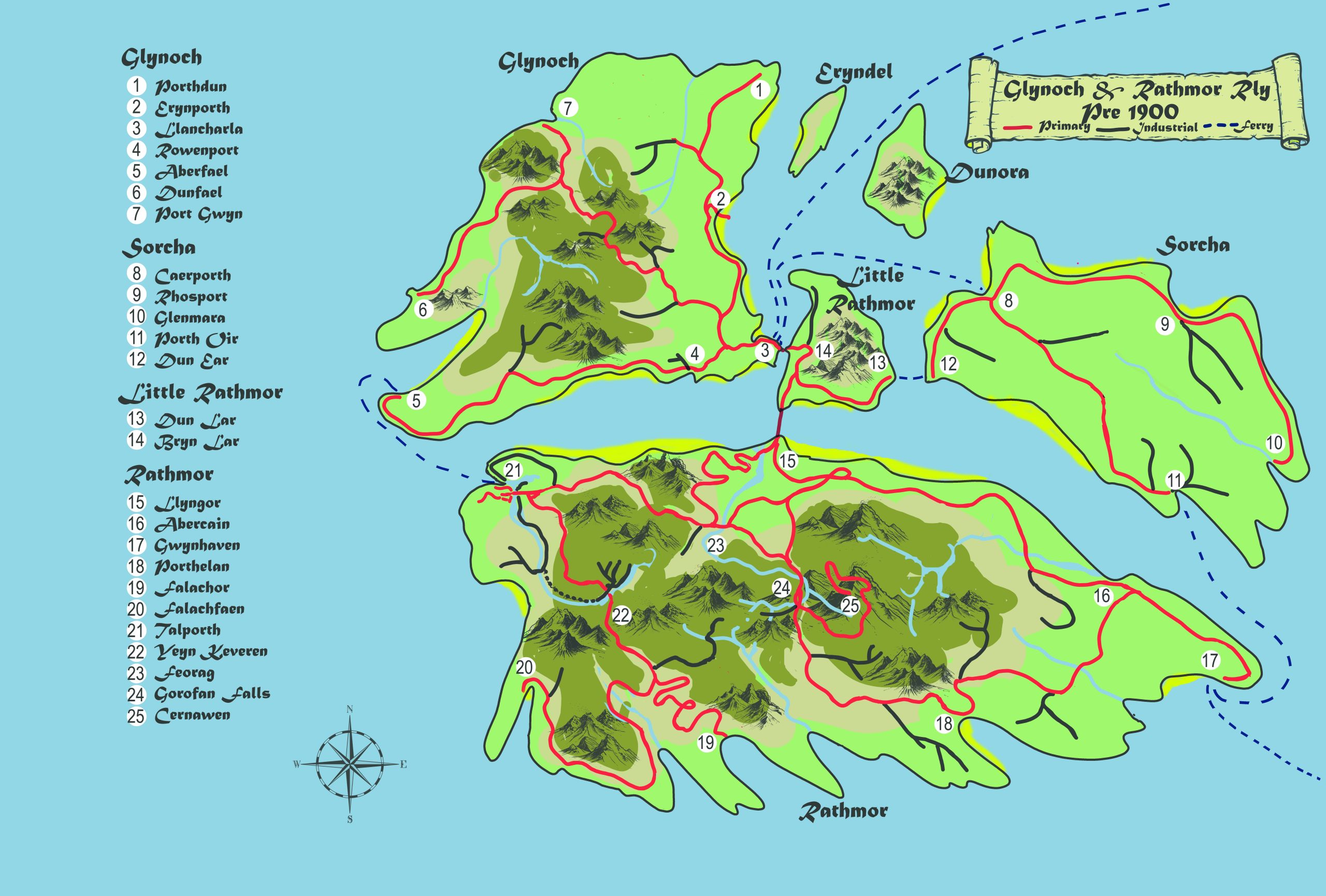
Island Railways PRE 1900
An age of expansion and consolidation, where ambitious new routes filled the gaps between once-isolated systems
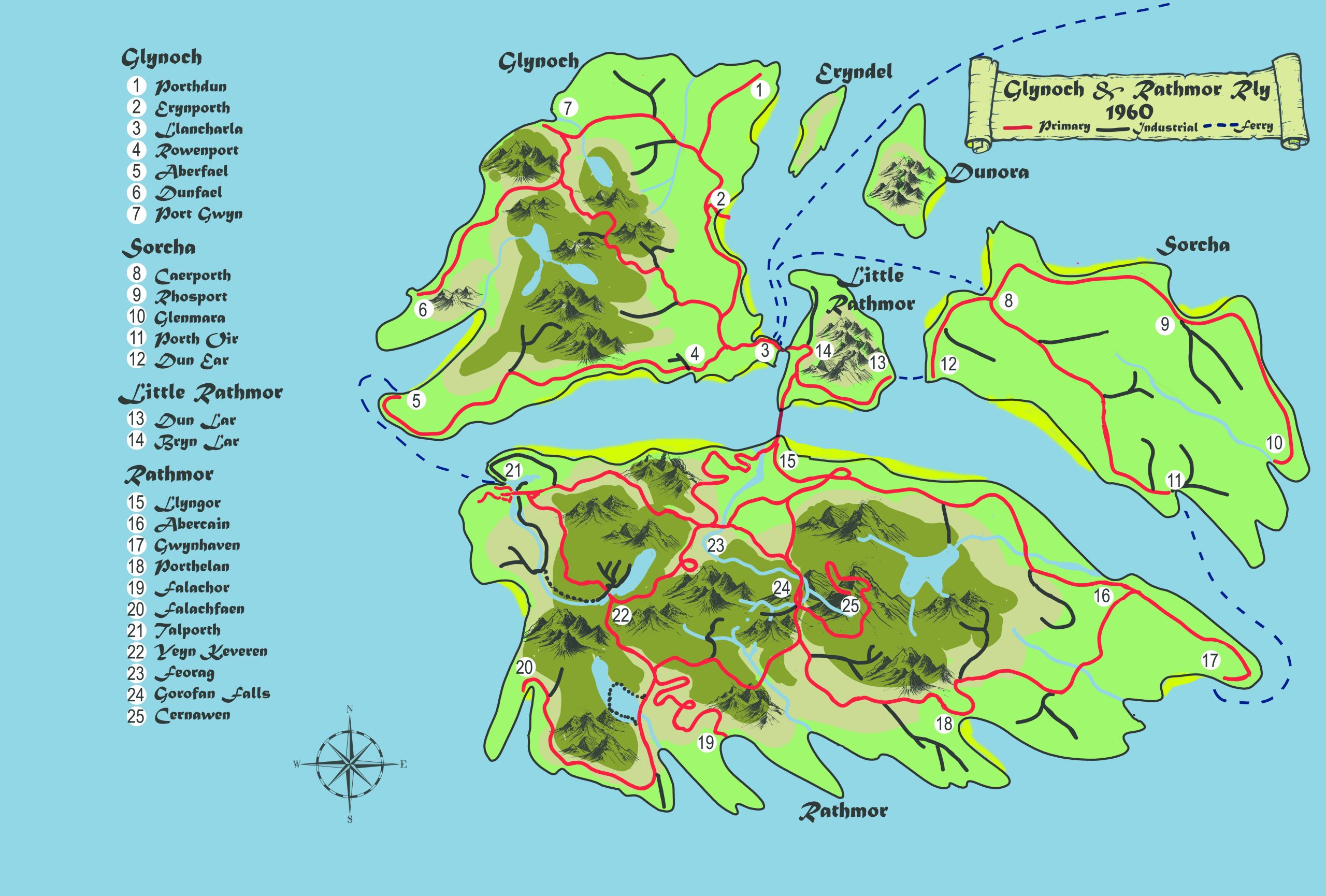
Island Railways 1960
Expansion driven increasingly by strategic military and industrial needs
0 Comments